






Definition & Meaning
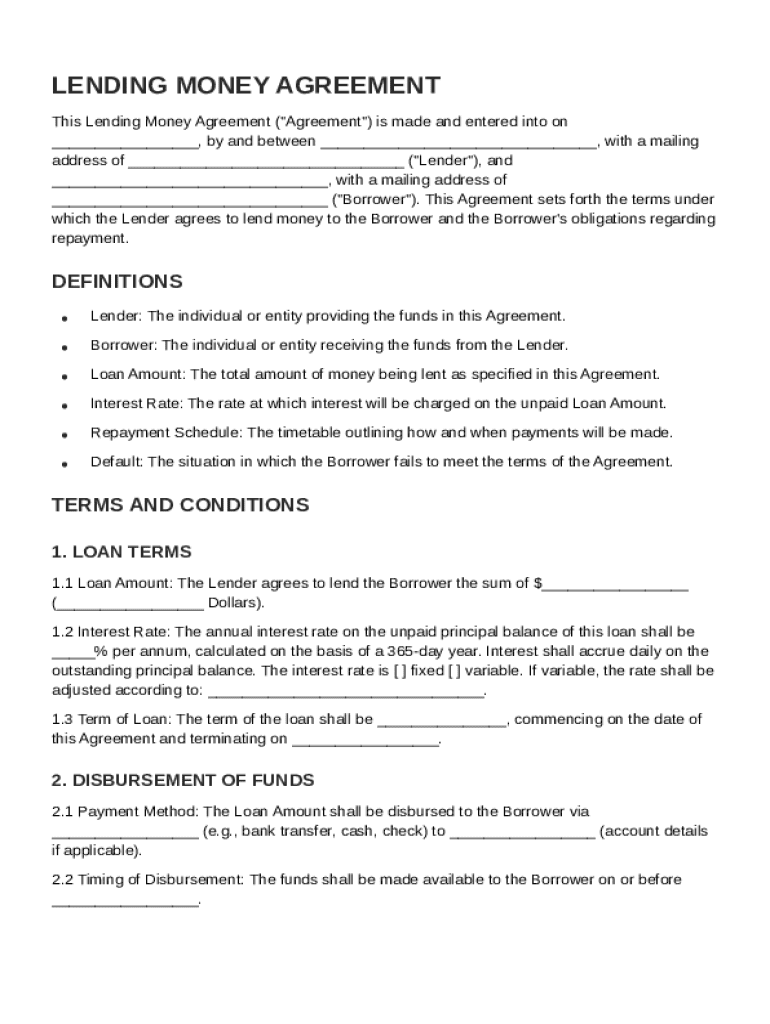
A Lending Money Agreement is a legally binding document that specifies the terms and conditions under which one party, the lender, provides a loan to another party, the borrower. The agreement typically outlines the loan amount, interest rates, repayment schedule, and conditions for default. It serves as a legal framework to ensure clarity and enforceability in the lending process. By defining the roles and responsibilities of both parties, it helps prevent disputes and misunderstandings that could arise during the loan term.
Key Elements of the Lending Money Agreement Template
The Lending Money Agreement Template comprises several critical components that ensure a comprehensive understanding between the lender and borrower. Key elements include:
- Loan Amount: This specifies the total money lent to the borrower and forms the basis of the agreement.
- Interest Rate: The document details the interest rate applied to the loan, which could be fixed or variable, affecting the total repayment amount.
- Repayment Schedule: Includes the timeline and frequency of payments, such as monthly installments, and the total duration over which the loan will be repaid.
- Default Conditions: Outlines the consequences if the borrower fails to meet the agreed repayment terms, including penalties or legal action.
- Collateral Requirements: If applicable, the agreement may require the borrower to provide collateral to secure the loan, detailing what assets can be claimed in case of default.
How to Use the Lending Money Agreement Template
Using the Lending Money Agreement Template involves several straightforward steps designed to ensure the legal bindingness and clarity of the document. The process includes:
- Customize Details: Begin by filling in the personal and contact information for both the lender and borrower. Also, specify the loan amount, interest rate, and repayment schedule as agreed upon by both parties.
- Review Legal Provisions: Examine clauses related to default conditions, amendments, and governing law to ensure they meet the legal standards and are satisfactory to both parties.
- Add Specific Clauses: If necessary, include additional clauses relevant to the specific circumstances of the agreement, such as early repayment options or conditions for collateral.
- Seek Legal Advice: It is often advisable to consult with a legal professional to review the agreement for any potential loopholes or to confirm its compliance with relevant laws.
Important Terms Related to Lending Money Agreement Template
Understanding specific terminology within the Lending Money Agreement is vital for all parties involved. Some important terms include:
- Amortization: The process of gradually reducing the loan principal over time through scheduled payments, which include both interest and principal components.
- Principal: The original sum of money lent to the borrower, which excludes any interest or fees.
- Prepayment Penalty: A fee imposed on the borrower if they decide to pay off the loan before the scheduled end date.
- Covenants: These are conditions set within the agreement that the borrower must adhere to, such as maintaining insurance or providing financial statements.
Steps to Complete the Lending Money Agreement Template
Completing the Lending Money Agreement Template requires careful attention to ensure all elements are accurately reflected. Here is a step-by-step guide:
- Fill Out Preliminary Information: Input details of the lender and borrower, loan amount, and terms in the designated fields.
- Detail Repayment Terms: Clearly state the repayment schedule, interest rate, and total loan duration.
- Include Legal Clauses: Insert standard clauses about governing law, modification of terms, and dispute resolution.
- Validate with Signatures: Both parties should sign the document in the presence of a witness or notary public if necessary for validation.
- Distribute Copies: Provide each party with a signed copy of the agreement for their records.
Legal Use of the Lending Money Agreement Template
The Lending Money Agreement Template is structured to comply with legal standards, making it a reliable tool for formalizing loan arrangements. It establishes the enforceability of the loan terms, ensuring both parties can seek legal recourse if disputes arise. The template provides:
- Clarity and Accountability: By detailing loan terms, it minimizes misunderstandings and clearly outlines expectations for both parties.
- Legal Recourse: In the event of a default, the document serves as evidence of the agreed terms, supporting legal actions to recover unpaid funds.
- Compliance: Ensures adherence to applicable federal and state lending regulations, safeguarding against potential legal issues.
Examples of Using the Lending Money Agreement Template
Using the Lending Money Agreement Template can apply to various real-world scenarios, providing a structured approach to private lending. Examples include:
- Personal Loans: An individual loaning money to family members or friends can use the agreement to formalize terms and protect personal relationships.
- Business Loans: Entrepreneurs borrowing funds from private investors or other businesses can outline terms to secure capital while protecting lender interests.
- Student Loans: Financial assistance between parties for educational purposes can be documented to define repayment obligations and schedule.
State-by-State Differences
The Lending Money Agreement Template may need adjustments to comply with state-specific regulations concerning lending practices. Some variations include:
- Interest Rate Limits: Usury laws differ by state, dictating the maximum allowable interest rate on loans.
- Notarization Requirements: Some states may require agreements to be notarized, adding a layer of verification.
- Disclosure Obligations: Certain jurisdictions may necessitate additional disclosures regarding loan terms or lender rights.
Versions or Alternatives to the Lending Money Agreement Template
While the standard Lending Money Agreement Template serves most purposes, various versions or alternatives may be more suitable for specific needs:
- Secured Loan Agreement: Includes provisions for collateral, providing lenders more security in case of borrower default.
- Unsecured Loan Agreement: Used where loans are given without the need for collateral, often relying on trust or the borrower’s creditworthiness.
- Convertible Loan Agreement: Allows for the conversion of the loan to equity at a future date, commonly used in startup financing.
These alternatives provide flexibility and risk mitigation, aligning with the diverse needs of borrowers and lenders.