






Definition and Meaning of Mutual Termination of Employment Agreement
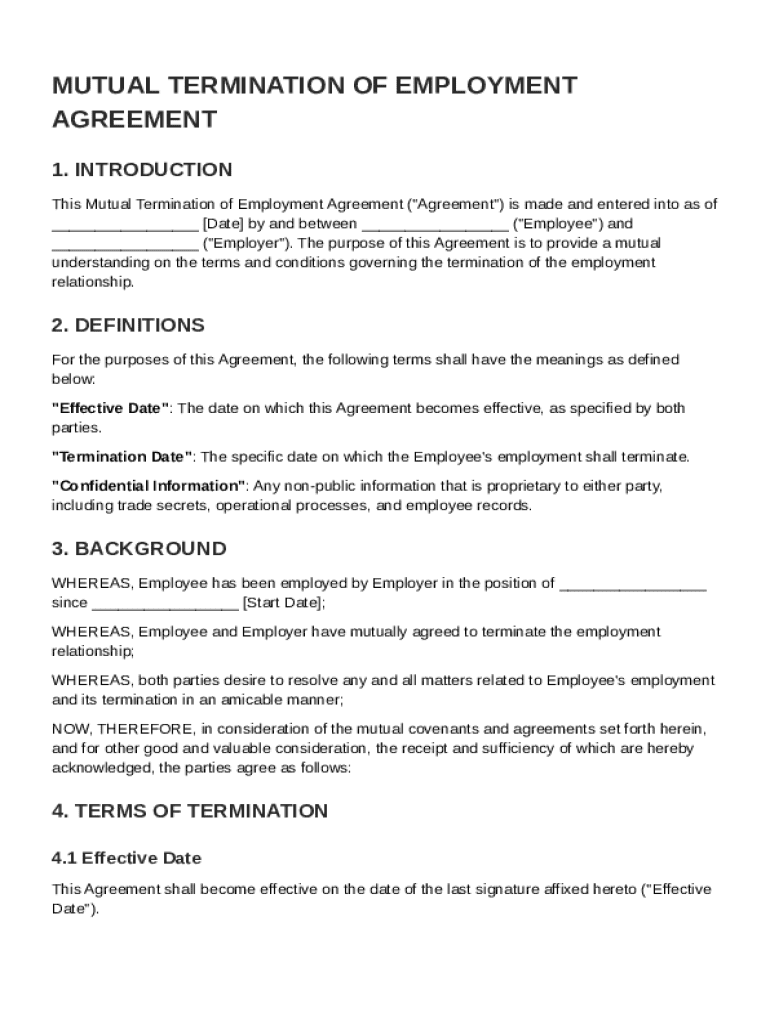
A Mutual Termination of Employment Agreement is a legal contract in which both an employer and an employee agree to end the employment relationship under terms that are mutually satisfactory. This type of agreement clarifies the rights and responsibilities of each party at the conclusion of employment, minimizing potential disputes. By using this form, both parties usually waive their rights to pursue further claims against each other, fostering an amicable end to employment.
Core Elements
- Voluntary Agreement: Both parties must agree voluntarily to the terms without coercion.
- Resolution of Claims: Often includes a mutual release of all claims, preventing future legal actions related to the employment.
- Definition of Terms: Critical terms including effective date, final payments, confidentiality, and return of company property are defined clearly.
Practical Example
An employee at a tech firm and their employer may come to a mutual agreement to part ways due to a change in the company's project focus that no longer aligns with the employee's role. The agreement will include terms on final compensation and confidentiality, ensuring both parties leave on good terms without unresolved issues.
Steps to Complete the Mutual Termination of Employment Agreement Template
Completing a Mutual Termination of Employment Agreement involves several precise steps. Here's a structured process you can follow to ensure accuracy and legal compliance.
- Initial Discussions: Have discussions between the parties involved to establish mutual agreement on the termination.
- Prepare the Document: Use the template to draft the necessary terms and conditions.
- Define Terms Clearly: Clearly outline terms regarding final compensation, benefits, or severance packages.
- Review Legal Implications: Legal review by both parties ensures the agreement complies with state and federal regulations.
- Signatures: Obtain signatures from both parties, after which the document becomes legally binding.
- Distribute Copies: Provide a signed copy to each party for their records.
Common Pitfalls and Solutions
- Ambiguity: Ensure terms are clear and specific to prevent misunderstandings.
- Lack of Legal Review: Involve legal counsel to review the agreement's terms, ensuring they meet state and federal requirements.
Important Terms Related to the Mutual Termination of Employment Agreement Template
Understanding terms associated with a mutual termination agreement can be crucial for both employers and employees.
Key Terms
- Effective Date: The date when the termination officially takes place.
- Final Settlements: Entitlements owed to the employee, such as outstanding wages or benefits.
- Confidentiality Clause: A section that restricts the sharing of the employer's business information after termination.
- Non-Disparagement Clause: Prevents either party from making negative statements about the other.
Real-World Implications
An HR manager must ensure that employees understand these terms to mitigate risks of non-compliance and legal disputes. Non-clarity in terms such as "Final Settlements" can lead to confusion over what the employee is owed post-termination.
Legal Use of the Mutual Termination of Employment Agreement Template
The template must be used legally and ethically to ensure enforceability and uphold the rights of both parties.
Key Legal Considerations
- Compliance with Labor Laws: Review the agreement's terms for compliance with state and federal labor laws.
- Voluntary Consent: Ensure that the agreement is signed voluntarily by both parties, with neither under duress.
- Release of Claims: Both parties typically agree to release future claims, which must be reasonable and equitable.
Case Study
In a large corporation, a senior executive agrees to mutual termination due to restructuring. The agreement includes legally sound clauses aligned with state laws to facilitate a smooth transition, reducing the risk of future legal entanglements.
Who Typically Uses the Mutual Termination of Employment Agreement Template
This template is typically used by a range of business entities and individuals.


Common Users
- Employers and HR Teams: To systematically handle employee exits.
- Employees: Seeking an amicable split while ensuring fair treatment.
- Legal Advisors: Guiding clients through termination negotiations.

Utilization Scenarios
- Corporate Reorganizations: Used to manage employee exits during large-scale organizational changes or mergers.
- Personal Circumstances: When an employee's personal circumstances change, requiring a departure from their role.
Key Elements of the Mutual Termination of Employment Agreement Template
The structure of the agreement includes several key elements essential for clarity and enforceability.
Fundamental Sections
- Commencement and Effective Date: Specifies when the agreement and termination become effective.
- Duties and Obligations Post-Termination: Details what is required of both parties after the termination.
- Compensation and Benefit Clauses: Accounts for any financial settlements post-termination.
Variations
Different jurisdictions may require specific inclusions, such as additional worker protections, which can vary significantly from state to state.
State-Specific Rules for the Mutual Termination of Employment Agreement
Employment laws in the United States can vary widely depending on the state, affecting the structure and enforceability of a mutual termination agreement.
Examples of State Variations
- California: Requires additional provisions related to employee rights and severance due to more stringent labor laws.
- New York: Might necessitate particular language on non-disparagement clauses in mutual releases.
Implications
These variations underscore the need for state-specific legal advice when drafting agreements, ensuring compliance with local legislation to avoid invalidating the contract.
Benefits of Using the Mutual Termination of Employment Agreement Template
Using a structured template can offer multiple benefits for both employees and employers.
Advantages
- Clarity and Fairness: Provides clear, mutually agreed-upon terms which reduce future disputes.
- Simplified Process: Streamlines the termination process, saving time and administrative resources.
- Legal Protection: Protects both parties from potential legal claims by ensuring mutual confidentiality and non-disparagement.
Example Scenario
A mid-sized business facing economic challenges uses the template to conduct layoffs under terms that the affected employees find agreeable, thus preserving the company’s reputation while ensuring legal compliance.