01. Edit your form online
Type text, add images, blackout confidential details, add comments, highlights and more.

Type text, add images, blackout confidential details, add comments, highlights and more.

Draw your signature, type it, upload its image, or use your mobile device as a signature pad.

Send it via email, link, or fax. You can also download it, export it or print it out.
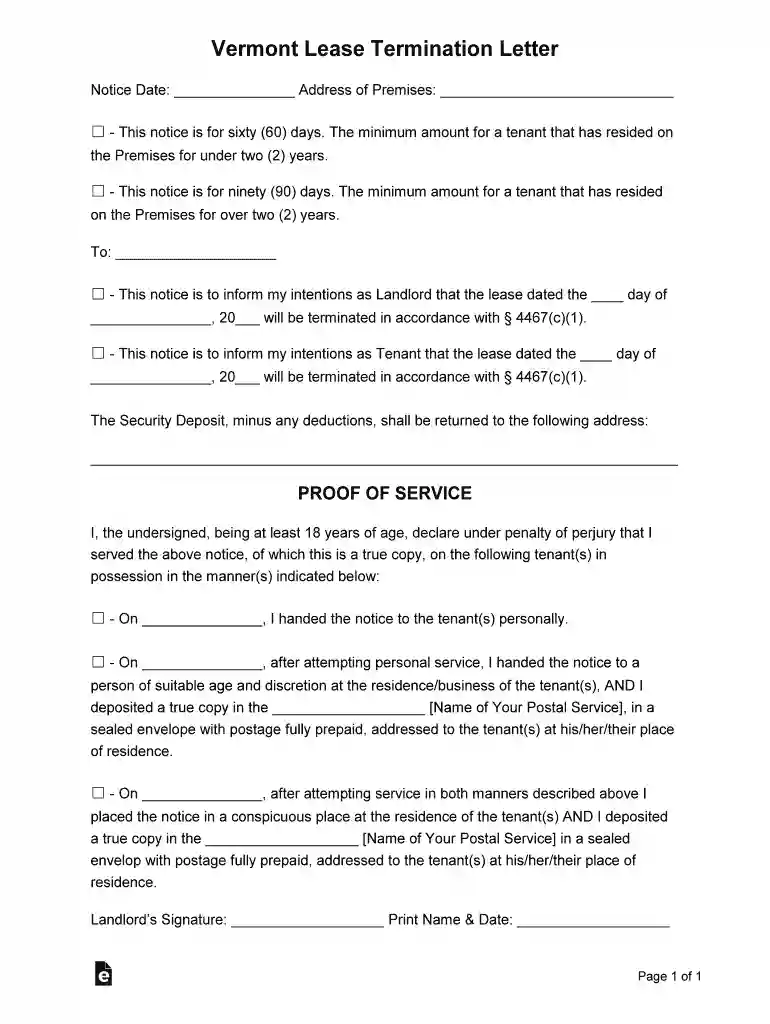
The Vermont Lease Termination Letter, commonly referred to as the 60 or 90 Day Notice, is a formal document used by either landlords or tenants to formally terminate a lease agreement. This letter serves as an official record of the intention to end the lease, ensuring both parties are legally informed and agree to the termination. It is especially crucial in clarifying the terms under which the termination occurs, such as the required notice period, to avoid potential disputes.
Securing the Vermont Lease Termination Letter Form is a straightforward process:
Ensuring you obtain the correct form is essential to maintain legal standing and adhere to Vermont's rental laws.
Vermont mandates distinct requirements for lease terminations:
These rules are designed to provide sufficient time for both parties to make necessary arrangements without undue pressure.
Filling out the Vermont Lease Termination Letter requires attention to detail:
The use of the Vermont Lease Termination Letter:
Failure to comply with the statutory requirements may result in:
This form is used by:
Real-world applications of the lease termination form are diverse:
These examples illustrate how the letter formalizes the process and ensures all parties are on the same page.
We've got more versions of the Vermont Lease Termination Letter Form60 or 90 Day Notice form. Select the right Vermont Lease Termination Letter Form60 or 90 Day Notice version from the list and start editing it straight away!
| Versions | Form popularity | Fillable & printable |
|---|---|---|
| 2015 | 4.8 Satisfied (140 Votes) |
At DocHub, your data security is our priority. We follow HIPAA, SOC2, GDPR, and other standards, so you can work on your documents with confidence.