




01. Edit your irs disagreement letter sample online
Type text, add images, blackout confidential details, add comments, highlights and more.

Type text, add images, blackout confidential details, add comments, highlights and more.

Draw your signature, type it, upload its image, or use your mobile device as a signature pad.

Send irs form 12509 via email, link, or fax. You can also download it, export it or print it out.
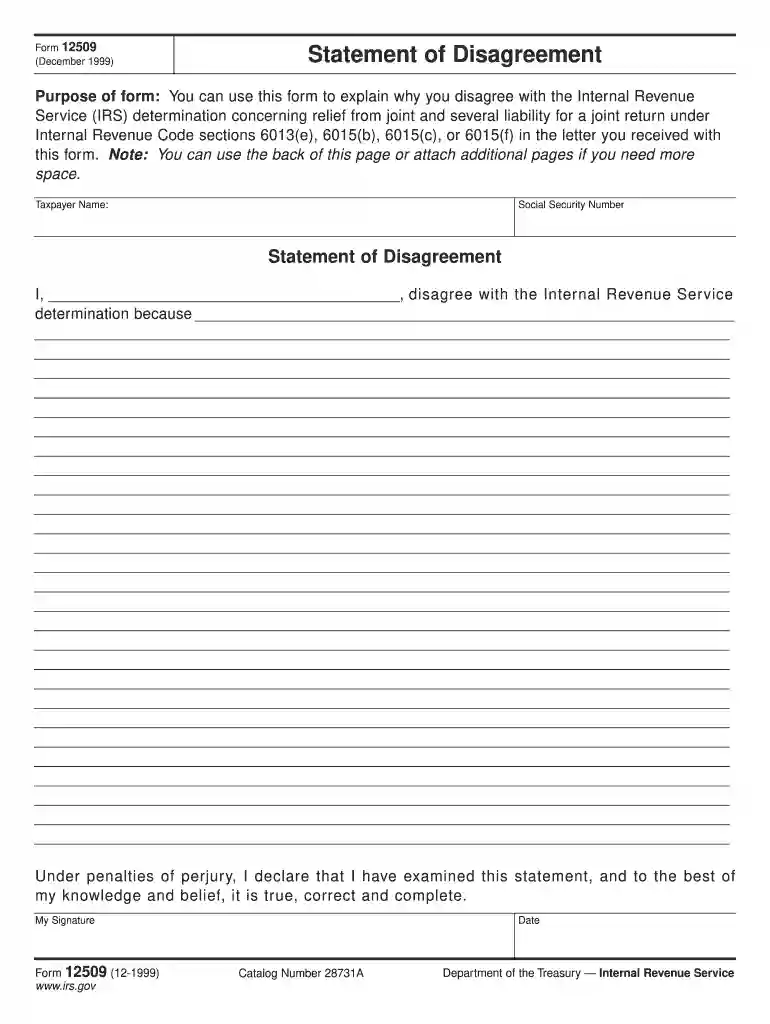
IRS Form 12509, also known as the Statement of Disagreement, is a document used by taxpayers to contest decisions made by the Internal Revenue Service (IRS) regarding relief from joint and several liability on a joint tax return. Specifically, the 1999 version refers to the edition of the form from that year. This form provides taxpayers with the opportunity to articulate reasons for their disagreement with the IRS's determination, ensuring a structured avenue for resolving disputes. The submission includes a declaration under penalties of perjury, which emphasizes the accuracy and truthfulness of the taxpayer's claims.
Identifying the Need: Taxpayers who disagree with an IRS decision on joint tax return liability can utilize this form. It is essential for disputes related to relief requests such as innocent spouse relief.
Completion Process: Begin by filling in personal details, including the taxpayer identification number and reasons for disagreement. Ensure accuracy, as errors could delay resolution.
Supporting Documentation: Attach relevant documents that substantiate your claim. These might include copies of correspondence with the IRS, prior tax returns, and any other evidence relevant to your case.
Declaration Statement: Sign the form to declare that the information provided is truthful to the best of your knowledge.
Submission: Send the completed form and supporting documentation to the address specified by the IRS, usually outlined in the correspondence you received regarding the decision.
Gather Personal Information: Collect necessary personal details such as name, address, and taxpayer identification number.
Document Reason for Disagreement: Clearly state the grounds for your disagreement with the IRS's decision. Be concise but thorough, ensuring all relevant points are covered.
Compile Supporting Evidence: Gather pertinent documents that bolster your case. These can include tax return copies, IRS correspondence, and any other exhibits that highlight errors or misinterpretations by the IRS.
Review the Declaration: Understand the legal implications of the declaration under penalties of perjury. This confirms the accuracy and truthfulness of your statements.
Finalize and Sign: Review the completed form for any omissions or errors. Sign and date the form to confirm your declaration.
Submit the Form: Send the completed form along with attachments to the IRS, as indicated in their guidelines. Retain copies for personal records.
Joint Tax Return Filers: Generally, couples who have filed a joint tax return and face disagreements with the IRS concerning joint liability are eligible to use this form.
Innocent Spouse Seeking Relief: Those seeking relief from joint liability under the innocent spouse provisions can file this form to contest IRS decisions.
Legal Representatives: Authorized persons or legal representatives can also file on behalf of a taxpayer, ensuring compliance with all representative regulations.
Personal Information Section: This contains taxpayer identification details crucial for processing.
Reason for Disagreement Section: Here, taxpayers outline the specific disagreements with the IRS's initial determination.
Declaration Clause: A legal statement confirming the accuracy and truthfulness of the provided information.
Signature: Validation of the taxpayer's identity and assent to the form's contents via a legally binding signature.
Joint and Several Liability: A legal concept where both parties in a joint tax return are individually responsible for the entire tax debt.
Innocent Spouse Relief: A provision allowing one spouse to be absolved from the tax debt incurred during a joint tax filing due to the actions or omissions of the other spouse.
Declaration Under Penalties of Perjury: A formal statement made by the taxpayer to certify the truthfulness and completeness of the information provided under legal penalty if falsified.
Strict Adherence Required: Timeliness is critical. Forms must be filed within the timeframe specified by the IRS, generally in response to notification of determination.
IRS Correspondence Guidelines: Refer to the dates outlined in IRS correspondence for precise mailing or submission due dates.
Mail Submissions: The completed form and accompanying documents should be mailed to the address specified in IRS communications.
In-Person Submissions: Possible at designated IRS offices but may require prior arrangement or appointment, complying with current IRS procedures.
Ensure all submissions are sent via trackable means to confirm receipt and maintain a copy for your records.
Delayed Responses: Failure to submit the form by the specified deadline can result in the forfeiture of one’s right to contest the IRS's decision regarding joint liability.
Filing Inaccuracies: Submitting incorrect or misleading information can result in penalties, including potential criminal charges under perjury laws. Compliance with form requirements is essential.
By understanding these critical aspects of IRS Form 12, taxpayers can effectively navigate disagreements and clarify their tax liability positions.
We've got more versions of the irs disagreement letter sample form. Select the right irs disagreement letter sample version from the list and start editing it straight away!
According to eSignature regulations, forms signed digitally have the same validity as traditionally approved ones. You can electronically sign almost any business and personal paperwork. Four types of documents still demand wet signatures only - wills and testamentary trusts, court orders and other court forms, state statutes governing divorce, adoption, or other family law, and notice of cancellation of utility services. If you follow the guidelines and utilize a safe and compliant software solution, like DocHub, you can eSign your irs form 12509 1999 without printing it.
You may quickly complete, modify, and even eSign your irs form 12509 1999 utilizing DocHub. Create a new profile and start your free trial. After that, you can add the document with the form and simply make all the needed edits. No need to print on paper or use a third-party application to sign it, as you can put your electronic signature on your document faster via DocHub.
At DocHub, your data security is our priority. We follow HIPAA, SOC2, GDPR, and other standards, so you can work on your documents with confidence.
Feb 3, 2026 This booklet only contains Tax and Earned Income Credit Tables from the Instructions for Form 1040 (and 1040-SR). 12,509, 9,120, 12,509Read more
This lists all of the files available from the IRS-PDF Library on the Fedworld Information Network. This page is updated each morning. Last updated Sunday, 2002Read more


