







Definition and Meaning
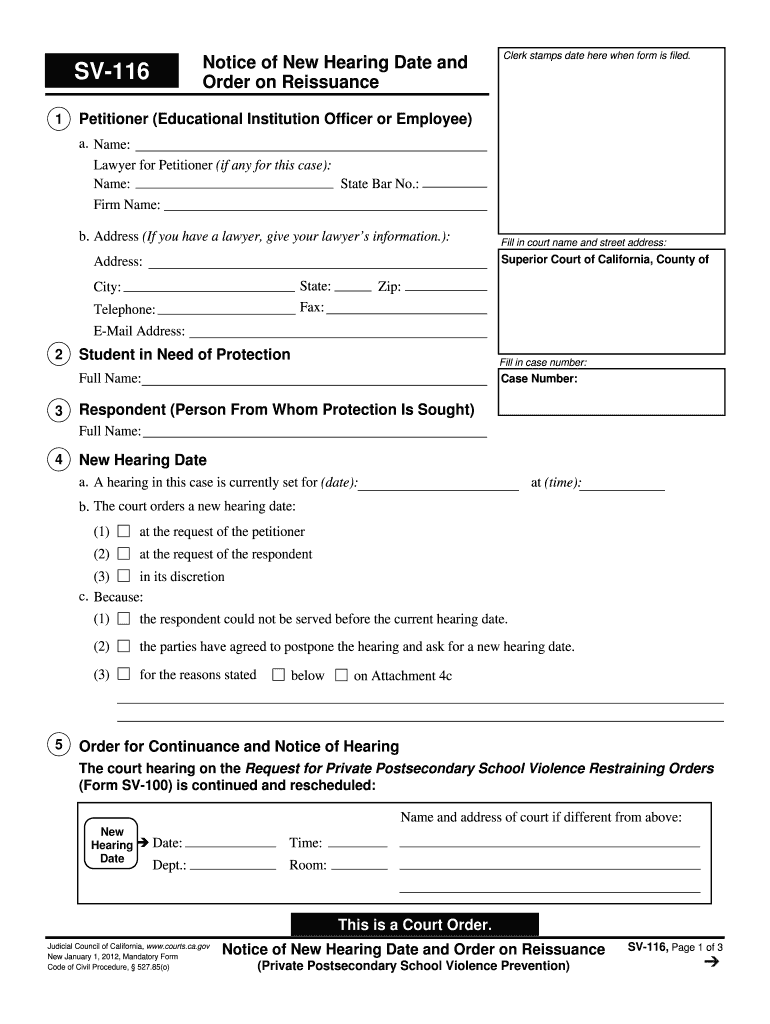
The SV-116 form, known as the "Notice of New Hearing Date and Order on Reissuance Judicial Council forms - courts ca," is a legal document utilized within the judicial system of California. This form serves as a notification of a rescheduled hearing date concerning cases that involve private postsecondary school violence restraining orders. It is a crucial component in the legal process for maintaining current and accurate scheduling in court proceedings. The document also addresses the continuation or reissuance of temporary restraining orders and lays out requirements for notifying involved parties.
How to Use the SV-116 Form
Using the SV-116 form requires a comprehensive understanding of its purpose and the legal context in which it is applied. When there is a need to reschedule a hearing related to a private postsecondary school violence restraining order, this form is used to communicate the new date officially. It is typically filed by the court or an authorized legal representative and must be served to all parties involved to ensure they are adequately informed of the changes.
- Confirm the current hearing status and any issued restraining orders.
- Obtain approval for rescheduling from appropriate authorities.
- Fill out the form with specific details, including the new date, time, and location of the hearing.
- Serve the form promptly to all parties involved as required by court regulations.
Steps to Complete the SV-116 Form
Completing the SV-116 form is a detailed process that requires attention to detail to ensure compliance with legal requirements. Below are the steps to follow:
- Gather Necessary Information: Collect all relevant details including case number, names of parties, and the original hearing date.
- Complete Form Fields: Fill in all required information accurately. This includes the new hearing date and any updates on current restraining orders.
- Review for Accuracy: Double-check all entered information to avoid errors that could affect the court proceedings.
- Serving the Form: Deliver copies to all involved parties using certified mail or through legal service to ensure proof of delivery.
Key Elements of the SV-116 Form
Understanding the key elements of the SV-116 form helps ensure accurate completion and adherence to legal standards. Important sections include:
- Case Information: Details such as case number and names of parties involved.
- New Hearing Date and Location: Specifics of the rescheduled court date and location, ensuring clarity for all parties.
- Temporary Restraining Order Information: Any orders currently in place must be detailed for continuity and legal compliance.
- Accommodations for Disabilities: Provisions are included to ensure accessibility for individuals requiring special accommodations.
Legal Use and Compliance
The use of the SV-116 form is bound by specific legal guidelines to maintain its validity in court. It is employed in scenarios that involve changing hearing dates for cases related to school violence restraining orders. Legal compliance requires that:
- The form is completed accurately and submitted within a prescribed timeframe.
- All parties receive a copy of the notice to preserve the fairness and the right to due process.
- Any amendments or further orders related to the case are communicated in the notice.
State-Specific Rules
Since the SV-116 form is specific to California, certain state-specific rules govern its usage. Users should be mindful of these nuances, as failure to comply with state regulations may invalidate the form. Key considerations include:
- Unique Filing Protocols: Specific court procedures for submitting the form within California jurisdictions.
- Time Sensitivity: Adherence to deadlines for notifying parties about the new hearing dates.
- Service Requirements: Methods approved by California courts for serving the notice to ensure lawful acknowledgment of the change.
Who Typically Uses the SV-116 Form
The SV-116 form is typically used by parties involved in legal disputes requiring postsecondary school violence restraining orders. This includes:
- Judges and Legal Representatives: Who utilize the form to ensure that all parties are informed of hearing schedule changes.
- Affected Individuals: Such as students or faculty involved in school-related disputes, who need to be aware of legal proceedings.
- Court Officials: Responsible for maintaining accurate records and ensuring procedural adherence in the legal system.


Important Terms Related to the SV-116 Form
Understanding the terminology associated with the SV-116 form ensures clarity in its use:
- Reissuance: Refers to the process of issuing a restraining order again due to a change in legal proceedings.
- Notice of New Hearing Date: Official communication about a rescheduled court hearing.
- Involved Parties: Individuals or organizations that are directly affected by the legal proceedings in question.
Examples of Using the SV-116 Form
To illustrate its application, consider a scenario where an initial hearing date was set for a restraining order case involving a dispute at a private postsecondary school. If new evidence surfaces necessitating additional time for consideration, the judge may issue an SV-116 form to reschedule the hearing. This ensures all parties are notified of the new date and any interim legal actions necessary to uphold existing temporary restraining orders during the wait.




