Ig260 2015 form-2026

Get Form
ig260 2015 form Preview on Page 1

Here's how it works

01. Edit your form online
Type text, add images, blackout confidential details, add comments, highlights and more.

02. Sign it in a few clicks
Draw your signature, type it, upload its image, or use your mobile device as a signature pad.

03. Share your form with others
Send it via email, link, or fax. You can also download it, export it or print it out.

Definition & Meaning

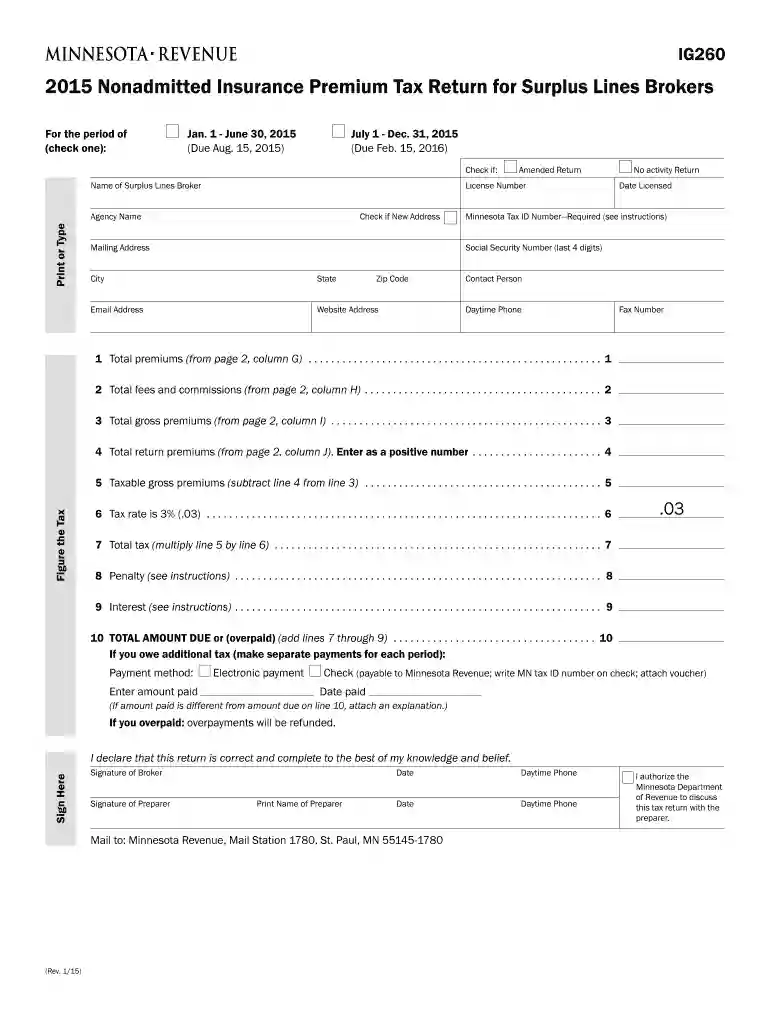
The IG form is officially known as the Nonadmitted Insurance Premium Tax Return. It is a requirement for surplus lines brokers operating within the state of Minnesota. The primary purpose of the form is to report premiums, fees, and commissions related to surplus lines insurance, which are insurance policies obtained from non-admitted insurers not licensed to operate within the state. The form ensures that brokers are compliant with state regulations and contribute their share of taxes based on the premiums they handle.

  • Surplus Lines Insurance: This refers to insurance provided by companies that are not licensed in the state of Minnesota but are legally permitted to offer coverage through authorized surplus lines brokers.
  • Nonadmitted Insurance: Insurance purchased from companies that do not hold a license in the state yet can legally provide insurance through brokers, catering to specific, often high-risk requirements.

Key Elements of the IG Form

The IG form encompasses several core components designed to gather essential information for tax calculation and compliance.

  • Taxable Gross Premiums: This section requires detailed reporting of all gross premiums earned, allowing for the calculation of the proper tax obligations.
  • Penalties and Interest: It includes information on late payment penalties and accruing interest, should the broker miss the submission deadline.
  • Electronic and Check Payment Methods: Brokers have options for settling their tax liabilities, with the section detailing procedures for both electronic transfers and traditional check payments.

Important Sections

  • Calculation Instructions: Clear guidance on computing taxes owed based on reported premiums.
  • Certification and Signature: This area confirms the accuracy of the provided information and requires the signature of the responsible person.

Steps to Complete the IG Form

Filling out the IG form involves several sequential steps to ensure accuracy and compliance.

  1. Gather Necessary Financial Data: Obtain all relevant financial records, including documents that detail gross premiums, fees, and commissions.
  2. Fill Out Taxable Amounts: Enter the total taxable gross premiums in the designated sections.
  3. Calculate Taxes and Penalties: Using the provided guidelines, compute the owed tax, adjusting for any penalties or interest due to late submission.
  4. Sign and Verify Your Submission: Ensure the form is signed by an authorized entity that verifies the information's integrity.
  5. Submit the Completed Form: Follow submission guidelines, which may include options for online submissions or physical mailing.

Legal Use of the IG Form

The IG form is legally mandated for specific insurance brokers.

  • Compliance Obligations: The form is essential for demonstrating compliance with Minnesota state insurance regulations.
  • Legal Assurance: It helps ensure that surplus lines brokers fulfill their state tax responsibilities accurately.

Contextual Requirements

  • Regular Reporting: Half-yearly submission reinforces regular compliance and financial transparency.
  • State-Specific Guidelines: Focusing on Minnesota, ensuring that brokers meet regionally targeted regulatory conditions.

Penalties for Non-Compliance

Failure to adhere to the requirements associated with the IG form can result in several penalties.

  • Financial Penalties: Calculated based on a percentage of unpaid taxes, these penalties can accrue interest over time.
  • Legal Repercussions: Continuing non-compliance could lead to legal action and potential revocation of the broker’s license to operate.

Filing Deadlines / Important Dates

Timeliness is crucial when dealing with the IG form to avoid penalties.

  • Semiannual Submission: Brokers must complete and submit their forms twice a year, with specific deadlines dictating the exact months of submission.
  • Grace Periods: Limited grace periods might be available under certain circumstances, yet this often incurs additional financial penalties.

Key Date Indicators

  • Regular Filing: Maintain awareness of standard filing periods to facilitate timely submissions and avoid incurring late penalties.

Who Typically Uses the IG Form

The IG form is primarily utilized by individuals and entities involved in surplus lines insurance within Minnesota.


  • Surplus Lines Brokers: Key users who facilitate transactions between clients and non-admitted insurers.
  • Insurance Companies: Though not directly filling the form, these companies rely on brokers to ensure compliance with tax obligations.
decoration image ratings of Dochub

Software Compatibility

For brokers leveraging technology, software compatibility is an important consideration.

  • Common Platforms: Compatibility with widely used financial software like QuickBooks simplifies data input and tax calculation.
  • Integration Capabilities: Platforms that seamlessly integrate with state electronic submission systems enhance efficiency and compliance.

Real-World Applications

  • TurboTax and QuickBooks: These programs support various tax form integrations, potentially offering upload and auto-fill options for financial data specific to surplus lines transactions.

See more ig260 2015 form versions

We've got more versions of the ig260 2015 form form. Select the right ig260 2015 form version from the list and start editing it straight away!
Versions Form popularity Fillable & printable
2023 4.6 Satisfied (33 Votes)
2022 4.7 Satisfied (58 Votes)
2021 4.3 Satisfied (72 Votes)
2020 4.4 Satisfied (192 Votes)
2019 4.4 Satisfied (29 Votes)
2018 4.3 Satisfied (169 Votes)
2017 4.3 Satisfied (23 Votes)
2016 4.4 Satisfied (113 Votes)
2015 4.4 Satisfied (2947 Votes)
2014 4 Satisfied (60 Votes)
2012 4 Satisfied (25 Votes)
be ready to get more

Complete this form in 5 minutes or less

Get form

Got questions?

We have answers to the most popular questions from our customers. If you can't find an answer to your question, please contact us.
Contact us
The Medicaid Transportation program ensures Medicaid members can get to and from their medical appointments at no cost to them. We arrange non-emergency transportation, such as pre-scheduled trips to primary care and the dentist. For emergency medical services, please call 911.
An Individual, HUF, AOP (not being co-operative societies), BOI or Artificial Juridical Person with business or professional income must submit Form 10-IEA if they wish to pay income tax as per the old tax regime.
Medicaid may give you a ride if you do not have a car that works or do not have a drivers license. You may also be able to get a ride if you have a physical or mental disability or are unable to travel or wait for a ride alone. Coverage for these rides may be different depending on your individual situation and needs.
Application to Transport Interstate or to Temporarily Export Certain NFA Firearms (ATF Form 5320.20) This form is used to obtain permission to temporarily or permanently move your registered National Firearms Act (NFA) machine gun, short barreled rifle or shotgun, or destructive device interstate.
The 2015-Form is used by your provider to inform MAS why you need a certain type of transportation other than mass transit. MAS is the company Medicaid has chosen to handle all non public transportation requests for Medicaid members.

Security and compliance

At DocHub, your data security is our priority. We follow HIPAA, SOC2, GDPR, and other standards, so you can work on your documents with confidence.

Learn more
ccpa2
pci-dss
gdpr-compliance
hipaa
soc-compliance

People also ask

Form 7217 is filed by any partner receiving a distribution of property from a partnership in a non-liquidating or liquidating distribution to report the basis of the distributed property, including any basis adjustment to such property as required by section 732(a)(2) or (b).
Self-employed individuals, partners, and those who used optional methods to calculate net earnings from self-employment should file Form 7206. The primary purpose of the form is to calculate the amount that can be claimed for the self-employed health insurance deduction.

Related links