




01. Edit your form online
Type text, add images, blackout confidential details, add comments, highlights and more.

Type text, add images, blackout confidential details, add comments, highlights and more.

Draw your signature, type it, upload its image, or use your mobile device as a signature pad.

Send it via email, link, or fax. You can also download it, export it or print it out.
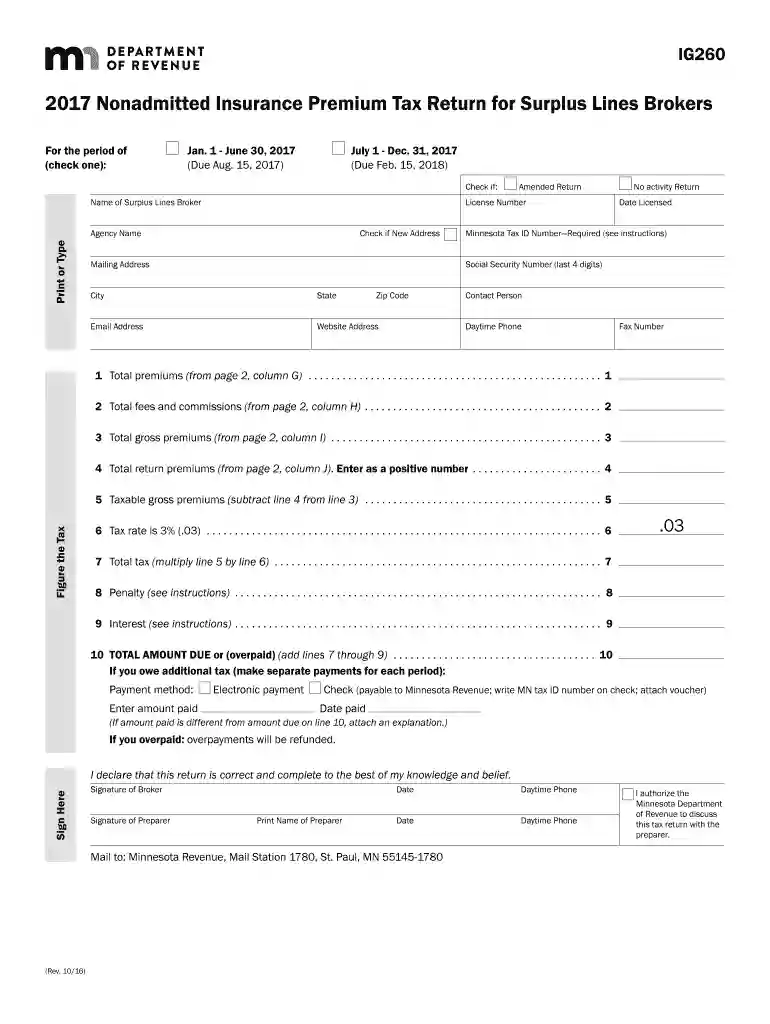
The Minnesota Form IG is the Nonadmitted Insurance Premium Tax Return specifically designated for Surplus Lines Brokers operating within the state of Minnesota. This form is essential for reporting insurance premiums on policies procured from insurers not licensed in Minnesota. It delineates obligations related to nonadmitted insurance, which refers to coverage secured from carriers that are not licensed to conduct business in the state.
The form is critical for ensuring compliance with state taxation laws for surplus lines insurance. Brokers must use it to report total premiums, calculate taxes, and declare any fees, commissions, and penalties for late payments associated with nonadmitted insurance. The comprehensive completion and submission of this form are mandatory, even if no taxable premiums exist.
To effectively use the Minnesota Form IG, brokers should first gather all necessary information about nonadmitted insurance transactions from the previous year. This includes details of premiums collected from surplus lines policies sold or procured for Minnesota residents.
Reporting Premiums: Begin by accurately entering the total dollar amount of nonadmitted insurance premiums received. This is crucial for ensuring that all proceeds from surplus lines transactions are properly accounted for.
Calculating Taxes: Utilize the provided instructions to compute the taxable gross premiums. The form will outline the applicable tax rates, which need to be applied to the reported premiums to determine the total tax liability.
Completing Sections: Include details on any fees or commissions collected. Enter penalties for any late payment of taxes, which helps avoid discrepancies during submission.
Brokers should review the completed form thoroughly before submission to ensure all information is accurate and complete.
Obtaining the Minnesota Form IG is a straightforward process. The form can be accessed and downloaded directly from the Minnesota Department of Revenue's official website.
Digital Download: Visit the department’s site, search for the form by name or code (IG260), and download the PDF version.
Request by Mail: Brokers preferring a physical copy may request one by contacting the Department via mail, ensuring they include their return address.
It's vital that brokers stay updated with the latest version of the form by reviewing the website regularly or subscribing to updates from the Department of Revenue.
Completing the Minnesota Form IG260 requires careful attention to detail and a thorough understanding of the filing requirements. Here’s a step-by-step guide:
Gather Required Information: Collect details of all surplus lines transactions completed in the reporting year, including premium amounts and client confirmation.
Fill Out Identification Details: Enter broker identification information, such as the broker's license number and contact details, in the designated fields.
Enter Premium and Tax Details: Accurately report all nonadmitted insurance premiums and use the form to compute the appropriate tax amounts.
Detail Fees and Penalties: Document any fees or commission amounts, and calculate any potential penalties for late or incorrect filings.
Review and Submit: Once complete, review the entire form for accuracy, ensuring all fields are filled, and submit the form by the specified due date.
Timely completion and submission can prevent penalties and ensure compliance with state regulations.
Filing the Minnesota Form IG260 is crucial for surplus lines brokers to remain compliant with state tax laws. This submission is not just a financial obligation; it also serves as a legal requirement that verifies all insurance transactions involving nonadmitted insurers.
Filing ensures that:
Compliance is Maintained: The form serves as proof of legal compliance with the state's taxation requirements.
Accurate Tax Collection: By reporting, the state can accurately assess and collect the due premiums, securing the integrity of tax revenue related to insurance operations.
Avoiding Legal Penalties: Proper filing protects brokers from incurring legal penalties or interest on unpaid taxes, maintaining a clean business record.
Understanding the form's importance can aid brokers in maintaining operational integrity within Minnesota's insurance market.
Several key elements must be considered when preparing the Minnesota Form IG. These include:
Broker Information: Captures the essential identification data of the submitting broker.
Premium Reporting: Detailed sections for reporting total premiums, adjustments, and other financial elements of nonadmitted insurance.
Tax Calculations: Specific lines dedicated to calculating the tax liabilities associated with collected premiums.
Penalties and Interest: A dedicated section to document any penalties or interests applicable to late or inaccurate filings.
Understanding these elements ensures accurate completion of the form and adherence to state-specific guidelines.
Minnesota has unique requirements for filing the Nonadmitted Insurance Premium Tax Return:
Annual Filing Requirement: All surplus lines brokers must file the IG260 form annually, regardless of whether any taxable transactions occurred.
Documentation Consistency: Brokers are required to maintain consistent and accurate records of all nonadmitted insurance activities to substantiate their returns.
Deadline Adherence: Strict adherence to filing deadlines is mandated. Late submissions may incur penalties unless justified by valid reasons backed by documentation.
By being aware of these state-specific rules, brokers can better prepare for annual filing and avoid potential compliance issues.
Failure to comply with the Minnesota Form IG260 requirements can result in several penalties:
Monetary Penalties: These include fines for late submissions or inaccuracies in reported data.
Interest Charges: Accrued on unpaid taxes after the filing deadline, adding to the financial burden of noncompliance.
Legal Repercussions: Persistent non-compliance can lead to legal actions or the revocation of the broker’s license to operate within Minnesota.
Brokers should maintain diligent record-keeping and remain vigilant of filing deadlines to avoid these penalties.
The Minnesota Form IG260 is used primarily by Surplus Lines Brokers operating within the state. These brokers engage in transactions involving nonadmitted insurers:
Surplus and Excess Line Brokers: Professionals dealing in specialty insurance that is not available through licensed insurers in Minnesota.
Corporate Entities: Insurance firms that require surplus lines policies for unique or high-risk scenarios not covered by standard policies.
Understanding the user demographic helps tailor the form’s completion process to meet specific needs of those directly affected.


We've got more versions of the minnesota form ig260 2017 form. Select the right minnesota form ig260 2017 version from the list and start editing it straight away!
| Versions | Form popularity | Fillable & printable |
|---|---|---|
| 2026 | 4.8 Satisfied (60 Votes) | |
| 2024 | 4.8 Satisfied (36 Votes) | |
| 2023 | 4.6 Satisfied (33 Votes) | |
| 2022 | 4.7 Satisfied (58 Votes) | |
| 2021 | 4.3 Satisfied (72 Votes) | |
| 2020 | 4.4 Satisfied (192 Votes) | |
| 2019 | 4.4 Satisfied (29 Votes) | |
| 2018 | 4.3 Satisfied (169 Votes) | |
| 2017 | 4.3 Satisfied (23 Votes) | |
| 2016 | 4.4 Satisfied (113 Votes) | |
| 2015 | 4.4 Satisfied (2947 Votes) | |
| 2014 | 4 Satisfied (60 Votes) | |
| 2012 | 4 Satisfied (25 Votes) |
At DocHub, your data security is our priority. We follow HIPAA, SOC2, GDPR, and other standards, so you can work on your documents with confidence.


