




01. Edit your form online
Type text, add images, blackout confidential details, add comments, highlights and more.

Type text, add images, blackout confidential details, add comments, highlights and more.

Draw your signature, type it, upload its image, or use your mobile device as a signature pad.

Send it via email, link, or fax. You can also download it, export it or print it out.
The term "MN Surplus Lines" refers to specific types of insurance policies that cover risks not adequately served by insurers licensed within Minnesota. These insurance contracts are procured from nonadmitted insurers, meaning the companies are not licensed by the state's insurance department but are permitted to cover risks under the laws governing surplus lines. This concept enables individuals and businesses to obtain coverage for unique or high-risk circumstances that traditional insurers might refuse. Surplus lines play a crucial role in the insurance market by offering solutions where conventional insurance avenues do not suffice.
Using MN surplus lines insurance involves a few critical steps. First, the individual or business requiring coverage must identify the risks not covered by admitted insurers in Minnesota. It is essential to work with a licensed surplus lines broker who can access nonadmitted insurers. This broker will assist in finding the best policy match, ensuring compliance with state regulations. Once a suitable policy is identified, the broker facilitates the purchase and ensures that the correct taxes, required under Minnesota law, are calculated and paid to the state.
The Minnesota state government allows surplus lines insurance as a legal means to procure coverage where admitted insurers fall short. It is governed by specific regulations requiring brokers to handle the policy purchasing and compliance aspects. This includes adhering strictly to reporting standards and ensuring all taxes owed are paid punctually, avoiding penalties.
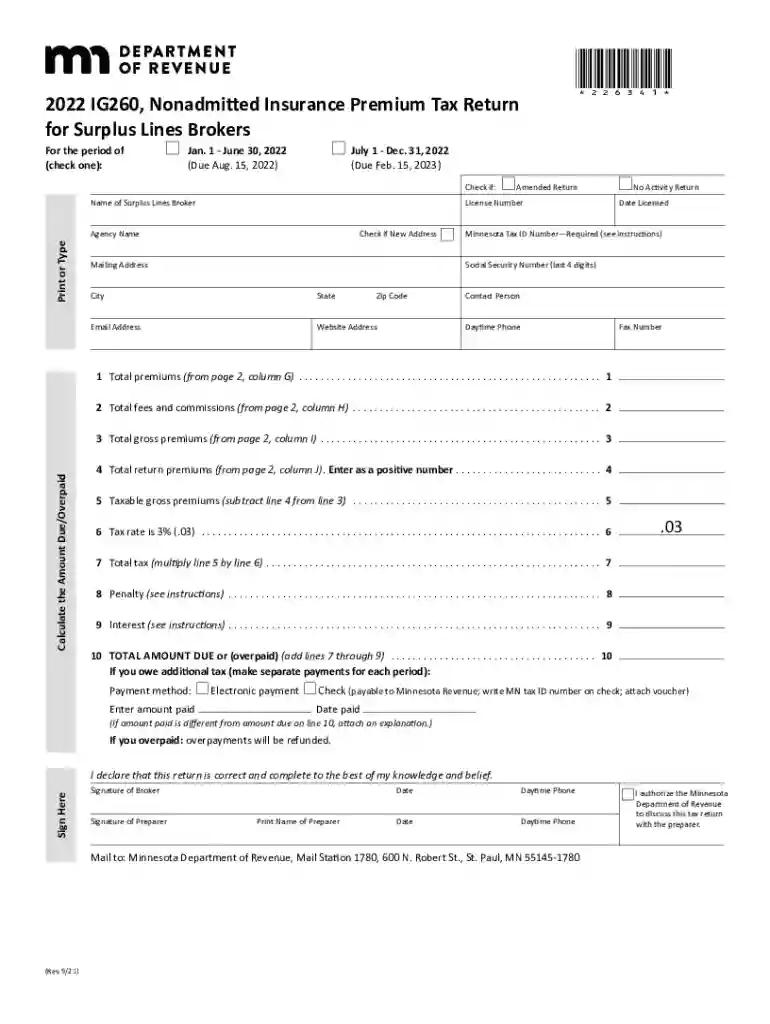
For surplus lines insurance brokers in Minnesota, the key deadlines relate to the semiannual tax return submissions. These include filing the IG260 form twice yearly, with precise due dates outlined by the Minnesota Department of Revenue. Even if no tax is due, brokers must submit this form timely to demonstrate compliance with state insurance laws.
To ensure compliance and proper documentation of MN surplus lines insurance, several documents are typically required:
Minnesota imposes specific rules governing the use and purchase of surplus lines insurance. This includes the necessity for brokers to have a surplus lines license and for all transactions to be fully documented and reported. Additionally, all surplus lines policies must be clearly identified as such, ensuring transparency and compliance with state regulations.
We've got more versions of the mn surplus lines form. Select the right mn surplus lines version from the list and start editing it straight away!
| Versions | Form popularity | Fillable & printable |
|---|---|---|
| 2026 | 4.8 Satisfied (60 Votes) | |
| 2024 | 4.8 Satisfied (36 Votes) | |
| 2023 | 4.6 Satisfied (33 Votes) | |
| 2022 | 4.7 Satisfied (58 Votes) | |
| 2021 | 4.3 Satisfied (72 Votes) | |
| 2020 | 4.4 Satisfied (192 Votes) | |
| 2019 | 4.4 Satisfied (29 Votes) | |
| 2018 | 4.3 Satisfied (169 Votes) | |
| 2017 | 4.3 Satisfied (23 Votes) | |
| 2016 | 4.4 Satisfied (113 Votes) | |
| 2015 | 4.4 Satisfied (2947 Votes) | |
| 2014 | 4 Satisfied (60 Votes) | |
| 2012 | 4 Satisfied (25 Votes) |
At DocHub, your data security is our priority. We follow HIPAA, SOC2, GDPR, and other standards, so you can work on your documents with confidence.
Surplus lines insurance contracts deal almost exclusively with business customers and are used to place insurance with companies that are not licensed inRead more
by RP Thavis 2004 This article reports on two cases decided by the Minnesota. Supreme Court during its 2003-04 term. The first is a major insurance coverage Read more


