




01. Edit your form online
Type text, add images, blackout confidential details, add comments, highlights and more.

Type text, add images, blackout confidential details, add comments, highlights and more.

Draw your signature, type it, upload its image, or use your mobile device as a signature pad.

Send it via email, link, or fax. You can also download it, export it or print it out.
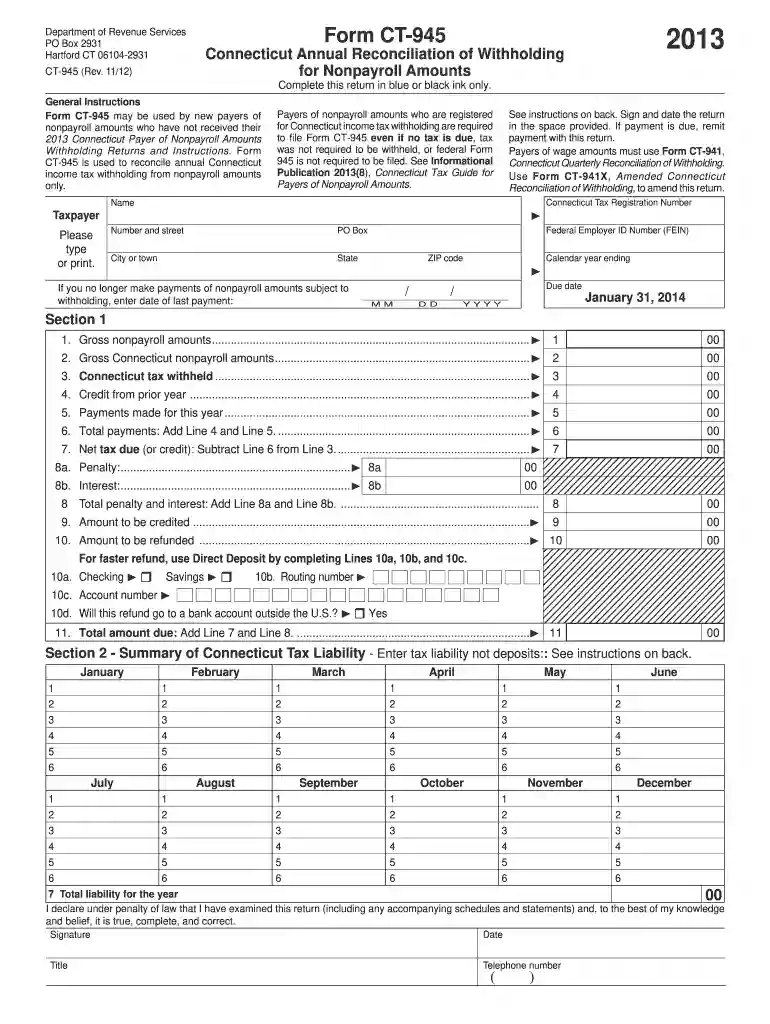
The Connecticut Form CT-945 for the year 2013 is an annual reconciliation form for nonpayroll amounts. It is used by employers or payers to report the amounts withheld for Connecticut income tax from nonpayroll payments throughout the fiscal year. This form ensures that the annual withholding amounts have been accurately reported and reconciled, reflecting the correct total of nonpayroll income tax withheld for the state of Connecticut.
Employers and payers should use Form CT to summarize the total nonpayroll amounts from which Connecticut taxes were withheld over the year. It acts as a reconciliation tool, aligning periodic withholding reported throughout the year with the actual amounts withheld. The form should be completed with precision, ensuring that all figures are accurately represented. Typically, the user will need to reference payroll records and other financial documentation to complete the form accurately.
Missing these deadlines may result in penalties and interest charges imposed by the Connecticut Department of Revenue Services.
Businesses and entities that have withheld Connecticut state income taxes from nonpayroll payments such as pensions, retirement distributions, and gambling winnings are typical users of Form CT. This includes corporations, limited liability companies (LLCs), and other business entities that process nonpayroll amounts requiring tax withholding.


Failure to submit Form CT by the stated deadline can result in significant penalties. These may include:
Ensuring timely and accurate submission of Form CT helps avoid such financial liabilities.
Having these documents prepared can streamline the form completion process and aid in accurate reconciliation.
Form CT can be completed using accounting software compatible with the Connecticut filing requirements. Common software includes:
These platforms allow for efficient data management and help ensure compliance with state-specific tax legislation, simplifying the filing process for businesses.
Consider a corporation that distributes gambling winnings to residents of Connecticut. Throughout 2013, the company withheld state income taxes from these winnings. At the end of the fiscal year, the corporation would use Form CT to report and reconcile the withheld taxes against the payments made during the year, ensuring all amounts match the reported totals. This form would ensure compliance with state tax laws and avert potential penalties.
We've got more versions of the form ct 945 2013 form. Select the right form ct 945 2013 version from the list and start editing it straight away!
| Versions | Form popularity | Fillable & printable |
|---|---|---|
| 2025 | 4.7 Satisfied (24 Votes) | |
| 2024 | 4.9 Satisfied (45 Votes) | |
| 2023 | 4.2 Satisfied (39 Votes) | |
| 2022 | 4.3 Satisfied (24 Votes) | |
| 2021 | 4.8 Satisfied (90 Votes) | |
| 2020 | 4.4 Satisfied (300 Votes) | |
| 2018 | 4.4 Satisfied (173 Votes) | |
| 2015 | 4.4 Satisfied (397 Votes) | |
| 2014 | 4 Satisfied (24 Votes) | |
| 2013 | 4.1 Satisfied (70 Votes) | |
| 2012 | 4.2 Satisfied (68 Votes) |
At DocHub, your data security is our priority. We follow HIPAA, SOC2, GDPR, and other standards, so you can work on your documents with confidence.
The personal exemption for individuals whose filing status is single has increased to $14,000 for the 2013 taxable year. There is a $1,000 reduction in the
May 2, 2017 Notice 2013-61 provides special administrative procedures for employers to make claims for refunds or adjustments of overpayments of social
Form. CT-945 is used to reconcile annual Connecticut income tax withholding from nonpayroll amounts only. Payers of nonpayroll amounts who are registered for


