




01. Edit your form online
Type text, add images, blackout confidential details, add comments, highlights and more.

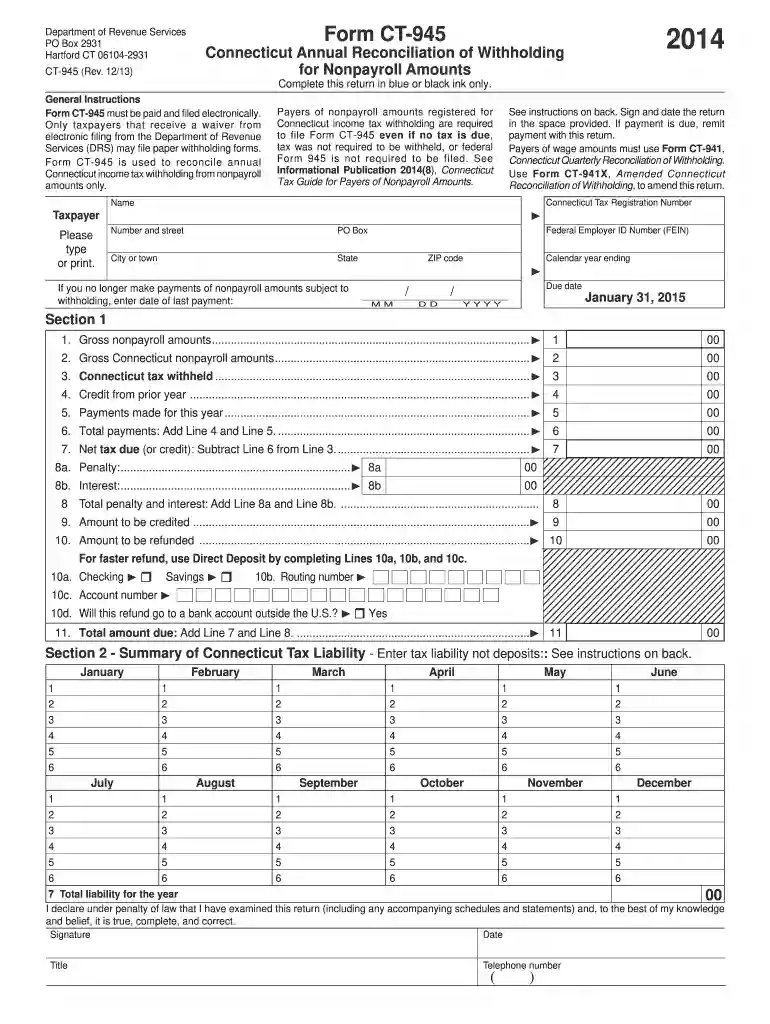
Type text, add images, blackout confidential details, add comments, highlights and more.

Draw your signature, type it, upload its image, or use your mobile device as a signature pad.

Send it via email, link, or fax. You can also download it, export it or print it out.
Form 945 is an essential IRS document used specifically for reporting federal income tax withheld from nonpayroll payments. Nonpayroll payments are generally defined as payments not related to typical employment income, such as pensions, gambling winnings, Indian gaming profits, and certain government payments. This form consolidates all the federal tax withholding information required by the IRS from these types of payments. Business entities or organizations that withhold tax on such payments must submit Form 945 annually to remain compliant with federal tax regulations. This ensures that nonpayroll tax liabilities are accurately reported and fulfilled.
The Instructions for Form 945 provide critical guidance for accurately completing the form. They include detailed explanations of what qualifies as a nonpayroll payment, specific withholding requirements, and how to rectify prior reporting errors. Understanding these instructions is crucial because errors in withholding or reporting can lead to discrepancies with the IRS, resulting in potential penalties. The instructions also clarify filing procedures, form submission deadlines, and specific IRS codes necessary for various types of payments, ensuring that organizations fulfill their tax obligations efficiently and accurately.
Instructions for Form 945 are accessible through the IRS website, providing a digital way to download the entire instruction set. Organizations can also request a physical copy to be mailed directly from the IRS by contacting their helpline. This dual method ensures that every entity responsible for filing has access to the information regardless of internet availability or preference for a tangible document. Staying updated with the latest version of the instructions is imperative as IRS regulations and thresholds may change annually, affecting reporting requirements.
Completing Form 945 involves several methodical steps to ensure accuracy:
The annual deadline for filing Form 945 is January 31 of the year following the tax period being reported. For example, taxes withheld in 2023 should be reported by January 31, 2024. Deadlines for depositing the actual taxes withheld vary, ranging from monthly to quarterly deposits based on the total tax liability, as dictated in IRS Circular E. Timely filing and accurate deposits are critical to avoid IRS penalties and interest on late payments. It is also advisable to retain filed forms and supporting documentation for at least four years to facilitate any required audits or verifications.
The instructions provide nuanced details, including:
Failure to file Form 945 properly, timely, or accurately can result in significant penalties from the IRS. Late filings incur penalties based on the amount of unpaid taxes, increasing over time. Underreported or untimely deposits of withholding taxes may also attract heavy fines. Ignoring IRS notices concerning discrepancies can lead to compounded interest on penalties. To mitigate these risks, organizations should adhere strictly to instructions, check submission timelines, and ensure withholding calculations are precise.
Implementing the Form 945 instructions can vary based on organizational scenarios:
These scenarios underscore the varied importance and application of the instructions, emphasizing the need for all payers to comprehend their responsibilities fully.
We've got more versions of the Instructions for Form 945 - IRS form. Select the right Instructions for Form 945 - IRS version from the list and start editing it straight away!
| Versions | Form popularity | Fillable & printable |
|---|---|---|
| 2025 | 4.7 Satisfied (24 Votes) | |
| 2024 | 4.9 Satisfied (45 Votes) | |
| 2023 | 4.2 Satisfied (39 Votes) | |
| 2022 | 4.3 Satisfied (24 Votes) | |
| 2021 | 4.8 Satisfied (90 Votes) | |
| 2020 | 4.4 Satisfied (300 Votes) | |
| 2018 | 4.4 Satisfied (173 Votes) | |
| 2015 | 4.4 Satisfied (397 Votes) | |
| 2014 | 4 Satisfied (24 Votes) | |
| 2013 | 4.1 Satisfied (70 Votes) | |
| 2012 | 4.2 Satisfied (68 Votes) |
At DocHub, your data security is our priority. We follow HIPAA, SOC2, GDPR, and other standards, so you can work on your documents with confidence.
You must complete this form if youre a semiweekly schedule depositor or became one because your accumulated tax liability during any month was.
Internal Revenue Service. 2007. Instructions for Form 945. Annual Return of Withheld Federal Income Tax. Section references are to the Internal Revenue Code
Report all federal income tax withholding from nonpayroll payments or distributions annually on one. Form 945. Dont file more than one Form 945 for any.


