
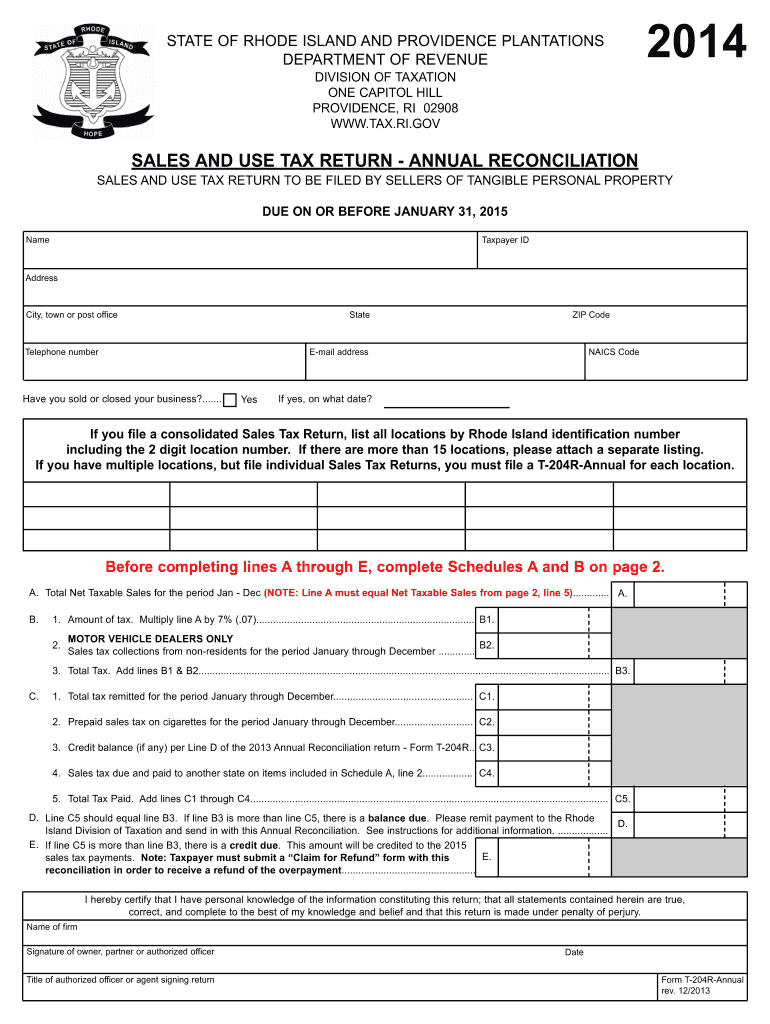







Definition & Meaning
The Annual Reconciliation form from the Rhode Island Division of Taxation serves primarily as a financial statement for businesses within the state to report their annual sales and use tax information. This form is critical for providing an accurate tally of yearly taxable transactions and any tax obligations or credits accumulated throughout the fiscal year. By reconciling taxes collected with taxes owed, businesses ensure compliance with state taxation laws, thereby minimizing the risk of audits or penalties.
Key Aspects
- Purpose: To reconcile sales and use tax collected against reported liabilities.
- Compliance: Mandatory for all sellers of tangible personal property within Rhode Island.
- Outcome: Ensures accurate taxation to prevent overpayment or underpayment scenarios.
How to Use the Annual Reconciliation Form
Businesses are required to accurately fill out the form by inputting their total gross sales, taxable sales, deductions, and the tax collected. This systematic process ensures that companies reconcile their financial obligations with their commercial activities.
Usage Guide
- Calculate Gross Sales: Include all sales to establish a comprehensive overview.
- Determine Taxable Sales: Exclude non-taxable sales to find the sales subject to tax.
- Record Deductions: Maximize relevant deductions to legally reduce tax liability.
- Calculate Tax Due or Overpaid: Balance the collected tax against the owed tax.
Steps to Complete the Annual Reconciliation Form
Completing this form involves a precise and methodical approach. Each section is designed to collect specific financial details, and accuracy is paramount to ensure that no discrepancies occur between what is reported and what is owed.
Detailed Steps
- Gather Necessary Financial Documents: Obtain invoices, receipts, and previous tax returns.
- Fill Out Business Information: Include business name, tax ID, and other identifiers.
- Report Total Sales and Deductions: Input all sales data and apply all eligible deductions.
- Determine Amount Owed or Credited: Summarize data to conclude the balance due.
- Submit the Completed Form: Choose between online, mail, or in-person submission methods.
Supporting the Filing Process
- Use accounting software integrations for error-free calculations.
- Ensure all financial data is up-to-date and reconciled with business accounts.
Filing Deadlines / Important Dates
It is crucial for businesses to adhere strictly to the filing deadlines to avoid penalties. Understanding the calendar for tax form submissions ensures compliance and helps in planning and managing taxes efficiently.
Key Timelines
- Annual Filing Date: Generally due by the end of January for the previous year’s taxes.
- Extension Options: Extensions may be available upon formal request but must be sought before the original deadline.
Required Documents
To accurately complete the Annual Reconciliation form, businesses must prepare a collection of pertinent financial documents. These serve as evidence of financial transactions and are essential for accurate reporting.
Essential Documentation
- Sales Receipts and Invoices: For verification of all taxable transactions.
- Previous Tax Returns: Assists in checking for consistency and accuracy.
- Deductions Documentation: Details of any claimed deductions.
Form Submission Methods
Businesses have multiple submission options for the Annual Reconciliation form, offering flexibility to align with company resources and capabilities.
Submission Options
- Online Submission: Preferred for quick processing and confirmation.
- Mail: Traditional method, ensure confirmed delivery receipt.
- In-Person: Direct submission at designated division offices.
Penalties for Non-Compliance
Failure to file or inaccurately filing the form can lead to severe repercussions. Awareness and adherence to the legal obligations that accompany this form are imperative for maintaining good standing with the Rhode Island Division of Taxation.
Consequences of Non-Compliance
- Financial Penalties: Include fines and interest charges on outstanding taxes.
- Legal Ramifications: Risk of audits and potential legal action from the state.
- Breaches of Tax Compliance: May affect business reputation and operational licenses.
Software Compatibility
Utilizing software to assist in filling out and submitting the form can significantly streamline the process. Business accounting software can integrate seamlessly into the workflow, reducing errors and saving time.
Popular Software Solutions
- TurboTax: Facilitates tax preparation and submission.
- QuickBooks: Provides built-in tools for tracking sales and generating reports.
- DocHub: Offers digital editing tools for completing forms online efficiently.




