
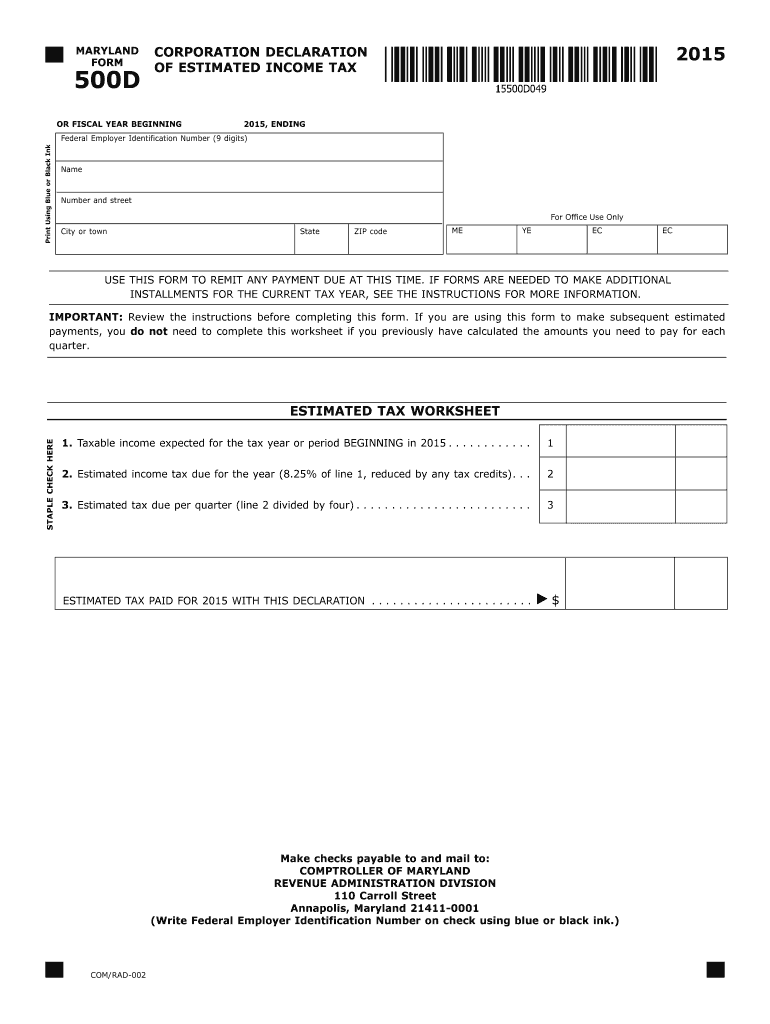







Definition and Meaning of the Maryland 500D 2015 Form
The Maryland 500D 2015 Form serves as a declaration tool for corporations to report and pay their estimated income tax for the fiscal year starting in 2015. It is designed to facilitate the calculation of income tax that a corporation anticipates owing to the state of Maryland. The form is essential for corporations planning to remit estimated taxes, especially when their expected taxable income in Maryland exceeds $1,000.
Key Elements Defined
- Taxable Income: The corporation's gross income minus allowable deductions determines the income subject to state tax.
- Estimated Payments: These are quarterly payments based on projected income to preempt end-of-year tax liabilities.
- Penalties: Failure to accurately estimate and pay taxes can result in fines or interest charges.
How to Use the Maryland 500D 2015 Form
To effectively utilize the Maryland 500D 2015 Form, corporations need to accurately estimate future taxable income and adhere to a schedule for tax payments. Properly completing the form ensures compliance and minimizes the risk of financial penalties due to underpayment.
Step-by-Step Completion
- Calculate Estimated Income: Determine the annual income expected for 2015, considering revenue streams such as sales and services.
- Deduct Allowables: Subtract all deductible expenses to derive the projected taxable income.
- Determine Tax Rate: Apply the relevant Maryland corporate tax rate to calculate the estimated tax liability.
- Schedule Payments: Divide the total estimated tax into quarterly payments for submission according to state deadlines.
How to Obtain the Maryland 500D 2015 Form
The Maryland 500D 2015 Form can be accessed through various channels to ensure corporations have the necessary resources to comply with tax regulations.
Available Methods
- Online Access: Download the form from Maryland's official tax website for secure, digital handling.
- Local Tax Offices: Obtain a physical copy by visiting state or regional tax authorities.
- Professional Services: Engage with tax professionals who can provide the form during consultations.
Steps to Complete the Maryland 500D 2015 Form
Completing the Maryland 500D 2015 Form involves several precise steps to ensure all necessary details are correctly reported.
Detailed Procedure
- Gather Financial Records: Collect all documentation related to revenue and deductible expenses.
- Form Completion: Fill in all required fields, ensuring accuracy in entered financial figures.
- Review Entries: Double-check calculations and ensure all sections are comprehensibly filled.
- Submit the Form: Forward the completed form electronically or via mail according to preferred submission methods.
Penalties for Non-Compliance
Non-compliance with the Maryland 500D 2015 Form requirements can lead to severe penalties impacting a corporation's financial standing.
Types of Penalties
- Late Payment Fines: Fees for missing estimated tax payment deadlines.
- Underpayment Interest: Additional charges for inadequate tax estimation.
- Additional Liabilities: Further tax obligations resulting from failure to report accurate income.
Examples of Using the Maryland 500D 2015 Form
Providing practical insight into how different corporations might use the form is beneficial for understanding its application.
Real-World Scenarios
- Expanding Businesses: A growing technology firm projects higher revenue and uses the form to estimate the increased tax.
- Seasonal Operations: A retail chain, experiencing variable seasonal sales, uses historical data to provide accurate income forecasts.
Form Submission Methods
Corporations have several options for submitting the Maryland 500D 2015 Form, allowing them to choose the most efficient method that suits their needs.
Submission Options
- Online Submission: Direct electronic submission via Maryland's tax portal.
- Mail: Sending a hard copy of the completed form to designated tax office addresses.
- In-Person Delivery: Dropping off the form at local tax offices for those preferring face-to-face interaction.
Business Entity Types that Benefit Most from the Maryland 500D 2015 Form
Different types of business entities find this form particularly advantageous for maintaining compliant tax practices.
Beneficiary Types
- Corporations: Entities that are legally distinct from their owners and require detailed tax planning.
- LLCs and Partnerships: Businesses with multiple stakeholders who rely on accurate income estimations to distribute tax liabilities correctly.




