




01. Edit your pay maryland estimated taxes online online
Type text, add images, blackout confidential details, add comments, highlights and more.

Type text, add images, blackout confidential details, add comments, highlights and more.

Draw your signature, type it, upload its image, or use your mobile device as a signature pad.

Send maryland estimated tax payments via email, link, or fax. You can also download it, export it or print it out.
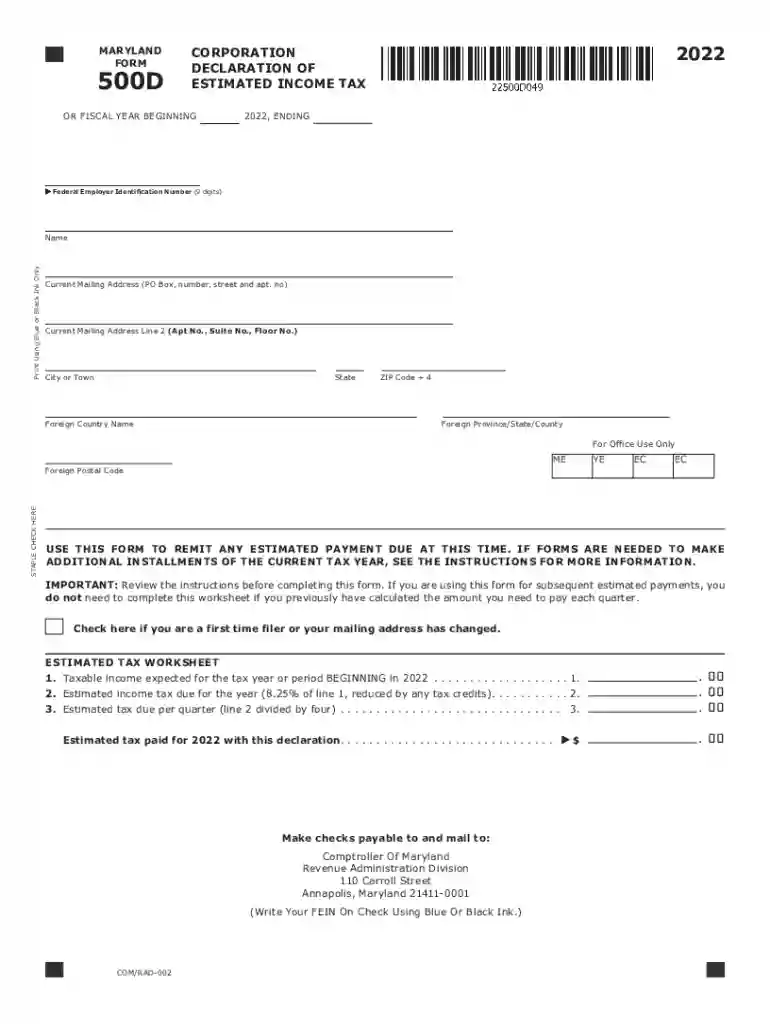
MD State Taxes Estimated Payment refers to the prepayment of Maryland state income tax that individuals or corporations anticipate owing for a tax year. This prepayment is crucial for avoiding end-of-year tax liabilities and potential penalties. Taxpayers estimate their annual income, deductions, and credits to project the amount of tax they will owe and make quarterly payments to the state. This method ensures a more manageable tax liability by distributing the payment across the year. For corporations, this is often done using the Maryland Form 500D, which is specifically designed for estimated income tax declaration and payment.
To use the MD State Taxes Estimated Payment system effectively, one must first accurately estimate their annual income and tax liability. Here are the typical steps to follow:
Estimate Taxable Income: Calculate the expected gross income, considering all sources of income, including wages, dividends, and any other earnings.
Determine Deductions and Credits: Subtract allowable deductions from the estimated gross income to determine the taxable income. Consider available credits that can reduce tax liability.
Calculate Estimated Tax: Use the Maryland state tax rate schedule to calculate the estimated tax liability based on the calculated taxable income.
Submit Quarterly Payments: Divide the estimated tax by four to determine the amount payable each quarter. Pay these installments by the due dates to avoid penalties.
Adjust Payments if Necessary: Reassess income and deductions throughout the year. If income changes significantly, adjust future payments accordingly to avoid underpayment or overpayment.
The Maryland Form 500D can be obtained through various methods to accommodate different taxpayer preferences:
Online Access: Visit the official website of the Maryland Comptroller to download the Form 500D. It is readily available for download in PDF format, ensuring that no physical visit is necessary.
Mail Delivery: Request a paper form by contacting the Maryland Comptroller’s office. This method may be preferable for individuals without internet access.
Tax Professional Assistance: Engage a tax preparer who can provide the necessary forms as part of tax planning services. They can also offer guidance on filling out the form accurately.
Local Tax Offices: Visit a local Maryland tax office to collect a physical copy of the form, if preferred.
Completing the Maryland Form 500D accurately ensures compliance and can prevent future tax issues:
Section for Personal Information: Enter your name, social security number, and other identifying information as requested on the form.
Income Estimate: Fill in the estimated income for the current tax year. This should include all potential sources of income.
Tax Computation: Calculate the estimated tax liability using the form’s built-in worksheet. The worksheet provides step-by-step instructions to arrive at the correct tax due.
Quarterly Payment Breakdown: Divide the total estimated tax liability by four to determine your quarterly payments. Record these amounts in the designated fields.
Submission and Payment: Choose your payment method - online, by mail, or other - and follow instructions to submit both the form and your payment by the deadline.
Estimating and paying state taxes in advance is not just a legal obligation, but also a financial strategy. Here are key reasons to engage in this practice:
Avoid Penalties: By making regular estimated payments, taxpayers avoid interest and penalties associated with underpayment of taxes.
Cash Flow Management: Spreading tax payments throughout the year can ease the financial burden at year-end, supporting better cash flow management.
Financial Planning: Regularly assessing income and tax liability encourages disciplined financial management and helps anticipate future obligations.
Certain groups are more likely to utilize the MD State Taxes Estimated Payment system due to the nature of their income:
Self-Employed Individuals: Those without taxes withheld from paychecks need to make estimated payments to cover their tax liability.
Corporations and LLCs: Business entities, especially those expecting a tax liability over $1,000, are required to make quarterly payments.
Retirees Receiving Pensions or Social Security: These individuals might not have enough withholding from their retirement income and should consider estimated payments to avoid penalties.


Understanding key terms is essential for accurate tax reporting:
Quarterly Payments: Payments made four times a year to cover estimated taxes.
Form 500D: The specific Maryland form used for declaring estimated corporate income tax.
Underpayment Penalty: A penalty imposed when too little tax is paid during the year.
Taxable Income: The amount of income that is subject to taxation after deductions and credits have been applied.
Failure to comply with estimated payment requirements can result in several penalties:
Underpayment Penalties: If tax paid through withholding and estimated payments is less than 90% of the current year's tax or 100% of the previous year's tax, penalties apply.
Interest Penalties: In addition to underpayment penalties, interest charges accrue on any unpaid tax balance.
Administrative Penalties: For corporations, failing to file Form 500D in a timely manner might lead to additional administrative fines.
Understanding these potential penalties highlights the importance of making accurate and timely estimated tax payments.
We've got more versions of the pay maryland estimated taxes online form. Select the right pay maryland estimated taxes online version from the list and start editing it straight away!
| Versions | Form popularity | Fillable & printable |
|---|---|---|
| 2024 | 4.2 Satisfied (57 Votes) | |
| 2023 | 4.4 Satisfied (20 Votes) | |
| 2022 | 4.8 Satisfied (45 Votes) | |
| 2021 | 4.4 Satisfied (154 Votes) | |
| 2020 | 4.4 Satisfied (350 Votes) | |
| 2019 | 4.2 Satisfied (109 Votes) | |
| 2018 | 4.3 Satisfied (41 Votes) | |
| 2017 | 4.4 Satisfied (179 Votes) | |
| 2016 | 4.4 Satisfied (101 Votes) | |
| 2015 | 4.4 Satisfied (50 Votes) | |
| 2014 | 4 Satisfied (26 Votes) | |
| 1997 | 4.3 Satisfied (40 Votes) |
At DocHub, your data security is our priority. We follow HIPAA, SOC2, GDPR, and other standards, so you can work on your documents with confidence.
Make a personal estimated payment - Form PV. Make a personal extension payment - Form PV. Set up an Individual payment agreement. Set up a recurring debitRead more
Declarations with payments in full are to be filed within 60 days of the receipt of $500 or more of income from awards, prizes, lotteries, or raffles, whetherRead more
Sep 16, 2013 This revenue procedure provides the domestic asset/liability percentages and domestic investment yields needed by for- eign life insuranceRead more


