




01. Edit your form online
Type text, add images, blackout confidential details, add comments, highlights and more.

Type text, add images, blackout confidential details, add comments, highlights and more.

Draw your signature, type it, upload its image, or use your mobile device as a signature pad.

Send it via email, link, or fax. You can also download it, export it or print it out.
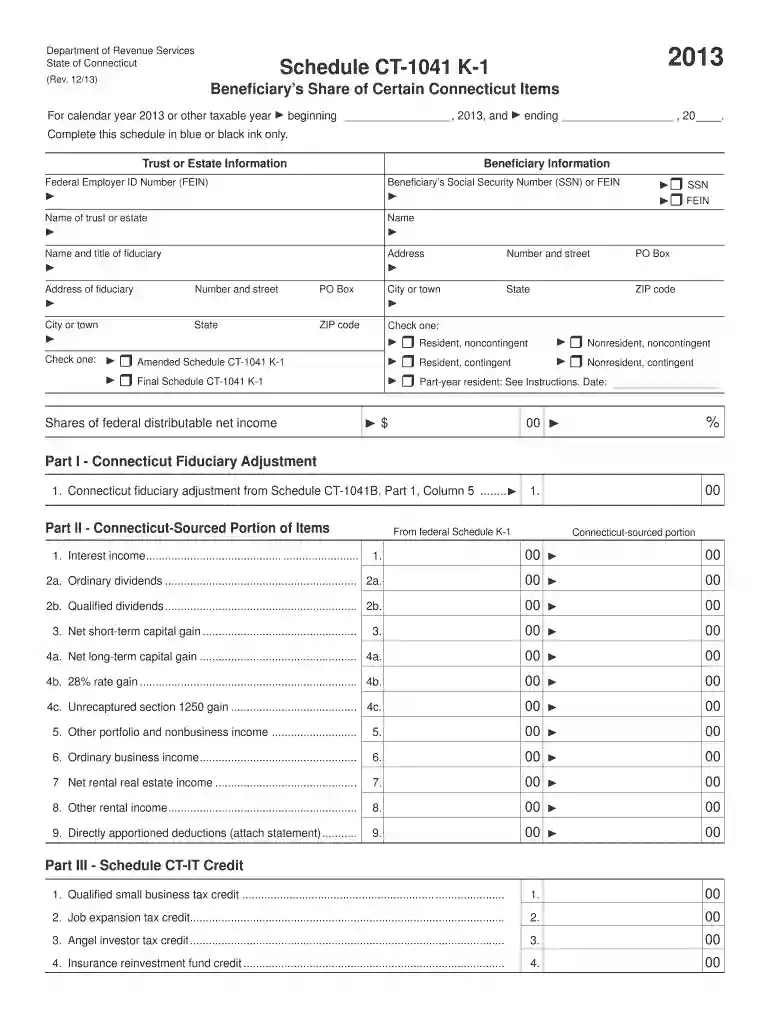
The Schedule CT-1041 K-1 form, issued by the Connecticut Department of Revenue Services, is used primarily by fiduciaries in handling estate or trust matters for the 2013 tax year. This document allows the reporting of a beneficiary's share of income, deductions, and credits sourced from a Connecticut trust or estate. Its main role is in distributing tax obligations appropriately between the fiduciaries and beneficiaries according to state tax laws.
To utilize the form CT-1041 K-1 effectively, fiduciaries must first gather all pertinent details related to the trust or estate. This includes noting the specific income items, deductions allowed under Connecticut tax law, and any applicable credits. Beneficiaries will subsequently use information from this form to report in their individual tax returns. The form ensures clear communication of tax obligations and liabilities, making accurate completion crucial for compliance.
Gather Information: Collect detailed records of the trust's financial activities during the tax year, including income, deductions, credits, and fiduciary adjustments specific to Connecticut taxes.
Complete Trust and Beneficiary Information: Fill in the identifying information for both the trust or estate and its beneficiaries. This includes Social Security Numbers or Federal Employer Identification Numbers.
Enter Connecticut Fiduciary Adjustments: Include any adjustments required under Connecticut tax law. This can affect the distributable income for beneficiaries.
Report Income, Deductions, and Credits: Input the beneficiary's share of the trust's income, deductions, and credits, ensuring alignment with Connecticut's specific tax regulations.
Review and Submit: Carefully review the completed form for accuracy, correct any discrepancies, and submit it accordingly.
This form is primarily used by fiduciaries managing trusts or estates that have Connecticut-sourced income. It is also utilized by beneficiaries to understand and report their share of income and deductions related to the Connecticut estate or trust. Individuals acting as trustees or executors are the typical users, ensuring that their beneficiaries meet state tax obligations.


Filing the Schedule CT-1041 K-1 is a legal requirement for fiduciaries managing trusts or estates with income sourced in Connecticut. By ensuring that beneficiaries report their correct share of income and deductions on their tax returns, fiduciaries adhere to state taxation laws. The form's correct usage ensures compliance with Connecticut's unique tax code, potentially avoiding legal penalties.
While the CT-1041 K-1 is specific to Connecticut, its structure is informed by federal standards for trust and estate taxation. The Internal Revenue Service (IRS) prescribes fundamental data that should be reflected in local versions of fiduciary documents. It is crucial for the information reported on the CT-1041 K-1 to be consistent with federal taxation principles to ensure no discrepancies arise.
For the 2013 tax year, Schedule CT-1041 K-1 should be completed and distributed to beneficiaries by the same deadline as federal tax filings, usually April 15th. Given Connecticut's specific guidelines, timely submission is essential to avoid penalties and ensure beneficiaries have the necessary data to file their personal state tax returns before state-specific deadlines.
Failure to properly complete or timely file the CT-1041 K-1 can result in significant penalties for both fiduciaries and beneficiaries. Connecticut law mandates precise and timely declaration of income and deductions, so inaccuracies or omissions can lead to fines and interest charges. Both the estate and beneficiaries might face financial setbacks and legal challenges if compliance is not met.
The Schedule CT-1041 K-1 can be completed in both digital and paper formats, providing flexibility. While a paper version is traditional, a digital submission is often more efficient, offering real-time updates and easier integration with other tax software. Digital filing also facilitates faster communication and distribution of the forms to beneficiaries, aligning with modern data management practices.
Trusts and estates that are designed to distribute income to beneficiaries, particularly those within or generating income within Connecticut, find this form critical. Businesses operating as estates or trusts that manage significant income directing toward multiple beneficiaries benefit from the clarity and preciseness of tax responsibility distribution that the Schedule CT-1041 K-1 provides.
To accurately complete the form, fiduciaries should have comprehensive financial records, including detailed income statements, records of deductions, and any correspondence related to Connecticut fiduciary adjustments. Ensuring all relevant data is collected before filling out the form simplifies the completion process and enhances accuracy in reporting.
We've got more versions of the form ct 1041 k 1t 2013 form. Select the right form ct 1041 k 1t 2013 version from the list and start editing it straight away!
| Versions | Form popularity | Fillable & printable |
|---|---|---|
| 2025 | 4.8 Satisfied (44 Votes) | |
| 2023 | 4.3 Satisfied (47 Votes) | |
| 2022 | 4.7 Satisfied (45 Votes) | |
| 2021 | 4.8 Satisfied (53 Votes) | |
| 2020 | 4.2 Satisfied (62 Votes) | |
| 2019 | 4.4 Satisfied (193 Votes) | |
| 2017 | 4.3 Satisfied (203 Votes) | |
| 2016 | 4.3 Satisfied (140 Votes) | |
| 2014 | 4.4 Satisfied (339 Votes) | |
| 2013 | 4 Satisfied (35 Votes) | |
| 2012 | 4.2 Satisfied (26 Votes) |
At DocHub, your data security is our priority. We follow HIPAA, SOC2, GDPR, and other standards, so you can work on your documents with confidence.
Acoustic parameter adjustment to match your speakers and listening environment. Automatic settings for speaker acoustic parameters.
Form CT-1041 K-1T and Schedule CT-1041 K-1s must be submitted on or before the fifteenth day of the fourth month following the close of the taxable year (April
Part-year residents and nonresidents do not qualify for the CT EITC and must file Form CT-1040NR/PY. Qualified taxpayers claim the CT EITC by completing


