




Here's how it works

01. Edit your form online
Type text, add images, blackout confidential details, add comments, highlights and more.

02. Sign it in a few clicks
Draw your signature, type it, upload its image, or use your mobile device as a signature pad.

03. Share your form with others
Send it via email, link, or fax. You can also download it, export it or print it out.
How to use or fill out form ct 1041 k 1t 2014 with our platform

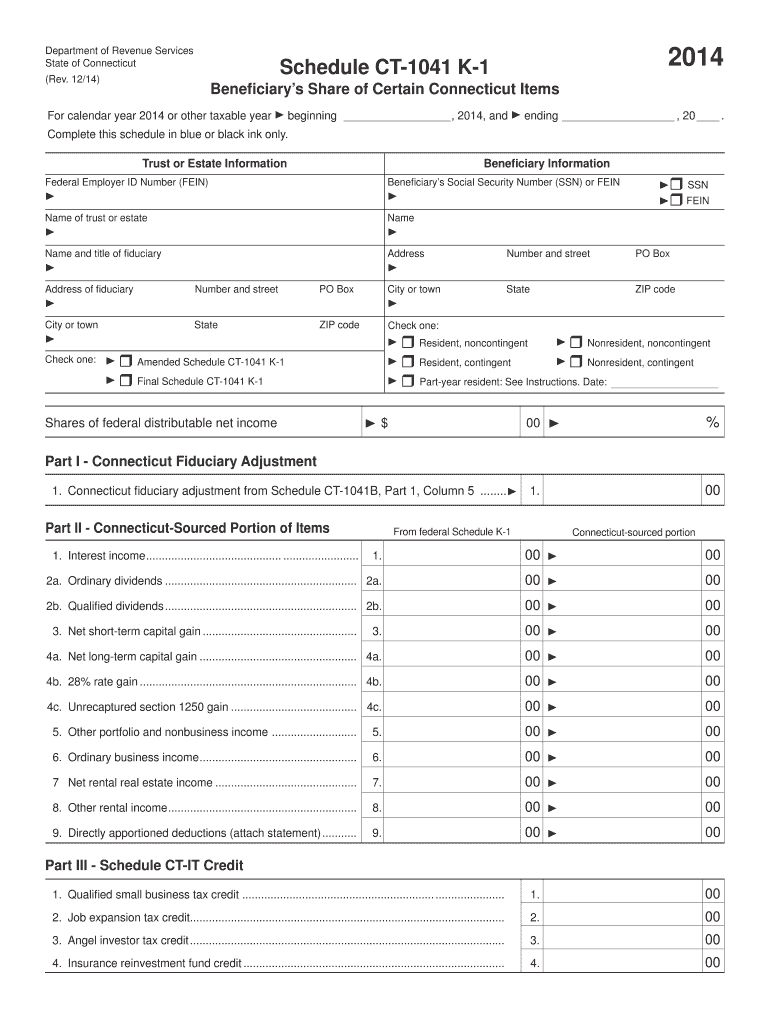
- Click ‘Get Form’ to open the CT-1041 K-1 form in the editor.
- Begin by filling out the Trust or Estate Information section. Enter the name of the trust or estate, along with the Federal Employer ID Number (FEIN) and fiduciary details.
- Next, complete the Beneficiary Information section. Input the beneficiary’s name, Social Security Number (SSN) or FEIN, and address. Ensure you check whether it is an SSN or FEIN.
- Indicate the beneficiary's resident status by checking one of the applicable boxes: Nonresident, Resident, or Part-year resident. If part-year resident, include relevant dates.
- Proceed to Part I for Connecticut Fiduciary Adjustment. Transfer entries from Schedule CT-1041B as needed.
- In Part II, report any Connecticut-sourced income from federal Schedule K-1. Fill in amounts for dividends and other income types as applicable.
- Complete Part III for Schedule CT-IT Credit by transferring entries from Worksheet B if applicable.
Start using our platform today to easily fill out your CT-1041 K-1 form online for free!
Fill out form ct 1041 k 1t 2014 online
It's free
It's free
See more form ct 1041 k 1t 2014 versions
We've got more versions of the form ct 1041 k 1t 2014 form. Select the right form ct 1041 k 1t 2014 version from the list and start editing it straight away!
| Versions | Form popularity | Fillable & printable |
|---|---|---|
| 2025 | 4.8 Satisfied (44 Votes) | |
| 2023 | 4.3 Satisfied (47 Votes) | |
| 2022 | 4.7 Satisfied (45 Votes) | |
| 2021 | 4.8 Satisfied (53 Votes) | |
| 2020 | 4.2 Satisfied (62 Votes) | |
| 2019 | 4.4 Satisfied (193 Votes) | |
| 2017 | 4.3 Satisfied (203 Votes) | |
| 2016 | 4.3 Satisfied (140 Votes) | |
| 2014 | 4.4 Satisfied (339 Votes) | |
| 2013 | 4 Satisfied (35 Votes) | |
| 2012 | 4.2 Satisfied (26 Votes) |
Got questions?
We have answers to the most popular questions from our customers. If you can't find an answer to your question, please contact us.
Contact us
What is a CT K1 form?
A pass-through entity (PE) must furnish Schedule CT K-1, Members Share of Certain Connecticut Items, to all members. General Instructions for PEs. A PE must complete Part 1 for resident noncorporate members, nonresident noncorporate members, and members that are pass-through entities.
Who needs to file a 1041 tax return?
If the estate generates more than $600 in annual gross income, you are required to file Form 1041, U.S. Income Tax Return for Estates and Trusts. An estate may also need to pay quarterly estimated taxes. See Form 1041 instructions for information on when to file quarterly estimated taxes.
Who needs to fill out a K-1 form?
The Schedule K-1 tax form is for inheritance recipients who need to report their share of income, deductions, or credits from the trust or estate. Get the clarity you need to file your income taxes correctly as a beneficiary.
Who generates a K1 for an estate?
Schedule K-1 (Form 1041) is an official IRS form thats used to report a beneficiarys share of income, deductions and credits from an estate or trust. Its full name is U.S. Income Tax Return from Estates and Trusts The estate or trust is responsible for filing Schedule K-1 for each listed beneficiary with the IRS.
What is a 1041 K-1 form?
IRS Schedule K-1 (Form 1041) Beneficiarys Share of Income, Deductions, Credits, etc. is used to report a beneficiarys share of income, deductions, and credits from a trust or estate. The fiduciary must file Schedule K-1 with the IRS for each beneficiary and provide each beneficiary with a copy.
Security and compliance
At DocHub, your data security is our priority. We follow HIPAA, SOC2, GDPR, and other standards, so you can work on your documents with confidence.
Learn more


Related forms

Personalcriminal history statement form
HVAC Service Agreement-- Royal Plus Home and Commercial
The document outlines an Annual Preventative Maintenance Agreement from Royal Plus, Inc., a plumbing, heating, and air c ...

Cfwb 015 form
The document is a referral form for employers to provide employee income information to the NYC Administration for Child ...

Form mv2932
The document is a Transportation Permission form from the Wisconsin Department of Children and Families, designed for ch ...

MAILING ADDRESS: Membership 82 Main Road,
The document is a membership application and waiver for the International Defensive Pistol Association of Trinidad. It o ...

PDF The Borough of Wilson Code Office
The document is an application form for home or commercial inspection and certification of occupancy in the Borough of W ...

WAIVER OF MEDICAL TREATMENT OR OBSERVATION FORM
The document is a 'Workers’ Compensation Waiver of Medical Treatment or Observation Form' where an employee acknowledges ...
DocHub encatalog20 Printable weekly activity report template excel Forms
The document outlines the application process for the permanent renewal of the LXMO permit issued by the Oregon Board of ...
People also ask
Who must file CT 1041?
The fiduciary of a nonresident trust or estate must file Form CT‑1041 if the trust or estate: Had income derived from or connected with sources within Connecticut; Incurred a net operating loss for Connecticut income tax purposes, but not for federal income tax purposes; or.
How does a K1 affect my taxes?
A Schedule K-1 can impact your personal taxes in key ways. It reports income from partnerships, S-corporations, and trusts. This income is often considered pass-through, meaning it goes directly to you without being taxed at the entity level.
What is a 1041 T tax form?
A trust or, for its final tax year, a decedents estate may elect under section 643(g) to have any part of its estimated tax payments (but not income tax withheld) treated as made by a beneficiary or beneficiaries. The fiduciary files Form 1041-T to make the election.


