




01. Edit your form online
Type text, add images, blackout confidential details, add comments, highlights and more.

Type text, add images, blackout confidential details, add comments, highlights and more.

Draw your signature, type it, upload its image, or use your mobile device as a signature pad.

Send it via email, link, or fax. You can also download it, export it or print it out.
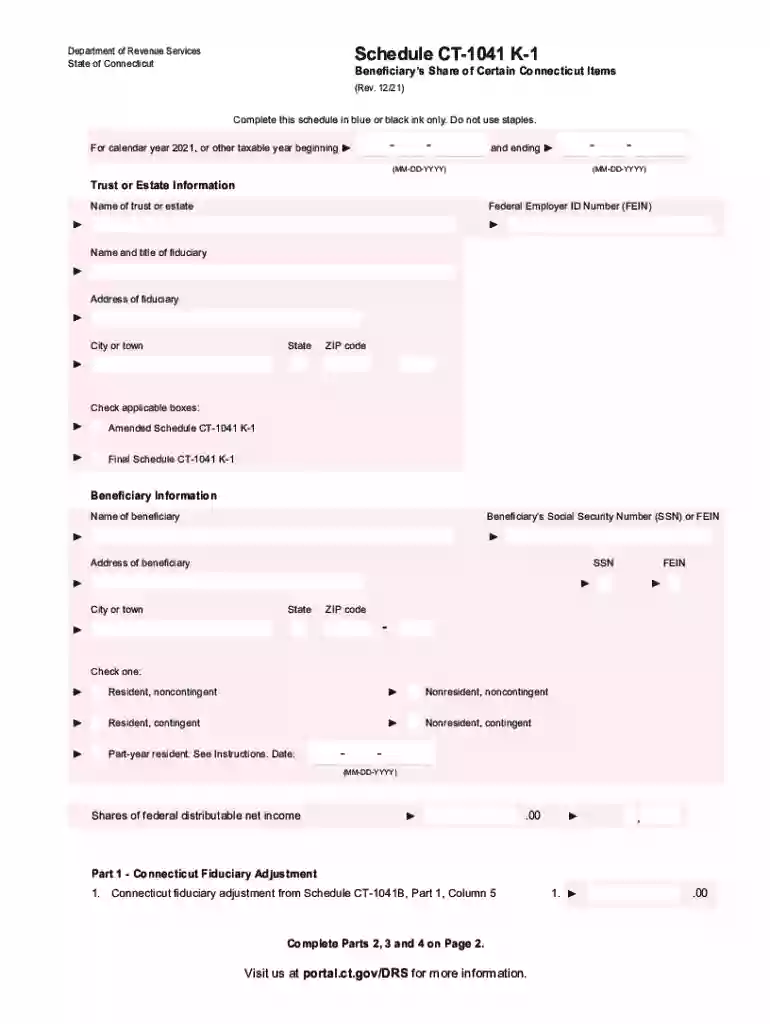
The Schedule CT-1041 K-1 is a crucial document for fiduciaries managing trusts or estates in Connecticut. It serves to report a beneficiary's share of income, deductions, credits, and other financial information from the trust or estate. This form is integral to ensuring tax compliance and accurately reflecting each beneficiary's tax obligations as derived from trust or estate distributions.
Beneficiaries use the information on their CT-1041 K-1 to complete their individual or business tax returns. It's crucial to align the items on the K-1 with the appropriate sections on personal tax filings to avoid discrepancies and potential audits.
Fiduciaries tasked with managing trusts or estates are responsible for preparing and distributing the CT-1041 K-1 forms to beneficiaries.
Fiduciaries must ensure the form is accurately populated and delivered to beneficiaries in a timely manner.
Timeliness is crucial for both fiduciaries issuing the CT-1041 K-1 and for beneficiaries utilizing the form.
Adhering to the legal stipulations surrounding the CT-1041 K-1 is vital for ensuring both fiduciaries and beneficiaries are compliant with state and federal tax laws.
Non-compliance can lead to several issues for both fiduciaries and beneficiaries.
The CT-1041 K-1 is specific to Connecticut, and the rules for completing and submitting this form are crafted in line with the state's tax laws.
These comprehensive insights into the CT-1041 K-1 form provide a robust understanding for both fiduciaries and beneficiaries handling trust or estate-based tax obligations in Connecticut.
We've got more versions of the ct 1041 k form. Select the right ct 1041 k version from the list and start editing it straight away!
| Versions | Form popularity | Fillable & printable |
|---|---|---|
| 2025 | 4.8 Satisfied (44 Votes) | |
| 2023 | 4.3 Satisfied (47 Votes) | |
| 2022 | 4.7 Satisfied (45 Votes) | |
| 2021 | 4.8 Satisfied (53 Votes) | |
| 2020 | 4.2 Satisfied (62 Votes) | |
| 2019 | 4.4 Satisfied (193 Votes) | |
| 2017 | 4.3 Satisfied (203 Votes) | |
| 2016 | 4.3 Satisfied (140 Votes) | |
| 2014 | 4.4 Satisfied (339 Votes) | |
| 2013 | 4 Satisfied (35 Votes) | |
| 2012 | 4.2 Satisfied (26 Votes) |
At DocHub, your data security is our priority. We follow HIPAA, SOC2, GDPR, and other standards, so you can work on your documents with confidence.
This Instruction Manual (Detailed) provides detailed instructions for advanced settings of the FR-A800 series inverters. 1041 A933 Digital source selection
by RS Kinyon 2013 Cited by 3 A copy of pages 1 and 2 of. Form 1041 is required to be attached to the Form 541. Schedule K-1 (541) reports the information on the Schedule K-1.Read more
A fiduciary must furnish Schedule CT‑1041 K‑1 on or before the fifteenth day of the fourth month following the close of the taxable year (April 15 if the trustRead more


