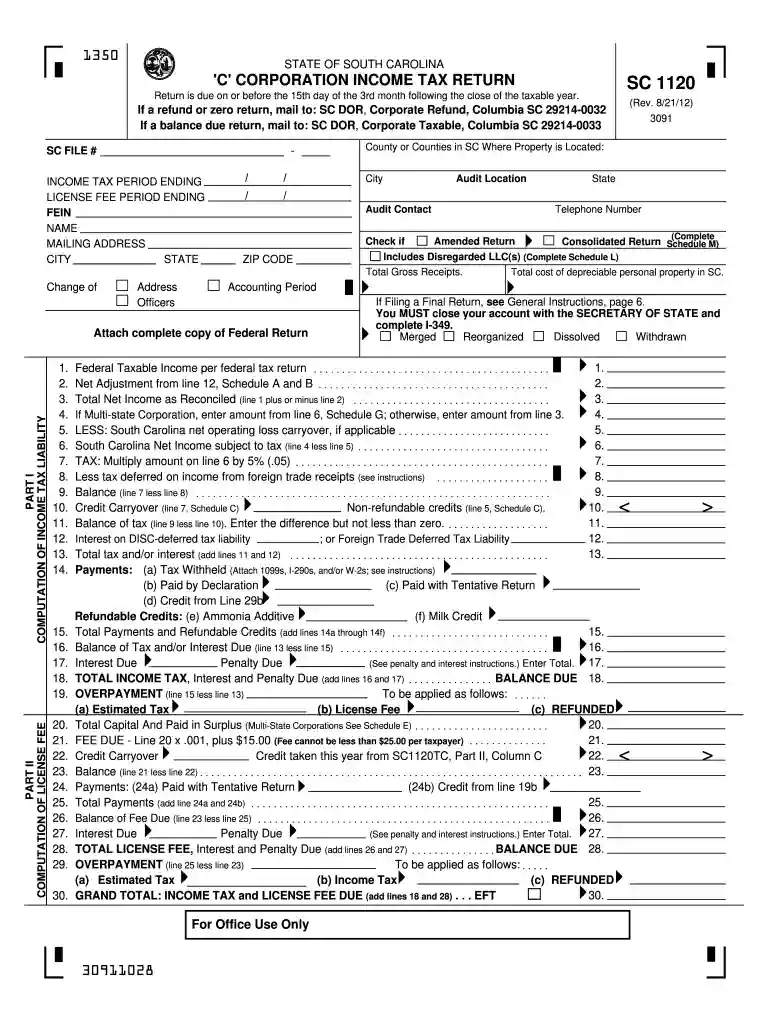
South carolina sc1120 2012 form-2026

Get Form
south carolina sc1120 2012 form Preview on Page 1

Here's how it works

01. Edit your form online
Type text, add images, blackout confidential details, add comments, highlights and more.

02. Sign it in a few clicks
Draw your signature, type it, upload its image, or use your mobile device as a signature pad.

03. Share your form with others
Send it via email, link, or fax. You can also download it, export it or print it out.

Definition and Meaning of the South Carolina SC Form

The South Carolina SC form is a tax document used by corporations to report income tax and license fee liabilities within the state of South Carolina. This form is essential for outlining corporate income and expenditures subject to state tax laws. It includes sections for calculations related to income tax, deductions, and credits, as well as details about corporate structure and operations. Understanding its components is crucial for compliance with state tax regulations.

Key Components of the SC1120 Form

  • Income Tax Computation: Includes fields for reporting total income, adjustments, and taxable income calculations.
  • Deductions and Credits: Provides areas to list allowable deductions and any credits that can significantly reduce tax obligations.
  • Corporate Details: Requires information about the corporate structure, including principal business activities and ownership details.

Steps to Complete the South Carolina SC Form

Accurate completion of the SC1120 form is crucial for legal compliance and avoiding penalties. Below are the steps to ensure a thorough and correct filing process:

  1. Gather Required Information: Assemble pertinent documentation, such as income statements, balance sheets, and previous tax returns.
  2. Enter Corporate Information: Fill out the corporation's name, address, and federal Employer Identification Number (EIN).
  3. Report Gross Income: Include income from all sources relevant to your business in South Carolina.
  4. Calculate Deductions and Credits: Identify eligible deductions and credits that can be subtracted from your gross income.
  5. Compute Tax Liability: Follow the instructions to compute your tax liability after accounting for deductions and credits.
  6. Review and Double-Check: Verify all entries for accuracy to prevent errors that can lead to audits or penalties.
  7. Sign and Submit: Ensure that authorized personnel sign the form and submit it by the deadline.

Detailed Breakdown of Deductions

  • Ordinary Business Costs: Include costs such as salaries, rent, and other operational expenses.
  • Specific Credits: Example credits might include energy efficiency incentives or employee training programs.

Filing Deadlines and Important Dates

Meeting deadlines is vital to remain in good standing with the South Carolina Department of Revenue. The SC1120 form must be filed by the 15th day of the third month following the close of the taxable year. Failure to meet this deadline could result in penalties or late fees.

Key Dates to Remember

  • Filing Deadline: Typically March 15 for a calendar year corporation.
  • Extension Requests: Corporations may apply for a filing extension if required documentation is not available.

Required Documents for Filing

Completing the SC1120 form necessitates the collection of several important documents:

  • Financial Statements: Comprehensive financial records summarizing income, expenses, assets, and liabilities.
  • Previous Year’s Tax Return: Helps ensure continuity and accuracy across filings.
  • Support for Deductions and Credits: Invoices, receipts, and relevant documentation that validate deductions and credits claimed.

Digital vs. Paper Version of the South Carolina SC Form

Corporations may choose to file the SC1120 form either digitally or via paper. Each method has its considerations:

  • Digital Submission: Offers faster processing, immediate confirmation of receipt, and generally reduces the chance of manual errors during filing.
  • Paper Submission: May be preferable for corporations with simpler structures or without access to reliable digital filing options.

Pros and Cons

  • Digital: Quick, efficient, and environmentally friendly. Requires technology literacy and reliable internet.
  • Paper: Tangible record, but slower and potentially subject to postal delays.

Who Typically Uses the South Carolina SC Form

The SC1120 form is predominantly utilized by 'C' corporations in South Carolina. These entities are required to report their financial activities for state tax assessment.


decoration image ratings of Dochub

Characteristics of Corporations Using SC1120

  • Operate legally within the state
  • Have income generated in South Carolina
  • Subject to state corporate tax laws

State-Specific Rules for the South Carolina SC Form

South Carolina has unique tax rules that may differ from federal or other state guidelines. Businesses must be aware of these nuances to ensure accurate filing:

  • Income Apportionment: Corporations that operate in multiple states must properly apportion income to South Carolina.
  • Specific Credits and Incentives: The state may offer location-specific incentives that can impact tax filings.

Penalties for Non-Compliance

Corporations failing to file correctly or on time can face significant penalties. Understanding potential repercussions is foundational to maintaining compliance:

  • Late Filing Penalties: Charges accrue monthly based on the amount owed.
  • Underpayment of Tax: Interest and additional penalties may apply if taxes are underreported.

Avoiding Penalties

  • Apply for Extensions: When more time is needed.
  • Maintain Accurate Records: Consistent accuracy helps avoid discrepancies leading to penalties.

By thoroughly understanding how to navigate the SC1120 form, corporations can effectively manage their tax responsibilities and comply with South Carolina's legal requirements.

See more south carolina sc1120 2012 form versions

We've got more versions of the south carolina sc1120 2012 form form. Select the right south carolina sc1120 2012 form version from the list and start editing it straight away!
Versions Form popularity Fillable & printable
2023 4.3 Satisfied (29 Votes)
2022 4.8 Satisfied (90 Votes)
2020 4.8 Satisfied (230 Votes)
2019 4.4 Satisfied (111 Votes)
2018 4.3 Satisfied (222 Votes)
2017 4.4 Satisfied (273 Votes)
2016 4.4 Satisfied (530 Votes)
2015 4.1 Satisfied (68 Votes)
2014 4 Satisfied (24 Votes)
2013 4.2 Satisfied (39 Votes)
2012 4.2 Satisfied (71 Votes)
2010 4.1 Satisfied (47 Votes)
2008 4 Satisfied (39 Votes)
2006 4 Satisfied (54 Votes)
2004 4 Satisfied (50 Votes)
be ready to get more

Complete this form in 5 minutes or less

Get form

Got questions?

We have answers to the most popular questions from our customers. If you can't find an answer to your question, please contact us.
Contact us
Unless exempt under section 501, all domestic corporations (including corporations in bankruptcy) must file an income tax return whether or not they have taxable income. Domestic corporations must file Form 1120, unless they are required, or elect to file a special return.
South Carolina does not require LLCs to file an annual report. Taxes. For complete details on state taxes for South Carolina LLCs, visit Business Owners Toolkit or the State of South Carolina .
Form 1120-S can be filed electronically through the IRSs e-file system or with most tax prep software like most tax forms. You can also file the form by mail.
If filing the SC1120-T by paper, include your name, FEIN, tax year, and SC1120-T in the memo of the check. Do not send cash. Attach your payment to the SC1120-T and mail to: SCDOR, Corporate Voucher, PO Box 100153, Columbia, SC 29202.

Security and compliance

At DocHub, your data security is our priority. We follow HIPAA, SOC2, GDPR, and other standards, so you can work on your documents with confidence.

Learn more
ccpa2
pci-dss
gdpr-compliance
hipaa
soc-compliance