




01. Edit your form online
Type text, add images, blackout confidential details, add comments, highlights and more.

Type text, add images, blackout confidential details, add comments, highlights and more.

Draw your signature, type it, upload its image, or use your mobile device as a signature pad.

Send it via email, link, or fax. You can also download it, export it or print it out.
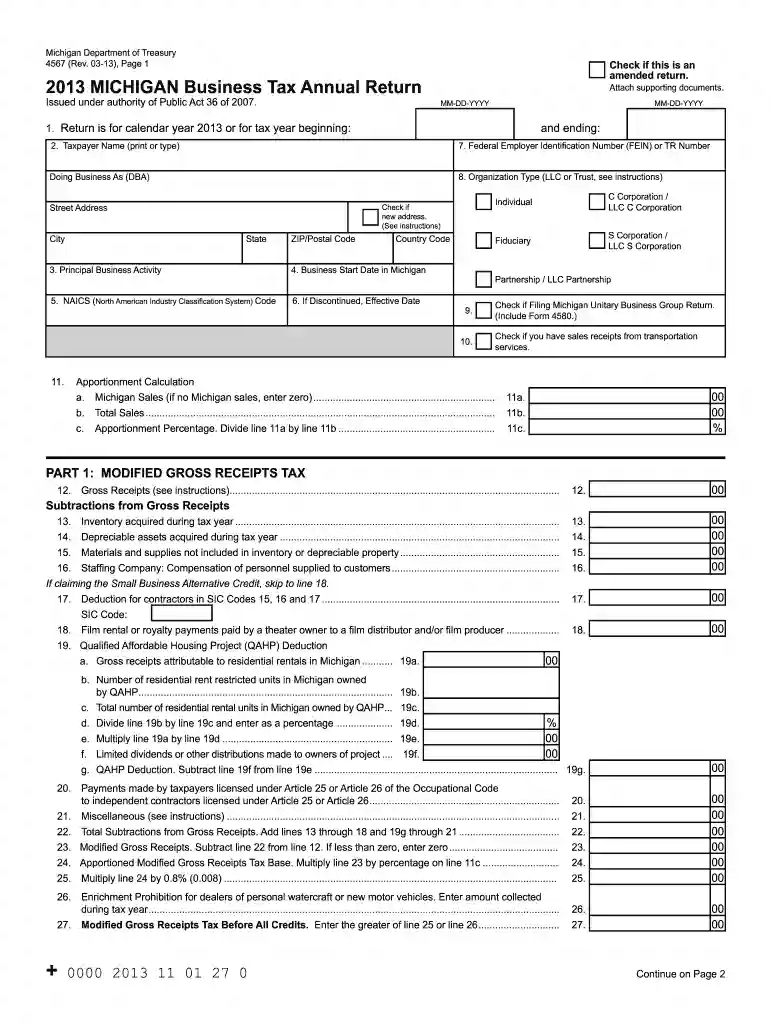
The 4567 form 2013 is a Michigan Business Tax Annual Return form that businesses use to report their Modified Gross Receipts Tax (MGRT) and Business Income Tax (BIT). The form requires businesses to provide an overview of their financial activities to determine the taxes owed. Issued under Public Act 36 of 2007, this form is crucial for businesses operating in Michigan to maintain compliance with state tax laws.
Filing the 4567 form 2013 involves several steps to ensure accurate reporting:
Businesses can obtain the 4567 form 2013 through multiple channels:
The form encompasses several crucial sections:
The 4567 form 2013 is predominantly used by:


Ensuring legal compliance is paramount when utilizing the form:
Michigan has unique requirements affecting this form:
Consider these scenarios:
Familiarize yourself with these terms:
Typically, the Michigan Department of Treasury sets a deadline of the last day of February for filing. Keeping abreast of any adjustments to this timeline is essential to maintain compliance and avoid penalties.
Optimal filing requires comprehensive documentation:
Failure to adhere to filing requirements can lead to:
These blocks have been selected and detailed to offer comprehensive guidance for understanding and using the 4567 form 2013, ensuring utmost applicability and depth for a varied audience.
We've got more versions of the 4567 form 2013 form. Select the right 4567 form 2013 version from the list and start editing it straight away!
| Versions | Form popularity | Fillable & printable |
|---|---|---|
| 2023 | 4.5 Satisfied (43 Votes) | |
| 2022 | 4.2 Satisfied (51 Votes) | |
| 2021 | 4.7 Satisfied (73 Votes) | |
| 2020 | 4.2 Satisfied (24 Votes) | |
| 2019 | 4.4 Satisfied (153 Votes) | |
| 2018 | 4.3 Satisfied (98 Votes) | |
| 2017 | 4.2 Satisfied (59 Votes) | |
| 2016 | 4 Satisfied (46 Votes) | |
| 2014 | 4.3 Satisfied (187 Votes) | |
| 2013 | 4.4 Satisfied (39 Votes) | |
| 2011 | 4 Satisfied (44 Votes) | |
| 2010 | 4 Satisfied (31 Votes) |
At DocHub, your data security is our priority. We follow HIPAA, SOC2, GDPR, and other standards, so you can work on your documents with confidence.
This form is also used to file an amended return. See page 6. Want your refund faster? See page 32 for Direct Deposit information.
Purpose: Use a 2013 Form CT-1040X to amend a previously-filed 2013 Connecticut income tax return for individuals. Visit the DRS. Taxpayer Service Center (TSC)


