




01. Edit your cdcr retired ccw online
Type text, add images, blackout confidential details, add comments, highlights and more.

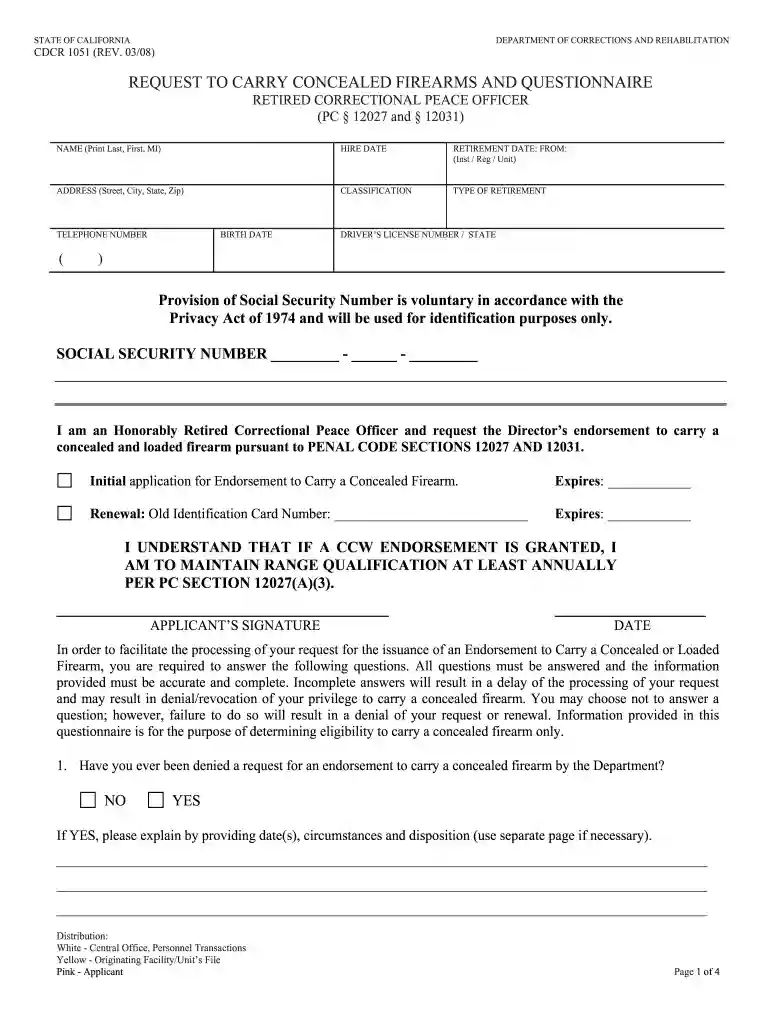
Type text, add images, blackout confidential details, add comments, highlights and more.

Draw your signature, type it, upload its image, or use your mobile device as a signature pad.

Send can correctional officers carry guns off duty in california via email, link, or fax. You can also download it, export it or print it out.
The California Department of Corrections and Rehabilitation (CDCR) firearm qualification refers to the certification process that correctional officers and certain retired personnel undergo to legally carry firearms in accordance with California law. This qualification is critical for ensuring that individuals are adequately trained and assessed on their proficiency with firearms, particularly when these officers transition from active duty to carrying concealed weapons (CCW) as retired peace officers.
Essentially, the CDCR firearm qualification evaluates an individual's ability to handle firearms safely and effectively. It is not merely a basic assessment but involves rigorous training and evaluation that covers:
This qualification supports the overarching goal of maintaining public safety and responsible firearm ownership among those with law enforcement backgrounds.
Acquiring the CDCR firearm qualification involves several key steps that detailed guidelines outline. Here’s a breakdown of the process:
Eligibility Verification: Individuals must ensure they meet certain eligibility requirements. This typically includes a background check and a review of prior firearm privileges.
Enrollment in Training: Prospective candidates must enroll in an approved training course provided by CDCR or other recognized institutions. These courses often cover critical aspects of firearm handling, safety protocols, and legal regulations.
Completion of Firearm Proficiency Course: During the training, participants complete a comprehensive course covering various shooting exercises and safety drills. This may include both live-fire exercises and theoretical assessments involving California's firearm laws.
Passing the Qualification Test: To be certified, candidates must pass a qualification test that assesses their firearm skills. This test commonly involves shooting accuracy drills, safety evaluations, and written tests on legal knowledge.
Document Submission: Once an individual has passed the qualification test, they will need to submit the proper documentation to the CDCR, including proof of training completion and the qualification results.
Final Review and Approval: The CDCR will review the submitted documents before issuing the firearm qualification, thereby allowing the individual to carry a firearm legally.
Completing the CDCR firearm qualification follows a structured process designed to ensure that all applicants can satisfactorily demonstrate their skills and knowledge. Here’s a step-by-step guide:
Gather Necessary Documentation: Before beginning the qualification process, collect all required documents, such as identification and proof of prior training or eligibility.
Research Approved Courses: Find training courses that are accepted by CDCR for firearm qualification. This may include reaching out to local training centers or checking with the CDCR’s website for a list of certified programs.
Register for the Course: Enroll in the selected training program. Ensure that the course covers all necessary components, including firearm handling, safety practices, and applicable law.
Complete the Training: Attend and participate actively in the training sessions, which will encompass classroom instruction and practical shooting exercises.
Complete Proficiency Tests: Engage in the firearm proficiency tests as outlined in the course to assess shooting accuracy and safety compliance.
Submit Qualification Documentation: After successfully passing the tests, compile all necessary documentation, including training certificates and qualification scores.
Await Approval from CDCR: Submit the documentation to the CDCR and wait for their review and approval process.
Receive Your Certification: Upon successful approval, you will receive your firearm qualification certificate, allowing you to carry firearms in compliance with California laws.
The CDCR firearm qualification serves an essential legal purpose, which enables correctional officers and retired peace officers to carry firearms legally. Understanding the legal implications associated with firearm qualification is crucial:
Eligibility to Carry Concealed Weapons: The qualification is a prerequisite for retired officers seeking a concealed carry permit. This certification attests that they are trained and competent in handling firearms.
Compliance with California Law: Individuals must also adhere to California laws governing weapon carry, including restrictions on specific types of firearms and locations where carrying is prohibited.
Protection Under the ESIGN Act: The qualification is recognized under laws that protect the rights of peace officers, allowing them to carry firearms not just on duty but also off duty within legal frameworks.
Documentation of Training: The qualification serves as an official record of training and competency, which can be essential in legal scenarios if firearm use is called into question.
Understanding these aspects ensures that individuals not only comply with regulations but also remain aware of their responsibilities when carrying firearms.
Several key elements define the structure and requirements of the CDCR firearm qualification. Understanding these elements is essential for prospective candidates:
Comprehensive Training: The qualification entails a thorough training program that covers safety, shooting proficiency, and legal knowledge.
Assessment Protocols: The qualification includes practical assessments as well as written tests to evaluate overall understanding and skills.
Background Checks: Stringent background checks are mandatory to validate that candidates uphold the necessary standards for firearm possession and usage.
Renewal and Continuing Education: The qualification may require periodic renewal, necessitating updated training and re-assessment to ensure ongoing competency.
Documentation Standards: Maintaining accurate records and documentation throughout the training and qualification process is crucial for compliance and legal recognition.
Focusing on these elements can significantly enhance an individual’s understanding of the qualification process and what is expected before attaining certification.
We've got more versions of the cdcr retired ccw form. Select the right cdcr retired ccw version from the list and start editing it straight away!
| Versions | Form popularity | Fillable & printable |
|---|---|---|
| 2008 | 4.9 Satisfied (50 Votes) |
At DocHub, your data security is our priority. We follow HIPAA, SOC2, GDPR, and other standards, so you can work on your documents with confidence.
Jun 6, 2022 (2) Qualify quarterly using the off-duty concealed firearm in the presence of a certified. Rangemaster or Firearms Instructor on a course ofRead more
Students must pass the. California Department of Corrections and Rehabilitation Correctional Officer written examination and Physical Abilities Test and aRead more
Mar 31, 2020 Healths implementing regulations, CDCR 22-C100 et seq. The program authorizes patients with a qualifying medical or dental condition to useRead more


