
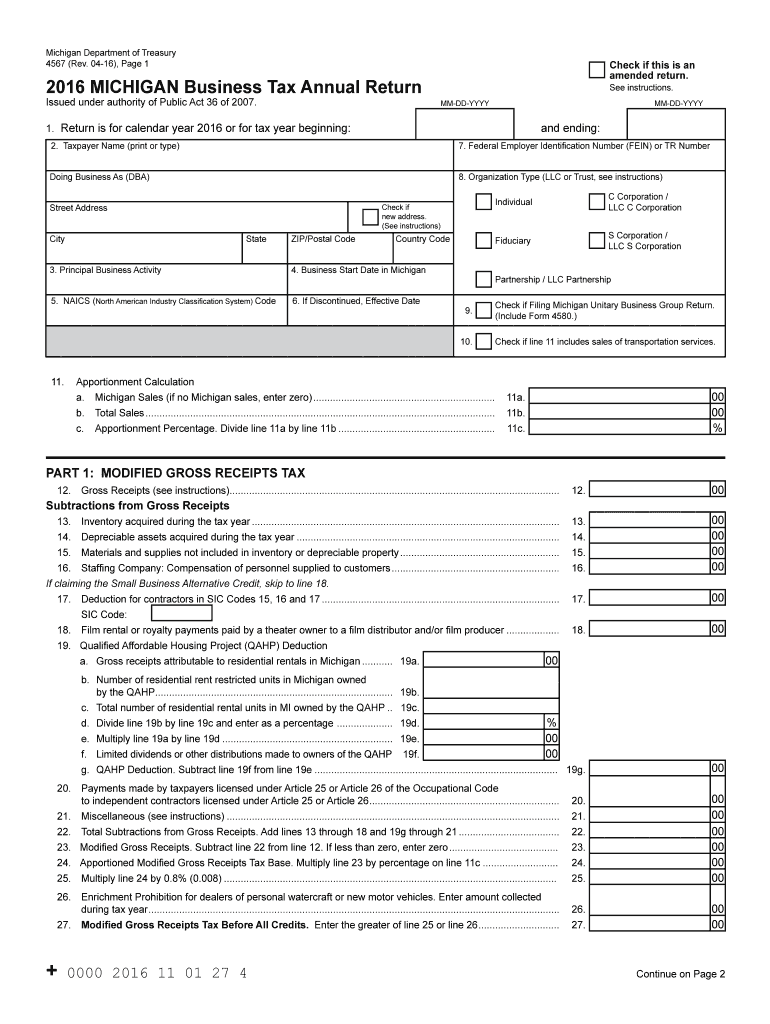







Definition & Meaning
The "Michigan 4567 Form 2016" is the official document used by businesses operating in Michigan to report their Modified Gross Receipts Tax (MGRT) and Business Income Tax (BIT) for the year 2016. This form is integral to the Michigan Business Tax (MBT) framework and assists businesses in complying with their state tax obligations. The form captures crucial financial data regarding a company's gross receipts and business income. It also outlines specific deductions, credits, and apportionment calculations required to determine the taxable income for the state.
How to Use the Michigan 4567 Form 2016
To effectively utilize the Michigan 4567 Form 2016, businesses must follow a structured process:
-
Gather Necessary Information: Compile all financial documents including income statements, balance sheets, receipts, and previous tax returns. This data forms the basis for calculating gross receipts and business income.
-
Complete Taxpayer Information: Enter the business’s name, address, and taxpayer identification number (TIN).
-
Calculate Gross Receipts: Sum up all receipts without deductions to determine the total gross receipts.
-
Business Income Calculation: Detailed instructions on the form guide the calculation from net income figures by considering adjustments and applicable credits.
-
Apportionment Calculations: If the business operates in multiple states, apportionment rules apply to determine the portion of income taxable in Michigan.
-
Review and Finalize: Ensure accuracy by reviewing each section before submitting.
Steps to Complete the Michigan 4567 Form 2016
Completing the form requires attention to detail and adherence to Michigan tax laws:
-
Section 1: Enter taxpayer identification details correctly.
-
Section 2: Report total gross receipts. Use financial records for precision.
-
Section 3: Calculate and input business income based on instructions provided.
-
Section 4: Apply any applicable credits and deductions to adjust the tax liability.
-
Section 5: For multi-state operations, complete the apportionment section to detail income allocation for Michigan taxation.
-
Section 6: Indicate tax liabilities and record any advance payments or credits applied.
-
Final Steps: Attach necessary schedules and supporting documents before submission.
Key Elements of the Michigan 4567 Form 2016
- Taxpayer Identification: Essential for verifying the business entity and corresponding tax records.
- Gross Receipts: Captures total revenue before deductions, forming the base for MGRT.
- Business Income: Adjustment of net income considering specific taxpayer circumstances.
- Apportionment: Necessary for businesses operating in multiple jurisdictions to ensure proper tax allocation.
- Deductions and Credits: Opportunities for tax reduction based on eligible activities and policies set forth by Michigan.
Who Typically Uses the Michigan 4567 Form 2016
This form is primarily used by:
- Corporations: Both domestic and foreign corporations conducting business within Michigan.
- Limited Liability Companies (LLCs): Treated as corporations for tax purposes.
- Partnerships and Similar Entities: In specific scenarios where the entity elects or qualifies to be taxed as a corporation.
- Unitary Business Groups (UBGs): Special filing guidelines exist for these entities to report combined income.


State-Specific Rules for the Michigan 4567 Form 2016
Michigan’s tax code has unique provisions that impact the completion of Form 4567. Recognize that:
- UBG Requirements: Detailed reporting of each member’s financial contribution to overall liabilities.
- Compliance with State Regulations: Adherence to Michigan’s apportionment and deductions rules is critical for accurate tax reporting.
- Documentation: Proper documentation of income adjustments and apportionment to validate tax calculations.
Filing Deadlines / Important Dates
Ensuring timely submission of the Michigan 4567 Form 2016 is crucial:
- Annual Deadline: Typically falls on the last day of the fourth month following the close of the tax year, i.e., April 30 for calendar-year filers.
- Amended Returns: Can be filed if errors are found post-submission, adhering to Michigan’s amended return guidelines.
- Penalties for Late Filing: Businesses must be aware of potential penalties and interest charges for late submissions to avoid financial repercussions.
Required Documents
When preparing the Michigan 4567 Form 2016, include:
- Financial Statements: Balance sheets and income statements for accuracy in reporting.
- Previous Tax Returns: Reference documents for understanding year-over-year adjustments.
- Supporting Schedules: Attachments that are necessary for explaining all calculations and claims made on the form.
- Receipts and Contracts: For substantiating gross receipts and business income claims.
Proper compilation and review of these documents will ensure compliance and accuracy in tax reporting for Michigan businesses.




