





Definition and Use of the 2006 California Resident Income Tax Return
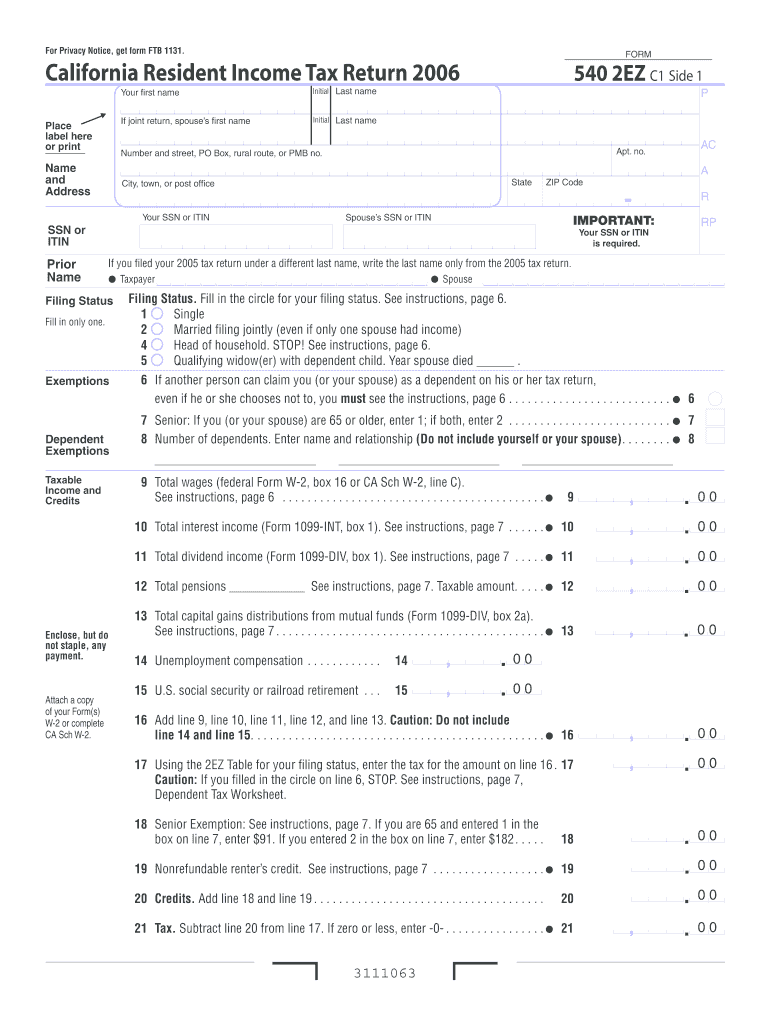
The 2006 California Resident Income Tax Return, commonly referred to as 2006 Form 540 2EZ, is a simplified tax document designed for certain California residents. It serves as an official means for residents to report their annual income and calculate their state income tax obligations. This form is specifically tailored for individuals with straightforward financial situations, typically those with income solely from wages, salaries, and interest under a specified limit. The streamlined layout makes it easier for taxpayers to complete their returns without the complexity found in more detailed tax forms.
Obtaining the 2006 California Resident Income Tax Return
To obtain the 2006 Form 540 2EZ, taxpayers could download the form directly from the California Franchise Tax Board's official website or request a paper copy from a local FTB office. While digital access provides the convenience of completing the form electronically, some residents may still prefer obtaining a paper copy for traditional filing. It was crucial for taxpayers to ensure they accessed the correct version of the form specific to the 2006 tax year, as tax laws and limits could differ significantly from year to year.
Steps to Complete the 2006 California Resident Income Tax Return
- Gather Required Information: Before starting, collect your Social Security Number (SSN), income statements such as W-2s or 1099s, and any relevant adjustment or credit documentation.
- Enter Personal Information: Begin by filling in personal details, including your name, address, and filing status.
- Report Income: Use the spaces provided to list total wages, taxable interest, and any additional income. For this form, income must typically stay within a simpler range.
- Claim Deductions and Credits: Include standard deductions and applicable tax credits designed to reduce tax liability.
- Calculate Tax: Complete the sections on taxable income and tax due, utilizing tables supplied within the instructions to find the applicable rates.
- Sign and Date: Ensure you sign and date the form before submission.
Important Considerations
- Direct Deposit Option: Complete banking information if opting for a direct deposit of any refund.
- Check for Errors: Review all entries for accuracy, as errors can delay processing or cause potential penalties.
Key Elements of the 2006 California Resident Income Tax Return
The 2006 Form 540 2EZ contains several important sections and lines that help define a taxpayer's financial obligations:
- Filing Status: Determines tax rates and standard deductions.
- Exemptions: Allows deductions for yourself and any dependents.
- Tax Computation: Based on income thresholds provided in the form, calculates the exact amount owed.
- Refund and Balance Due: Finalizes total tax obligations, offering space to request a refund or note any amount due.
Filing Deadlines and Important Dates
The standard deadline for 2006 tax returns was April 15, 2007. Taxpayers who needed more time could file for an extension, typically allowing until October 15 of the same year. It was important to notify the FTB as soon as possible if unable to meet the April deadline to avoid late fees and penalties.
Penalties for Non-Compliance
Failure to submit required tax returns or pay any due taxes by the stated deadlines could result in financial penalties, interest on the unpaid amount, and additional changes in future refunds or tax obligations.
Required Documents for Filing
When filing the 2006 California Resident Income Tax Return, it was necessary to have the following documents on hand:
- Form W-2: Showing wages and any withheld taxes.
- Form 1099: For reporting additional income, such as freelance work.
- Records of Next Payments or Deductions: Proof of deductible expenses or payments reducing taxable income.
Form Submission Methods
Taxpayers had the option to submit the 2006 Form 540 2EZ via several methods:
- Mail: Traditional mailing of a signed paper form to the California Franchise Tax Board's designated address.
- Electronic Filing (e-file): Utilizing tax software tools that support direct submission to the FTB.
- In-Person: Delivery to local FTB offices for more personalized assistance.
Taxpayer Scenarios: Who Uses the 2006 Form 540 2EZ?
The 2006 Form 540 2EZ is primarily reserved for California residents with relatively uncomplicated tax situations. This includes:
- Individuals with Single or Married Filing Jointly Status: Often without dependents.
- Retired Individuals: Those with a steady pension or Social Security income.
- Part-time Workers and Students: Various residents that meet the eligibility limits for this form.


Eligibility Criteria
Eligibility generally required the taxpayer to have a total income below a specific threshold, have no dependents, and derive income exclusively from wages, salaries, and interest income.

Digital vs. Paper Version: Advantages and Considerations
Filing digitally provided several advantages, such as faster processing times, reduced errors through automatic calculations, and immediate confirmation of form receipt. Conversely, the paper version allowed taxpayers to maintain a physical record, which some find beneficial for personal filing systems.
Software Compatibility
Tax preparation software compatible with the California tax system in 2006 included popular options like TurboTax and QuickBooks, providing electronic assistance with filing and mathematical computations.
The choice between digital and paper filing largely depended on personal preference, access to required technology, and familiarity with online tax preparation tools.