




01. Edit your form online
Type text, add images, blackout confidential details, add comments, highlights and more.

Type text, add images, blackout confidential details, add comments, highlights and more.

Draw your signature, type it, upload its image, or use your mobile device as a signature pad.

Send it via email, link, or fax. You can also download it, export it or print it out.
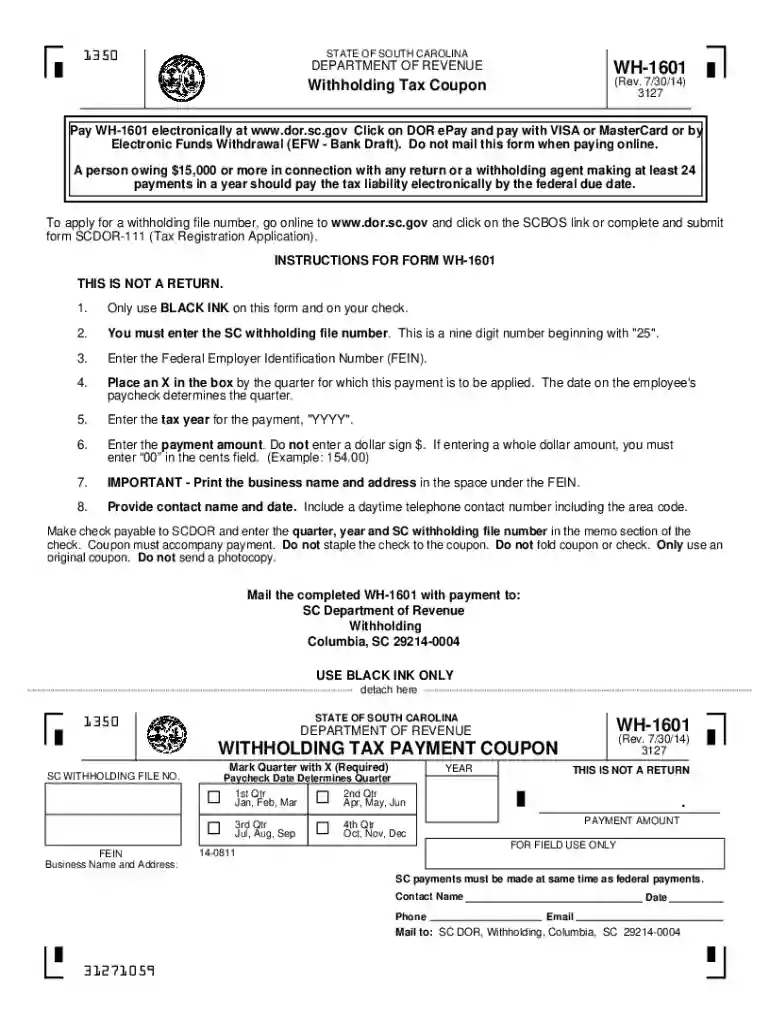
The WH-1601 SC Withholding Tax Payment form is a payment coupon provided by the South Carolina Department of Revenue. This form is utilized by employers to remit state withholding taxes electronically or via mail. It's crucial for businesses to understand that this document facilitates tax payment rather than serving as a tax return. Employers must accurately fill out information such as the SC withholding file number, the Federal Employer Identification Number (FEIN), the payment amount, and the tax quarter.
Completing the WH-1601 form involves several critical steps to ensure compliance with the South Carolina Department of Revenue's requirements:
Enter Taxpayer Identification Information:
Specify the Payment Amount:
Select Payment Method and Include Payment Quarter:
Sign and Date the Form:
Submission:
Employers can secure a copy of the WH-1601 form through several channels:
South Carolina Department of Revenue Website:
Request by Mail:
Electronic Access via Tax Software:
The WH-1601 form is primarily used by:
Businesses Operating in South Carolina:
Payroll Departments:
Tax Professionals:


When filing the WH-1601 form, ensure you have the necessary information and documentation:
Current SC Withholding File Number and FEIN:
Payment Details:
Relevant Quarter Details:
Submitting the WH-1601 form can be accomplished through various means to accommodate different business preferences:
Online:
Mail:
In-Person Delivery:
Utilizing the WH-1601 form includes adherence to several legal and compliance stipulations:
Accurate Information Provision:
Timely Submission:
State-Specific Regulations:
Failure to properly complete or timely submit the WH-1601 form can result in financial penalties and administrative issues. Understanding the implications of non-compliance ensures that businesses meet all statutory requirements and maintain good standing with revenue authorities.
We've got more versions of the WH-1601 SC Withholding Tax Payment form. Select the right WH-1601 SC Withholding Tax Payment version from the list and start editing it straight away!
| Versions | Form popularity | Fillable & printable |
|---|---|---|
| 2024 | 4.2 Satisfied (30 Votes) | |
| 2023 | 4.4 Satisfied (53 Votes) | |
| 2022 | 4.8 Satisfied (101 Votes) | |
| 2019 | 4.3 Satisfied (37 Votes) | |
| 2017 | 4.1 Satisfied (56 Votes) | |
| 2016 | 4.3 Satisfied (49 Votes) | |
| 2014 | 4.3 Satisfied (46 Votes) | |
| 2012 | 3.9 Satisfied (51 Votes) | |
| 2011 | 4.3 Satisfied (35 Votes) | |
| 2010 | 4 Satisfied (26 Votes) |
At DocHub, your data security is our priority. We follow HIPAA, SOC2, GDPR, and other standards, so you can work on your documents with confidence.
Nov 11, 1970 Calculates all payroll withholding taxes using one standard formula and a table of variable factors for federal, state and city taxes
MyDORWAY is the preferred way to securely upload W-2 and 1099 forms, register for Withholding accounts, file returns, and make payments online.
SC payments must be made at the same time as federal payments. Business name and address. Mail your WH-1601 and payment to: SCDOR, Withholding, PO Box 100161,


