01. Edit your form online
Type text, add images, blackout confidential details, add comments, highlights and more.

Type text, add images, blackout confidential details, add comments, highlights and more.

Draw your signature, type it, upload its image, or use your mobile device as a signature pad.

Send it via email, link, or fax. You can also download it, export it or print it out.
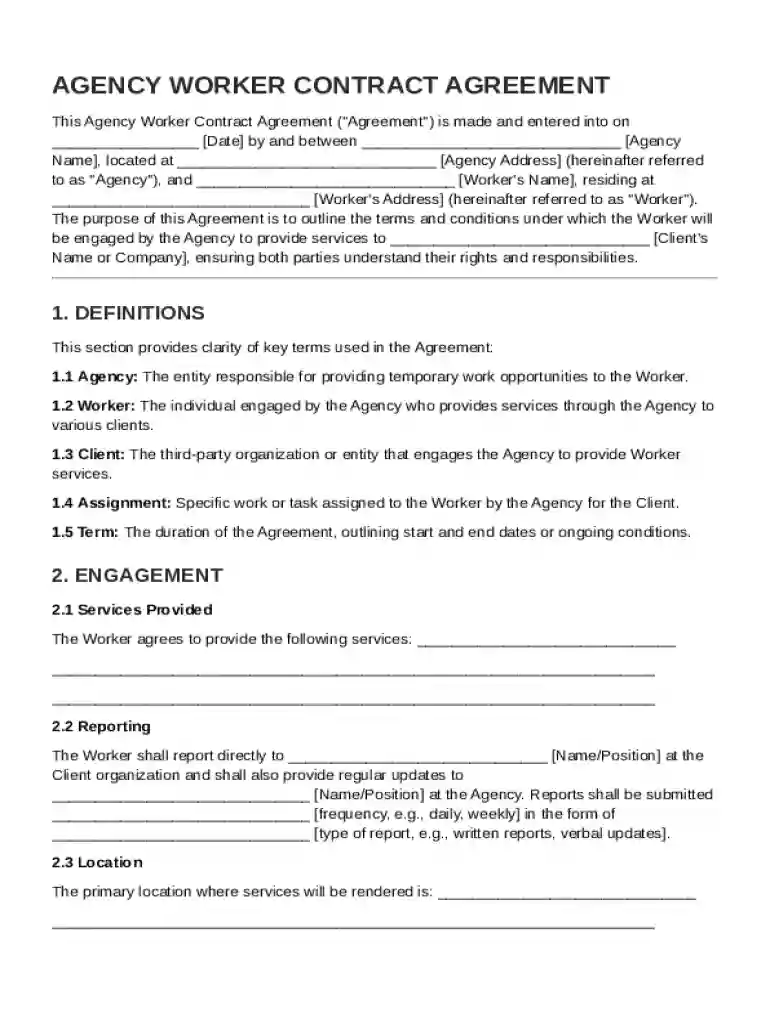
The Agency Worker Contract Template is an essential document used by hiring agencies to formalize the relationship between an agency, its worker, and the client to whom the worker provides services. This template serves as a legal agreement setting out the terms and conditions of engagement, ensuring all parties understand their rights and obligations. Essential clauses cover aspects such as compensation, confidentiality, liabilities, and the general duties of the worker. By defining key terms, the template helps prevent potential misunderstandings or disputes, providing a solid foundation for all parties involved. This template plays a crucial role in safeguarding the interests of both the worker and the agency, aligning expectations and responsibilities.
Using the Agency Worker Contract Template involves a series of straightforward steps aimed at customizing the document to fit the specific needs of the agency, worker, and client. Begin by downloading the template and opening it with a compatible document editor. Carefully read through each section, which typically includes details on job duties, compensation, and confidentiality agreements. Modify these sections to align with the particular job role and requirements of the client. Be sure to add any specific terms or conditions that are unique to the engagement. Double-check that all the information is accurate, as errors could lead to legal complications. Once completed, the contract should be reviewed by legal counsel to ensure it complies with applicable laws before being signed by all parties involved.
The Agency Worker Contract Template consists of several critical sections, each addressing different aspects of the worker's engagement.
These elements ensure that the agreement is comprehensive, addressing all areas vital to the employment arrangement and protecting the interests of all parties involved.
Legally, the Agency Worker Contract Template is crafted to comply with relevant labor laws and regulations, serving as a binding agreement once signed. It defines the working relationship, specifying the legal rights and obligations of each party, thus preventing conflicts. Furthermore, it includes provisions for legal compliance regarding employment standards, such as wage laws and anti-discrimination policies. Agencies often consult legal professionals to tailor the template according to jurisdictional requirements to minimize legal exposure. Importantly, the agreement's enforceability is contingent on the clarity and fairness of its terms, necessitating careful drafting and mutual consent.
These steps help ensure the contract is both comprehensive and legally compliant, providing a clear framework for the working relationship.
State-specific rules can significantly influence the structure and content of the Agency Worker Contract Template. Different states have unique labor laws regarding aspects like minimum wage, overtime pay, and worker rights. For example, states such as California may have more stringent regulations on employment classifications and benefits. Agencies must adapt the contract to reflect such local legal requirements to ensure compliance. Keeping abreast of state-specific changes helps in tailoring the template correctly, which is crucial to avoiding legal complications and ensuring that worker rights are respected throughout the employment period.
The Agency Worker Contract Template is widely used by staffing agencies, hiring firms, and human resource departments in various industries. Companies relying on temporary or contract workers employ this template to ensure standardized and transparent hiring practices. In sectors like healthcare, IT, and construction, where contract-based work is prevalent, the template is crucial for managing temporary workforce engagements efficiently. Additionally, freelancers and independent contractors might use this template to draft contracts when entering into agreements with agencies, ensuring that their rights and duties are clearly stated. Its versatility makes the template an indispensable tool for any organization that engages in hiring agency-referred workers.


Real-world applications of the Agency Worker Contract Template span across industries, providing structure in numerous setups. For instance, a tech startup hiring software developers on a contract basis might use this template to outline project deliverables and payment schedules. Similarly, a healthcare staffing agency could utilize it to define the terms for temporary nurses working in various hospitals. It could also be employed by construction companies hiring skilled tradespeople for specific projects. Each instance illustrates the template's flexibility in catering to diverse operational needs, ensuring both legal protection and clarity in roles and responsibilities for all parties involved.
At DocHub, your data security is our priority. We follow HIPAA, SOC2, GDPR, and other standards, so you can work on your documents with confidence.