




01. Edit your form online
Type text, add images, blackout confidential details, add comments, highlights and more.

Type text, add images, blackout confidential details, add comments, highlights and more.

Draw your signature, type it, upload its image, or use your mobile device as a signature pad.

Send it via email, link, or fax. You can also download it, export it or print it out.
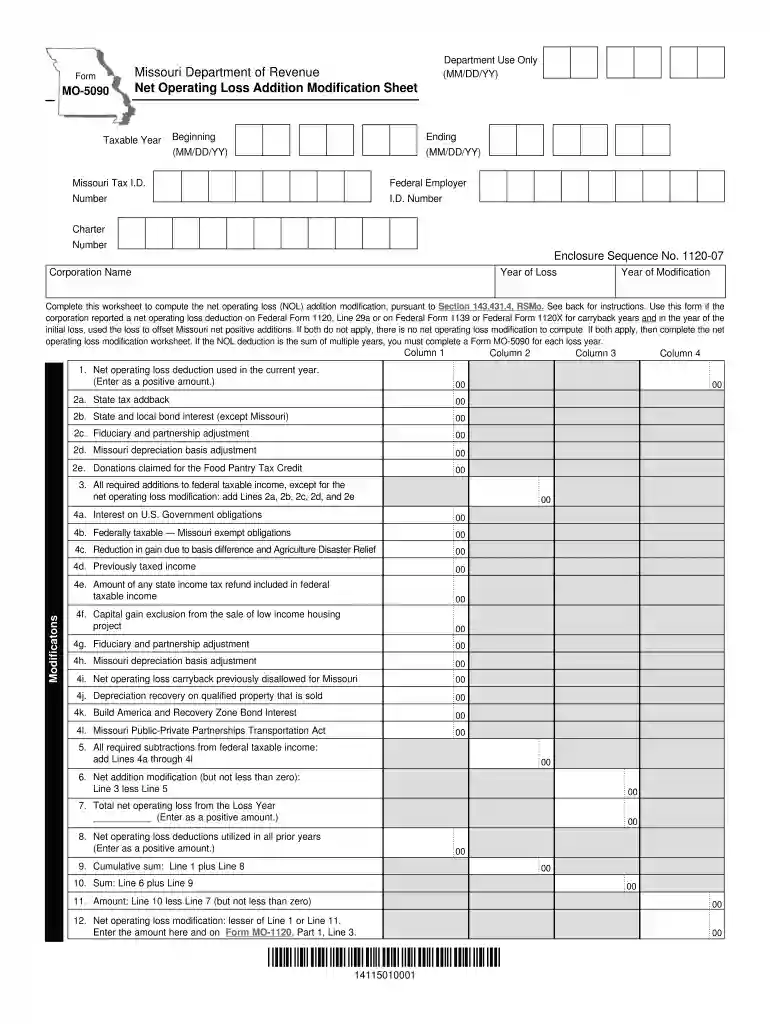
The 2017 MO MO-5090 is a specific form used by corporations in Missouri to compute the Net Operating Loss (NOL) addition modification. Corporations that have reported an NOL deduction on federal tax forms and used it to offset Missouri net positive additions must utilize this form. The form plays a crucial role in determining the appropriate tax adjustments required under Missouri state tax laws, ensuring proper compliance with state requirements for NOL adjustments.
To acquire the 2017 MO MO-5090 form, corporations can access the Missouri Department of Revenue's official website. The website offers downloadable versions of the form in PDF format, making it easy for businesses to print and fill out as needed. Alternatively, corporations may request a physical copy by contacting the Missouri Department of Revenue directly, ensuring they have all the necessary paperwork to complete their filing accurately.
Identify the NOL Deduction Year: Determine the specific years for which an NOL deduction was claimed on federal tax returns.
Calculate Missouri Adjusted Gross Income: Utilize previous state tax returns to compute the Missouri adjusted gross income relevant to the NOL modification.
Fill Out the Form: Input detailed information into the 2017 MO MO-5090 form, including any calculations for Missouri net positive additions.
Conduct Final Verification: Review all calculations for accuracy before submission, ensuring compliance with Missouri tax laws.
Submit the Form: File the completed form with the Missouri Department of Revenue, either through traditional mail or approved electronic submission methods.
The primary users of the 2017 MO MO-5090 are corporations based in Missouri that report NOL deductions on their federal tax returns. These corporations typically include:
Missouri has specific guidelines for handling NOL deductions, which are distinct from federal regulations. These rules underline the necessity for corporations to adjust their federal NOL figures to align with Missouri tax codes. Corporations must be aware of:
The submission deadline for the MO MO-5090 aligns with the corporate tax filing deadlines established by the Missouri Department of Revenue. Corporations are required to submit this form at the same time as their Missouri corporate tax returns. Penalties may apply for late submissions, emphasizing the importance of adhering to these critical dates to avoid fines.
To complete the MO MO-5090 accurately, corporations should gather the following documents:
These documents form the foundation of accurate NOL adjustment reporting, ensuring comprehensive compliance with Missouri tax laws. Each form submission should be thoroughly reviewed for completeness and accuracy before filing.
We've got more versions of the 2017 MO MO-5090 form. Select the right 2017 MO MO-5090 version from the list and start editing it straight away!
| Versions | Form popularity | Fillable & printable |
|---|---|---|
| 2025 | 4.7 Satisfied (43 Votes) | |
| 2024 | 4.8 Satisfied (29 Votes) | |
| 2023 | 4.9 Satisfied (36 Votes) | |
| 2022 | 4.1 Satisfied (22 Votes) | |
| 2021 | 4.8 Satisfied (67 Votes) | |
| 2020 | 4.2 Satisfied (43 Votes) | |
| 2019 | 4.2 Satisfied (80 Votes) | |
| 2018 | 4.4 Satisfied (205 Votes) | |
| 2017 | 4.2 Satisfied (38 Votes) | |
| 2010 | 4.2 Satisfied (62 Votes) |
At DocHub, your data security is our priority. We follow HIPAA, SOC2, GDPR, and other standards, so you can work on your documents with confidence.
Complete this worksheet to compute the net operating loss (NOL) addition modification, pursuant to Section 143.431.4, RSMo. See back for instructions.
An advanced course in predictive model applications. Students will be exposed to different models in financial economics, and datasets, to make informed
Some features are not available in certain regions. Due to product improvements, specifications and appearance are subject to change without notice.


