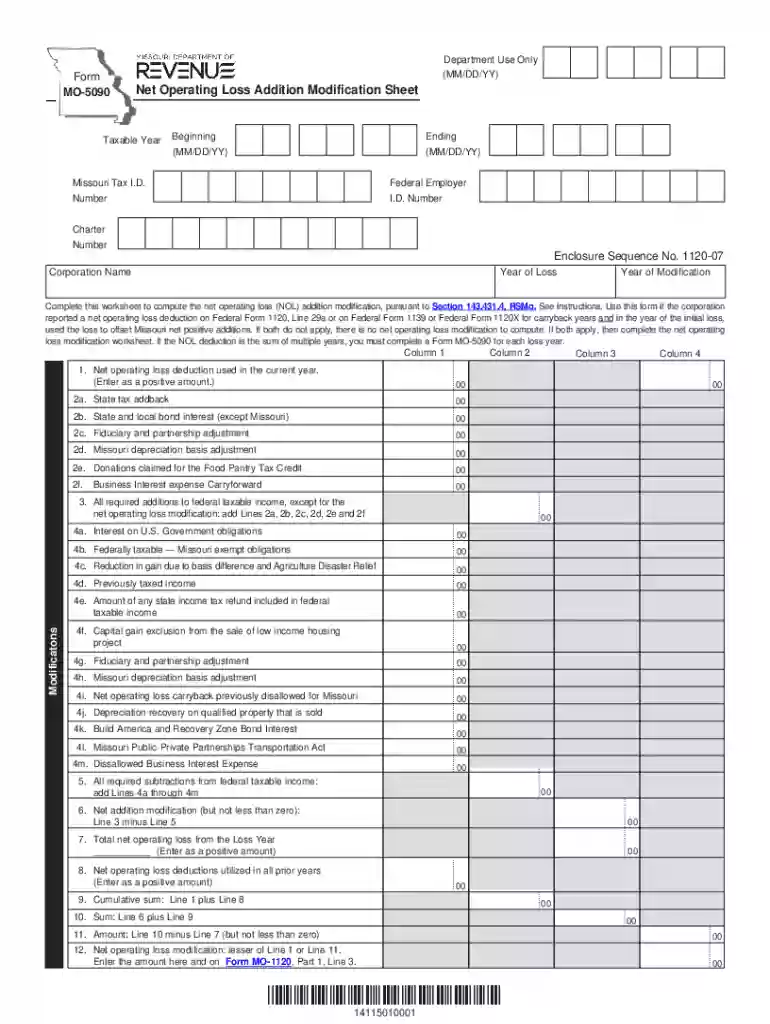
Form MO-5090 - Net Operating Loss Addition Modification Sheet - Missouri-2026

Get Form
form mo 5090 Preview on Page 1

Here's how it works

01. Edit your form mo 5090 online
Type text, add images, blackout confidential details, add comments, highlights and more.

02. Sign it in a few clicks
Draw your signature, type it, upload its image, or use your mobile device as a signature pad.

03. Share your form with others
Send mo 5090 instructions via email, link, or fax. You can also download it, export it or print it out.

Definition and Purpose of Form MO-5090

The Form MO-5090, officially known as the Net Operating Loss Addition Modification Sheet for Missouri, is a specialized tax document used by corporations within the state to account for net operating loss (NOL) deductions. This form serves an essential role in ensuring that corporations accurately report adjustments related to NOL as mandated by Missouri's tax laws, specifically under Section 143.431.4 of the Revised Statutes of Missouri (RSMo). Its primary purpose is to calculate the necessary additions or modifications to federal taxable income, ensuring compliance with state tax regulations.

How to Use the Form MO-5090

To effectively use Form MO-5090, corporations must adhere to several critical steps. It begins with collecting all relevant financial data related to NOL deductions reported on federal tax documents. Users need to follow the form's detailed instructions to fill in various financial figures, such as the required additions and subtractions to the federal taxable income. Each entry must be precise, as incorrect data can lead to inaccuracies in the final tax computation. The process involves sequentially working through each line item and adhering to the guidelines provided, ensuring that separate forms are completed for every loss year.

Steps to Complete the Form MO-5090

  1. Gather Necessary Documents: Assemble all relevant financial data, including federal tax forms showing reported NOL deductions.
  2. Complete Personal Information: Enter corporate identification details, ensuring accuracy in the company name, address, and taxpayer ID number.
  3. Report NOL Deductions: Input figures of NOL deductions previously reported on federal tax forms.
  4. Calculate Adjustments: Use the form's instructions to compute additions and subtractions to federal taxable income.
  5. Prepare Separate Forms Per Year: If multiple loss years need reporting, ensure each year has an individually completed form.
  6. Verify the Computation: Double-check all financial entries and calculations to avoid errors.
  7. Submit the Form: Once complete, submit the form through your chosen filing method, either online, by mail, or in-person.

Key Elements of the Form MO-5090

  • Corporate Information: Includes fields for corporate name and taxpayer identification.
  • NOL Deduction Details: Sections dedicated to reporting NOL as per federal submissions.
  • Addition Modification Calculations: Detailed areas for computing necessary adjustments to align with state requirements.
  • Year-Specific Reporting: Each form pertains to a single loss year, requiring separate documentation for multiple years.
  • Instructions Section: Provides step-by-step guidance for accurately entering data and performing computations.

Examples of Using the Form MO-5090

  • Corporation A's NOL Deduction: When Corporation A incurs a loss carried forward from a previous year, they must utilize Form MO-5090 to adjust their Missouri taxable income and remain compliant with state tax requirements.

  • Small Business Scenario: A small business that used federal NOL deductions to offset income should complete Form MO-5090 to adjust its state tax filings, ensuring all NOL impacts are correctly reported at the state level.

Important Terms Related to Form MO-5090

  • Net Operating Loss (NOL): A period when a company's allowable tax deductions exceed its taxable income, typically carried forward to reduce future taxable income.
  • Addition Modification: Adjustments mandated by state law to the federal taxable income to properly reflect state tax obligations.
  • RSMo Section 143.431.4: Missouri statute guiding the treatment of NOL in the state's tax computations.

Eligibility Criteria for Form MO-5090

Corporations must meet specific conditions to use Form MO-5090:

  • Presence in Missouri: Operate within Missouri state.
  • Reported Federal NOL: Have a valid NOL deduction claimed on federal tax returns.
  • Tax Compliance: Be in good standing with both federal and Missouri tax regulations.
decoration image ratings of Dochub

Business Types That Benefit Most from Form MO-5090

  • Corporations: Especially those with substantial NOLs needing adjustments for Missouri tax purposes.
  • LLCs and Partnerships: Businesses structured as LLCs or partnerships that report NOLs on federal forms may also require the MO-5090 to align state filings.
  • Multi-State Operations: Businesses operating across multiple states ensuring precise NOL treatment under varying state laws.

Legal Use of the Form MO-5090

Form MO-5090 serves as a legal tool to ensure conformity with Missouri's tax laws pertaining to NOL. Its use is crucial for any corporation seeking to substantiate adjustments made to federal taxable income for state filing purposes. Compliance with its instructions and the submission of accurate information helps prevent penalties and legal issues arising from misreporting.

Form Submission Methods

Corporations may submit the MO-5090 via:

  • Online Platforms: Utilizing secure Missouri Department of Revenue portals.
  • Mail: Sending completed forms to the specified state tax address.
  • In-Person: Delivering documents to designated Missouri tax offices. Such varied submission methods offer flexibility to ensure timely filing.

In conclusion, the Form MO-5090 plays a crucial role in state tax compliance for corporations within Missouri. By addressing the necessary computations for NOL adjustments, it ensures that businesses align with local tax regulations while accurately reflecting their financial positions.

See more Form MO-5090 - Net Operating Loss Addition Modification Sheet - Missouri versions

We've got more versions of the Form MO-5090 - Net Operating Loss Addition Modification Sheet - Missouri form. Select the right Form MO-5090 - Net Operating Loss Addition Modification Sheet - Missouri version from the list and start editing it straight away!
Versions Form popularity Fillable & printable
2023 4.9 Satisfied (36 Votes)
2022 4.1 Satisfied (22 Votes)
2021 4.8 Satisfied (67 Votes)
2020 4.2 Satisfied (43 Votes)
2019 4.2 Satisfied (80 Votes)
2018 4.4 Satisfied (205 Votes)
2017 4.2 Satisfied (38 Votes)
2010 4.2 Satisfied (62 Votes)
be ready to get more

Complete this form in 5 minutes or less

Get form

Got questions?

We have answers to the most popular questions from our customers. If you can't find an answer to your question, please contact us.
Contact us

Signing documents on a mobile device is quick, easy, and doesn’t require software installation when you have an account with DocHub. Log in from any browser, complete your empty fields with your data, and click on Sign → Create your signature. You can draw your electronic signature just as you usually do on paper, add its image to your mo 5090, or type in your name and stylize its look. No matter what option you select, your paperwork will be valid.

As a comprehensive document modifying platform, DocHub is available on mobile phones. Open DocHub in your choice of mobile internet browser and use our smart mobile-friendly toolset to fill out your mo form 5090.

Generally, an NOL arising in a tax year beginning in 2021 or later may not be carried back and instead must be carried forward indefinitely. However, farming losses arising in tax years beginning in 2021 or later may be carried back two years and carried forward indefinitely.
Because Missouri adopts federal adjusted gross income in calculating Missouri taxable income, Missouri allows a net operating loss (NOL) deduction as a carryover or carryback in the same manner as allowed for federal purposes.
NOL Carryover Provisions Maryland allows net operating loss (NOL) deduction under I.R.C. 172 to carryback for up to two years, without regard to any special federal provision allowing an election under I.R.C. 172(b)(1)(H) to carryback the NOL for up to 5 years. See Administration Release No.

Security and compliance

At DocHub, your data security is our priority. We follow HIPAA, SOC2, GDPR, and other standards, so you can work on your documents with confidence.

Learn more
ccpa2
pci-dss
gdpr-compliance
hipaa
soc-compliance
be ready to get more

Complete this form in 5 minutes or less

Get form

People also ask

Most taxpayers no longer have the option to carryback a net operating loss (NOL). For most taxpayers, NOLs arising in tax years ending after 2020 can only be carried forward. The 2-year carryback rule in effect before 2018, generally, does not apply to NOLs arising in tax years ending after December 31, 2017.
The guidelines for Missouri on a 5 Year carry back Net Operating Loss, due to the CARES ACT COVID-19 are as follows: Missouri decouples from federal, however, the amended returns for the 5 years carry back must be filed with Missouri if the NOL is carried back for 5 years on the federal return.
Maryland recognizes a federal NOL as the NOL for calculating Maryland taxable income. However, the Maryland IRC decoupling modifications could affect the amount of the NOL or the amount used in carryback and carryforward years. So, Maryland requires net operating loss addition and subtraction modifications.
For federal and Missouri purposes, a corporation can use the federal NOL incurred in one tax year to reduce the taxable income in another tax year. The NOL deduction cannot exceed the corporations taxable income (after special deductions).
Generally, an NOL arising in a tax year beginning in 2021 or later may not be carried back and instead must be carried forward indefinitely. However, farming losses arising in tax years beginning in 2021 or later may be carried back two years and carried forward indefinitely.

Related links