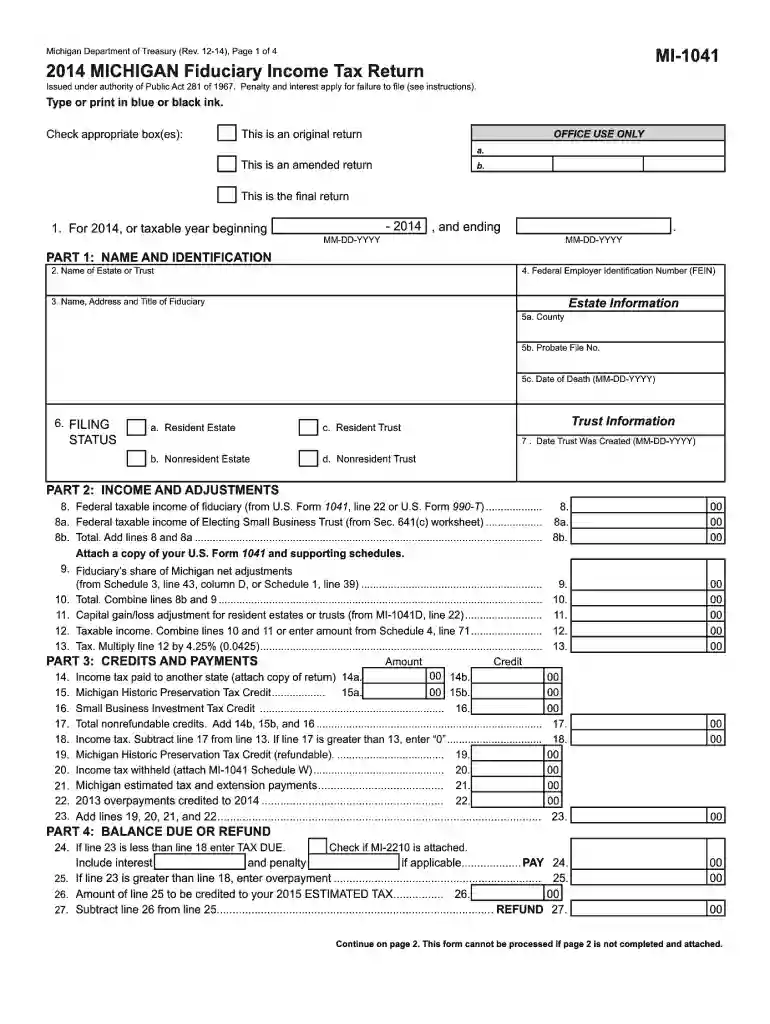
2014 mi 1041 form-2026

Get Form
2014 mi 1041 form Preview on Page 1

Here's how it works

01. Edit your form online
Type text, add images, blackout confidential details, add comments, highlights and more.

02. Sign it in a few clicks
Draw your signature, type it, upload its image, or use your mobile device as a signature pad.

03. Share your form with others
Send it via email, link, or fax. You can also download it, export it or print it out.

Definition & Purpose of the 2014 MI-1041 Form

The 2014 MI-1041 Form, also known as the Michigan Fiduciary Income Tax Return, is utilized by estates and trusts to report income, deductions, and tax liabilities to the Michigan Department of Treasury. This document serves as a structured means of ensuring that estates and trusts comply with state tax obligations. It includes comprehensive sections for different types of income, necessary adjustments, and potential credits as well as payments.

Key Objectives

  • Report Federal Taxable Income: Establishes the starting point for calculating Michigan taxable income.
  • State Adjustments: Allows for calculation of Michigan-specific modifications.
  • Credits and Payments: Summarizes any applicable credits and payments to determine final liability.

How to Obtain the 2014 MI-1041 Form

The 2014 MI-1041 Form can be accessed through several means:

  • Online Download: Available directly from the Michigan Department of Treasury's official website. Downloading forms online ensures you have the most recent and accurate versions.
  • Request by Mail: Fill out a request form on the Michigan Department of Treasury’s website to receive a paper copy by mail.
  • Physical Pickup: Obtain the form at specific governmental or tax-related offices during business hours.

Steps to Complete the 2014 MI-1041 Form

Successfully completing the form requires attention to detail and accuracy. Follow these steps for an orderly process:

  1. Gather Necessary Information: Collect all income statements, deduction records, and previous tax documents.
  2. Input Federal Taxable Income: Begin with the federal taxable income figures as the foundational element of the form.
  3. Calculate Michigan Adjustments: Use the instructions to identify relevant state adjustments and incorporate them into your calculations.
  4. Document Credits and Payments: Thoroughly detail all applicable credits and payments on the form.
  5. Review for Accuracy: Double-check all entries to mitigate errors that could lead to penalties.
  6. Sign and Date: Ensure the fiduciary or authorized representative signs it before submission.
  7. Submit by Deadline: File the completed form by the specified due date to avoid penalties.

Important Dates for Filing

Accurate filing of the MI-1041 form is crucial, with the deadline typically set for April 15 of the year following the tax year in question. In 2015, this would mean ensuring submission by April 15, 2015.

Extensions and Penalties

  • Request for Extension: If more time is needed, apply for an extension ahead of the deadline to avoid penalties.
  • Late Filing Penalties: Submissions after the deadline without an extension may incur fines and interest on the tax owed.

Who Typically Uses the 2014 MI-1041 Form

This form is specifically for estates and trusts operating within Michigan that are required to report their financial activities to the state.


decoration image ratings of Dochub

Examples of Users

  • Estates in Probate: Executors must file the MI-1041 to address income during probate.
  • Family Trusts: Trustees managing family trusts need to report income and distributions.
  • Special Needs Trusts: These trusts must adhere to state tax filing requirements using the form to report all pertinent financial information.

Key Elements of the 2014 MI-1041 Form

Understanding the core sections of the form assists in proper completion and submission:

  • Income Section: Captures total income, including dividends, interest, and potential business income.
  • Deduction Detail: Outlines allowable deductions specific to Michigan tax law, impacting taxable income.
  • Tax Computation and Liability: Provides a framework for calculating the actual tax due after adjustments and credits.
  • Payment Summary: Concludes with a reconciliation of payments made and amounts still outstanding.

Legal Use and Compliance

Using the MI-1041 form requires adherence to Michigan state tax law to ensure legality and compliance. Filing a complete and accurate form can prevent misunderstandings or legal complications.

Importance of Compliance

  • Avoid Penalties: Accurate and timely filing prevents costly penalties and legal issues.
  • Maintain Good Standing: Ensures the estate or trust remains in good standing with state authorities, safeguarding financial assets.

Software Compatibility for Filing

For those seeking technological solutions to ease the filing process, the form is compatible with various tax software.

  • TurboTax: Supports completion and submission processes.
  • QuickBooks: Assists with record-keeping and numbers preparation.
  • H&R Block Software: Provides a straightforward platform for filing state tax returns for estates and trusts.

These software options facilitate a smoother filing experience, often offering step-by-step guidance and ensuring calculations adhere to the latest tax laws and regulations.

See more 2014 mi 1041 form versions

We've got more versions of the 2014 mi 1041 form form. Select the right 2014 mi 1041 form version from the list and start editing it straight away!
Versions Form popularity Fillable & printable
2023 4.6 Satisfied (45 Votes)
2022 4.5 Satisfied (56 Votes)
2021 4.7 Satisfied (43 Votes)
2020 4.8 Satisfied (175 Votes)
2019 4.2 Satisfied (42 Votes)
2017 4.3 Satisfied (149 Votes)
2016 4.3 Satisfied (43 Votes)
2015 4.3 Satisfied (51 Votes)
2014 4.4 Satisfied (392 Votes)
1998 4.4 Satisfied (52 Votes)
be ready to get more

Complete this form in 5 minutes or less

Get form

Got questions?

We have answers to the most popular questions from our customers. If you can't find an answer to your question, please contact us.
Contact us
If youre wondering when to file 1041 Forms, you should file it each year the estate is open. As long as the estate exists, a Form 1041 should be filed. The due date for filing a 1041 falls on tax day.
Get federal tax forms for current and prior years Download them from IRS.gov. Order online and have them delivered by U.S. mail. Order by phone at 1-800-TAX-FORM (1-800-829-3676)
Executors of estates or administrators of trusts are considered fiduciaries because they hold money or other assets on behalf of a beneficiary. The Internal Revenue Service requires these fiduciaries to file Form 1041.
Income tax on income generated by assets of the estate of the deceased. If the estate generates more than $600 in annual gross income, you are required to file Form 1041, U.S. Income Tax Return for Estates and Trusts. An estate may also need to pay quarterly estimated taxes.
You can get copies of your last 7 years of tax returns.

Security and compliance

At DocHub, your data security is our priority. We follow HIPAA, SOC2, GDPR, and other standards, so you can work on your documents with confidence.

Learn more
ccpa2
pci-dss
gdpr-compliance
hipaa
soc-compliance
be ready to get more

Complete this form in 5 minutes or less

Get form

People also ask

Copies of old returns The Internal Revenue Service (IRS) can provide you with copies of your tax return from the most recent seven tax years. You can request copies by preparing Form 4506 and attaching payment of $43 for each one.
To get an exact copy of your tax return from the IRS with all schedules and attachments (e.g. W-2, 1099, 1098), youll need to complete Form 4506. Youll also need to write a $30 check or money order to United States Treasury. The IRS mailing address and request instructions are included on the form.

Related links