




01. Edit your form online
Type text, add images, blackout confidential details, add comments, highlights and more.

Type text, add images, blackout confidential details, add comments, highlights and more.

Draw your signature, type it, upload its image, or use your mobile device as a signature pad.

Send it via email, link, or fax. You can also download it, export it or print it out.
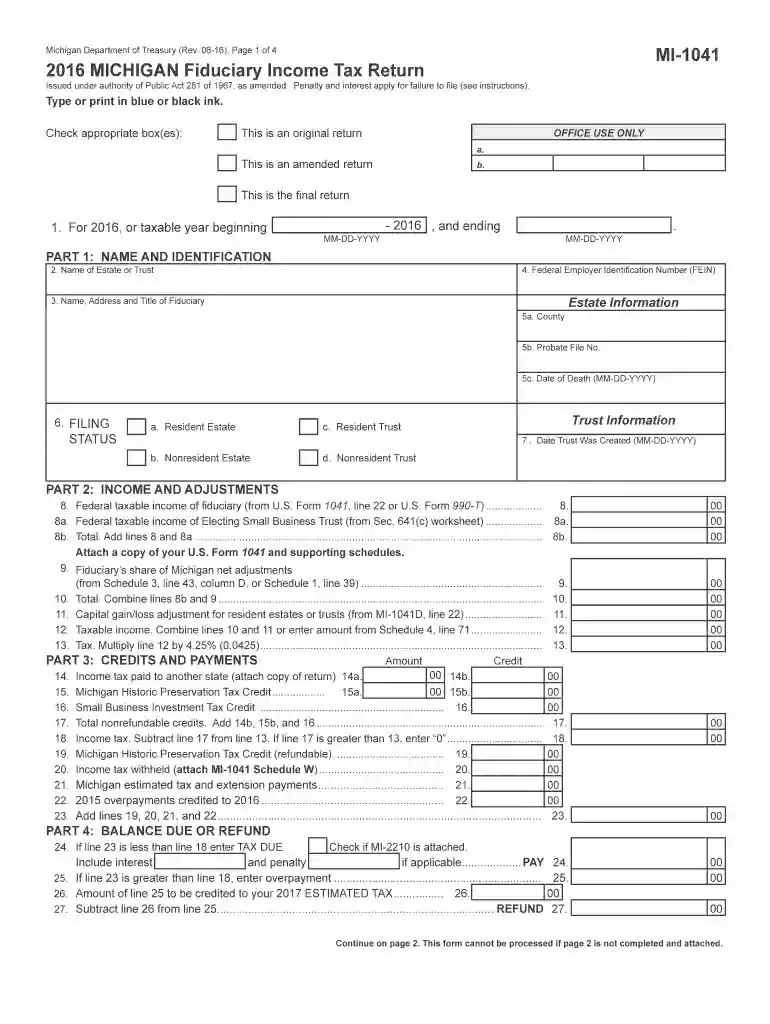
The 2016 Michigan Schedule 1 Form, known officially as the Michigan Adjustments of Income Form, is a supplementary document used by taxpayers in Michigan. This form is essential for modifying the federal adjusted gross income (AGI) to account for Michigan-specific tax laws. It helps address any income deductions and additions that are unique to the state's tax regulations, ensuring compliance with state tax requirements. Specifically, Schedule 1 allows taxpayers to reconcile any discrepancies between federal and state tax filings and is critical for accurate computation of state taxable income.
Taxpayers can easily obtain the 2016 Michigan Schedule 1 Form through multiple channels. Here are a few primary methods:
Online Access: The Michigan Department of Treasury's official website offers the form for download. Taxpayers can visit the site, navigate to the forms section, and download the Schedule 1 form directly.
Tax Preparation Software: Many digital platforms, such as TurboTax and QuickBooks, offer access to state-specific forms. Users can download and fill out the form through these software solutions during their tax preparation process.
Local Libraries or Post Offices: Traditionally, many libraries and post offices offer printed copies of tax forms, including the Schedule 1. Taxpayers can pick up a physical copy if they prefer to file a paper return.
Professional Tax Preparers: Accountants or tax professionals typically have comprehensive access to all necessary forms and can provide clients with copies of the 2016 Schedule 1 as part of their services.
Completing the 2016 Michigan Schedule 1 Form involves several meticulous steps to ensure accurate filing. Here is a detailed procedure:
Review Federal AGI: Begin by reviewing the federal adjusted gross income section on your federal tax return, as this forms the basis for state tax adjustments.
Identify Adjustments: Document any income additions or subtractions specific to Michigan, such as retirement allowances, refunds, salaries, and municipally owned utilities.
Enter the Figures: Use the form sections dedicated to additions and subtractions to input the relevant figures derived from the above adjustments.
Calculate State AGI: After making the respective adjustments, compute the Michigan AGI by following the instructions provided on the form. This adjusted figure is crucial for determining final taxable income.
Cross-Verify Entries: Ensure that all entries are accurate by cross-referencing them with documentation like your W-2 forms or other relevant tax documentation.
Submit with Tax Return: Include the completed Schedule 1 form with the Michigan income tax return to provide the state with a comprehensive picture of your taxable income.
The 2016 Michigan Schedule 1 Form is predominantly used by:


The 2016 Michigan Schedule 1 Form is comprised of crucial sections, each designed to capture different income details:
Being aware of key filing deadlines is crucial for taxpayers:
Proper preparation involves gathering specific documents:
Non-compliance with Michigan's filing requirements incurs several consequences:
By understanding the crucial aspects of the 2016 Michigan Schedule 1 Form, taxpayers can ensure proper compliance and accurate reporting in alignment with Michigan tax laws.
We've got more versions of the 2016 michigan schedule 1 form form. Select the right 2016 michigan schedule 1 form version from the list and start editing it straight away!
| Versions | Form popularity | Fillable & printable |
|---|---|---|
| 2025 | 4.3 Satisfied (20 Votes) | |
| 2024 | 4.6 Satisfied (55 Votes) | |
| 2023 | 4.6 Satisfied (45 Votes) | |
| 2022 | 4.5 Satisfied (56 Votes) | |
| 2021 | 4.7 Satisfied (43 Votes) | |
| 2020 | 4.8 Satisfied (175 Votes) | |
| 2019 | 4.2 Satisfied (42 Votes) | |
| 2017 | 4.3 Satisfied (149 Votes) | |
| 2016 | 4.3 Satisfied (43 Votes) | |
| 2015 | 4.3 Satisfied (51 Votes) | |
| 2014 | 4.4 Satisfied (392 Votes) | |
| 1998 | 4.4 Satisfied (52 Votes) |
At DocHub, your data security is our priority. We follow HIPAA, SOC2, GDPR, and other standards, so you can work on your documents with confidence.
Apr 15, 2020 If you are amending for tax year 2016 or prior, you must use Form MI-1040X-12. must be reported on the Michigan Pension Schedule. (Form 4884)
I-539, Application to Extend/Change Nonimmigrant Status. If you need to file a Form I-539 application, refer to information and instructions on our Form I


