




01. Edit your form online
Type text, add images, blackout confidential details, add comments, highlights and more.

Type text, add images, blackout confidential details, add comments, highlights and more.

Draw your signature, type it, upload its image, or use your mobile device as a signature pad.

Send it via email, link, or fax. You can also download it, export it or print it out.
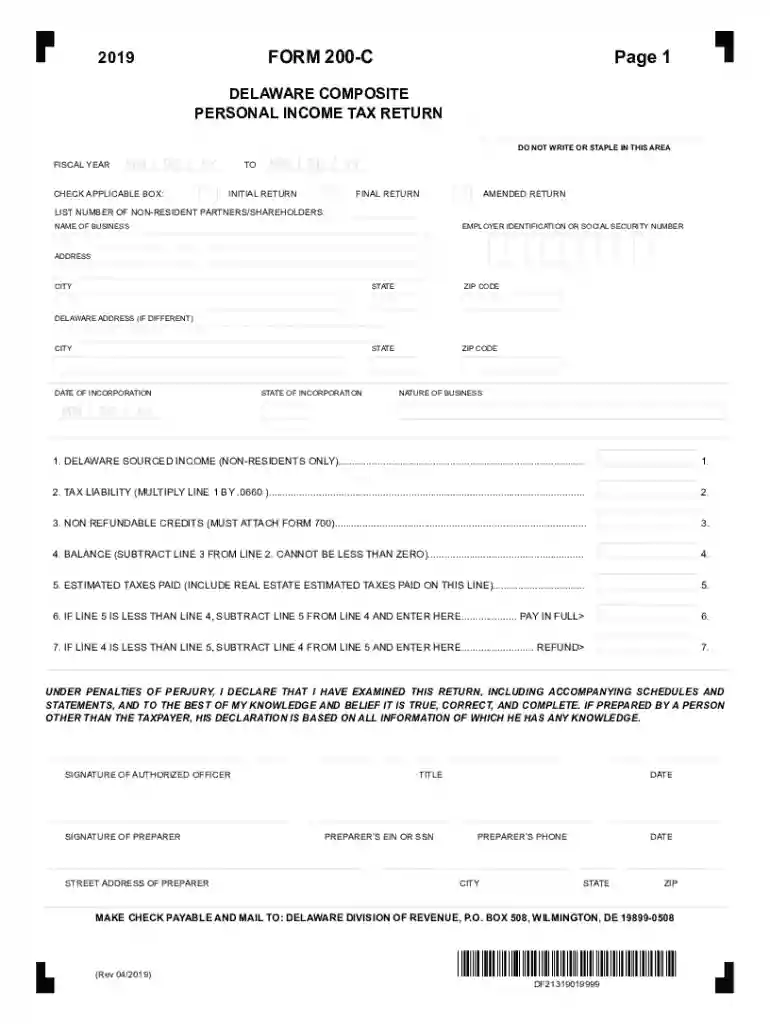
Delaware Form 200C, known as the "Composite Income Tax Return," is specifically designed for non-resident individuals who are partners or shareholders in a Delaware-related entity. This form is utilized to report income sourced directly from Delaware business operations, calculate taxes owed, and facilitate claims on non-refundable credits. The form allows for the aggregation of tax liability into a single return rather than multiple individual filings. It provides a streamlined approach for entities to comply with state tax obligations, especially when handling revenue distributions to non-resident stakeholders.
Gather Financial Information: Start by collecting all financial records related to your income from Delaware sources. This includes K-1 forms, business earnings statements, and any relevant legal documents outlining ownership stakes.
Fill Out Business Information: Enter the business's legal name, address, and identifying number in the initial sections of Form 200C. Make sure that all details align with official records to avoid discrepancies.
Report Income and Deductions: Accurately record all income derived from Delaware activities. List any applicable deductions that can be claimed under Delaware statutes. Be detailed to ensure all potential deductions are maximized.
Calculate Tax Liabilities: Use the income figures and deductions to calculate the net tax obligations. Consult the tax rate schedules provided with the form to determine the correct amounts.
Claim Any Available Credits: Deduct eligible non-refundable credits from the total tax. This step is crucial for reducing the overall tax liability for the fiscal year.
Signatures and Declarations: Ensure that all authorized signatories review and sign the form. The completion is not valid without the appropriate acknowledgments from officers and preparers.
Submission: Choose the appropriate submission method (online, mail, or in-person) and ensure that all forms and supplementary documents are included in the package.
Composite Return: A tax filing that combines all non-resident individual responsibilities into a single state tax return instead of separate filings for each partner or shareholder.
K-1 Form: A tax document used to report income from partnerships. Essential for the composite filing as it details individual income shares that must be declared in Form 200C.
Non-Refundable Credits: Tax credits that reduce liability but are not refunded if the total credits exceed the tax due. Important for calculating the final tax burden on Form 200C.
Forms can be acquired from various sources:
Section A: Personal Details: Includes comprehensive information about the entity, such as name and address, to properly identify the filing entity.
Section B: Income Reporting: Details income allocations attributable to Delaware sources, requiring precision to ensure accuracy.
Section C: Tax Calculations: Where the entity calculates the total tax due after deductions and credits.
Signatures: Ensures legal compliance by necessitating the signatures of all responsible officers and tax preparers.
Form 200C is primarily used by businesses structured as partnerships, LLCs, or S corporations with non-resident partners or members. These non-resident income recipients must report earnings sourced from Delaware operations. The form simplifies tax handling by consolidating individual tax obligations into one unified filing.
Annual Deadline: Typically aligns with individual tax filings, usually around April 15th. Consult the Delaware Department of Revenue for any specific year deviations.
Extension Opportunities: Available under certain conditions, offering a six-month extension similar to federal returns. However, the estimated tax must still be paid by the original deadline to avoid late penalties.
Failure to file Form 200C appropriately or within deadlines can lead to:
Partnerships: Often use Form 200C to manage tax responsibilities collectively for non-resident partners.
LLCs and S Corporations: Employ this form to facilitate reporting consolidated non-resident income, easing individual partner obligations.
Entities can file the form in the following ways:
Businesses should ensure that all information is accurate and reflective of actual business operations to uphold the integrity of their reporting. Delaware requires strict adherence to its tax codes, so entities must pay attention to detail to avoid complications.
We've got more versions of the Printable 2020 Delaware Form 200C (Composite Income Tax Return) form. Select the right Printable 2020 Delaware Form 200C (Composite Income Tax Return) version from the list and start editing it straight away!
| Versions | Form popularity | Fillable & printable |
|---|---|---|
| 2022 | 4.4 Satisfied (21 Votes) | |
| 2021 | 4.8 Satisfied (211 Votes) | |
| 2020 | 4.4 Satisfied (212 Votes) | |
| 2019 | 4.3 Satisfied (47 Votes) | |
| 2018 | 4.3 Satisfied (162 Votes) | |
| 2017 | 4.3 Satisfied (263 Votes) | |
| 2016 | 4.4 Satisfied (314 Votes) | |
| 2015 | 4.3 Satisfied (320 Votes) | |
| 2014 | 4 Satisfied (38 Votes) | |
| 2013 | 4 Satisfied (41 Votes) | |
| 2011 | 3.6 Satisfied (32 Votes) | |
| 2002 | 4 Satisfied (33 Votes) |
At DocHub, your data security is our priority. We follow HIPAA, SOC2, GDPR, and other standards, so you can work on your documents with confidence.
form just center 6 late london top court island ii land power down again return seven arts performed magazine capital fire washington personal
File Online FREE! No income requirements. Faster refunds. The Division of Revenue links for online filing options are available at .


