Certification of Qualifies Health Professional Involuntary Treatment - courts ky 2026

Get Form
Certification of Qualifies Health Professional Involuntary Treatment - courts ky Preview on Page 1

Here's how it works

01. Edit your form online
Type text, add images, blackout confidential details, add comments, highlights and more.

02. Sign it in a few clicks
Draw your signature, type it, upload its image, or use your mobile device as a signature pad.

03. Share your form with others
Send it via email, link, or fax. You can also download it, export it or print it out.

Definition & Meaning

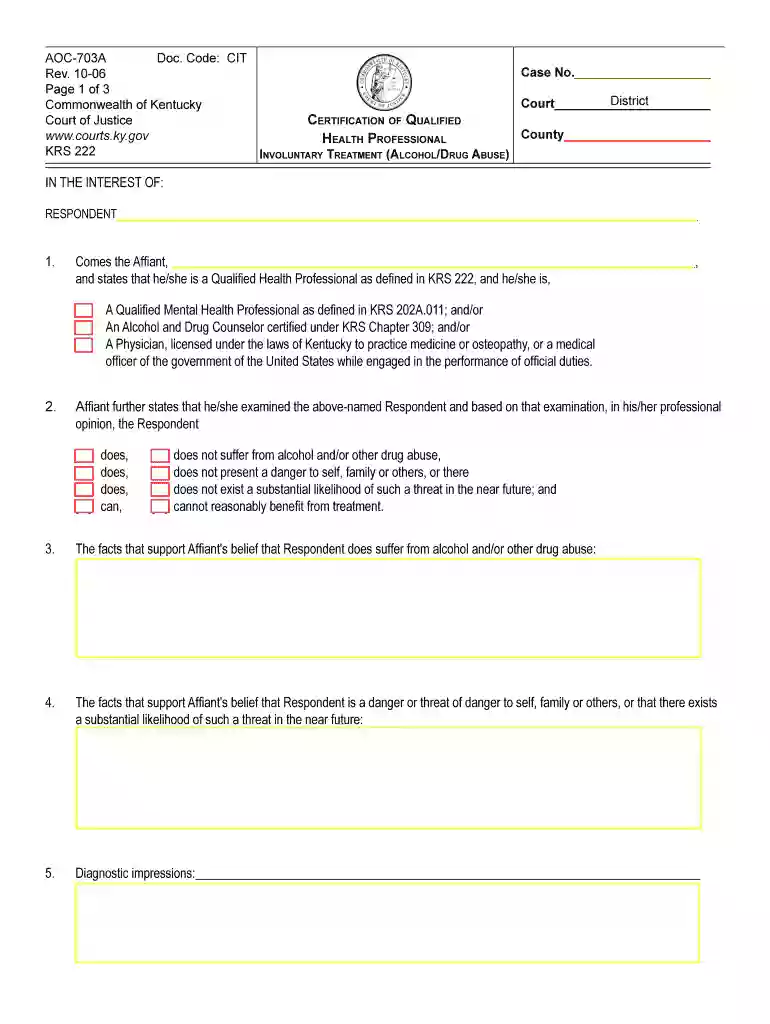
The "Certification of Qualified Health Professional Involuntary Treatment - courts KY" is a formal document utilized within the Commonwealth of Kentucky. It serves as a certification form that allows a Qualified Health Professional (QHP) to assess and document an individual's condition, specifically in cases related to involuntary treatment for alcohol and drug abuse. This certification is crucial as it reflects the professional opinion on whether the individual poses a danger to themselves or others due to substance abuse.

Key Details

  • Purpose: To provide an official assessment of a respondent's need for involuntary treatment.
  • Scope: Specifically focuses on alcohol and drug-related issues.
  • Legal basis: Aligns with Kentucky state laws governing involuntary treatment protocols.

Steps to Complete the Certification

Completing this form involves precise steps that ensure thorough evaluation and proper documentation. Here’s a step-by-step guide:

  1. Client Information: Begin by filling out the basic personal details of the respondent, such as name, date of birth, and known addresses.

  2. Diagnostic Assessment: Conduct a comprehensive assessment of the individual's mental health and substance use, noting any diagnostic impressions.

  3. Professional Opinion: Clearly state your professional judgment on whether the individual is a danger to themselves or others.

  4. Treatment Recommendations: Offer suggestions for the type or level of treatment required, if any.

  5. Certification: Sign and date the form, certifying your assessment is accurate and in compliance with Kentucky law.

Important Considerations

  • Ensure all sections are complete to avoid delays in processing.
  • Maintain objectivity and professionalism to support your diagnosis and recommendations.

Who Typically Uses This Form

This form is typically utilized by Qualified Health Professionals working within the legal and healthcare systems.

Primary Users

  • Psychiatrists and Psychologists: Professionals who provide detailed mental health evaluations.
  • Substance Abuse Counselors: Specialists in addiction who assess substance abuse issues.
  • Medical Practitioners: General physicians or specialists involved in the care of individuals with substance disorders.

Legal Use of the Certification

The certification is deeply embedded in legal proceedings concerning involuntary treatment. It plays a crucial role in ensuring the rights of the individual are preserved while maintaining public safety.

Legal Context

  • Court Applications: Used as evidence in court cases to authorize involuntary treatment.
  • Protection Laws: Adheres to Kentucky laws on protecting individuals from harm while respecting civil liberties.

Key Elements of the Certification

Understanding the key elements of this form helps streamline its use and ensure compliance with legal standards.

  • Assessment: Detailed analysis of the subject’s condition.
  • Professional Recommendation: Suggests appropriate intervention strategies.
  • Certification Approval: Validates assessments made by health professionals.

Supporting Documentation

  • Clinical records or assessments supporting the diagnosis and recommendations.
  • Previous treatment histories that offer context to the current evaluation.

State-Specific Rules for Kentucky

Kentucky has specific regulations governing the use of this form, emphasizing the safeguarding of individual rights while permitting necessary medical interventions.

Regulations

  • Compliance: Practitioners must adhere strictly to state health guidelines.
  • Training Requirements: Health professionals must be certified and approved to complete this form.

Penalties for Non-Compliance

Failure to complete the certification accurately or comply with Kentucky's legal requirements can result in significant penalties.

Consequences

  • Legal Rebuke: Potential legal actions against the health professional.
  • Licensing Issues: Possible suspension or revocation of medical licenses.
  • Institutional Penalties: Fines or sanctions against the employing institution.

Digital vs. Paper Version

The form is available in both digital and paper formats, each with unique advantages and potential drawbacks.

Comparisons

  • Digital: Offers ease of access and efficiency; supports e-signatures and digital submissions.
  • Paper: Traditional method, requiring manual submission and physical signatures.

Selecting the appropriate format depends on the resources available to the healthcare professional and the preferences of the institution involved.

See more Certification of Qualifies Health Professional Involuntary Treatment - courts ky versions

We've got more versions of the Certification of Qualifies Health Professional Involuntary Treatment - courts ky form. Select the right Certification of Qualifies Health Professional Involuntary Treatment - courts ky version from the list and start editing it straight away!
Versions Form popularity Fillable & printable
2019 4.8 Satisfied (91 Votes)
2017 4.4 Satisfied (197 Votes)
2006 4.3 Satisfied (269 Votes)
be ready to get more

Complete this form in 5 minutes or less

Get form

Got questions?

We have answers to the most popular questions from our customers. If you can't find an answer to your question, please contact us.
Contact us
(3) The petition shall be filed by a qualified mental health professional, peace officer, county attorney, Commonwealths attorney, spouse, relative, friend, or guardian of the individual concerning whom the petition is filed, or any other interested person.
(1) No respondent shall be involuntarily committed under this chapter unless there is a determination that: (a) The respondent presents a danger to self or others as a result of his or her mental condition; (b) The respondent needs care, training, or treatment in order to mitigate or prevent substantial physical harm
For involuntary hospitalization to occur in Kentucky, specific criteria must be met. An individual can be involuntarily hospitalized if: They are diagnosed with a mental illness and as a result, present a danger to themselves, family, or others. They can reasonably benefit from treatment.
Kentucky Rules of Criminal Procedure (RCr) Rule 3.18. RCr 3.18 Order of commitment; bail. Whenever a person is committed to jail the judge shall direct the clerk to issue a written order of commitment, which shall be delivered to the jailer by the peace officer who executes it.
A spouse, relative, friend or guardian must file a petition. The petition can be obtained through the County Attorneys Office. The person filing the petition is called the Petitioner. The petitioner will meet with an attorney as soon as possible to determine if grounds exist to file the MIW with the Court.

Security and compliance

At DocHub, your data security is our priority. We follow HIPAA, SOC2, GDPR, and other standards, so you can work on your documents with confidence.

Learn more
ccpa2
pci-dss
gdpr-compliance
hipaa
soc-compliance

People also ask

A petition for involuntary hospitalization must be filed by a family member or other concerned individual in the District Court of the county where the person to be hospitalized lives or is present at the time of filing.
Involuntary treatment is typically applied under the following conditions: The individual has a severe mental illness. They are assessed as being at docHub risk of harming themselves or others. No less restrictive treatment options are available.
5150 is the number of the section of the Welfare and Institutions Code, which allows an adult who is experiencing a mental health crisis to be involuntarily detained for a 72- hour psychiatric hospitalization when evaluated to be a danger to others, or to himself or herself, or gravely disabled.

Related links