




01. Edit your form online
Type text, add images, blackout confidential details, add comments, highlights and more.

Type text, add images, blackout confidential details, add comments, highlights and more.

Draw your signature, type it, upload its image, or use your mobile device as a signature pad.

Send it via email, link, or fax. You can also download it, export it or print it out.
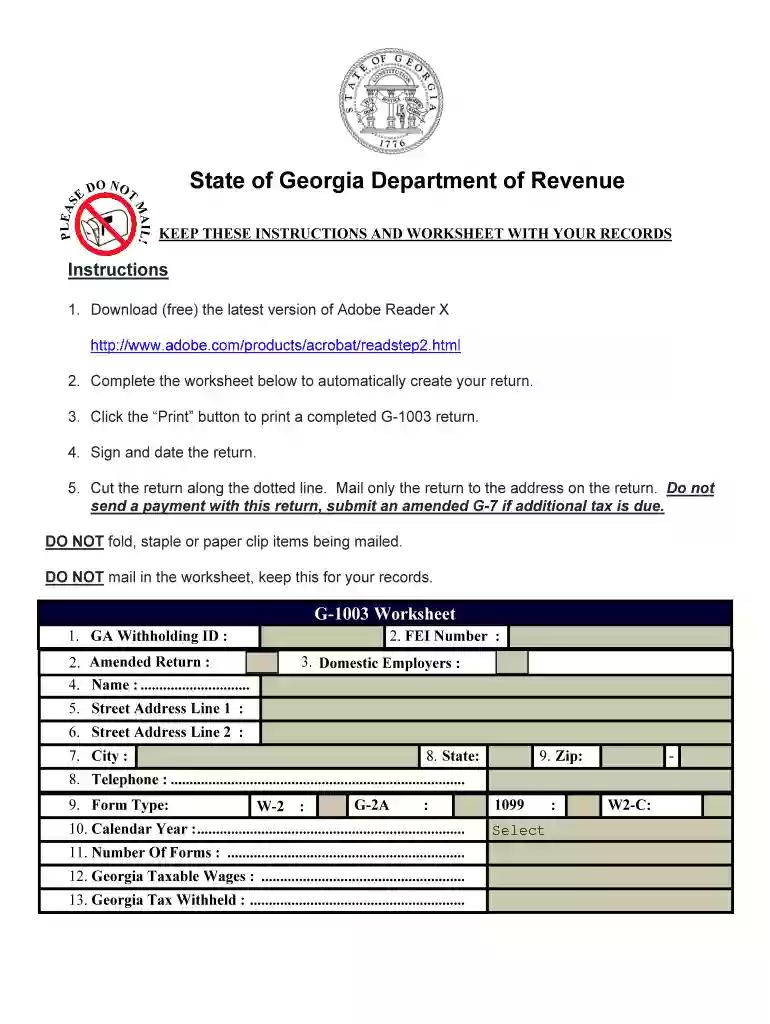
The Georgia Department of Revenue Form G-1003 is primarily used for transmitting state withholding information. It is an essential tool for employers in Georgia who need to report income statements such as W-2s and other tax-related forms to the state revenue department. This form ensures that the Department of Revenue has accurate data on the taxes withheld by employers from employee wages. Understanding the purpose and scope of the G-1003 form is critical for compliance with Georgia state tax laws.
To use Form G-1003 effectively, employers in Georgia must collect and compile data from various income statements issued to employees, such as W-2s and 1099s. The form facilitates the aggregation of these data points into a simplified report that demonstrates the total state income tax withheld. Users must complete the form accurately by following the detailed instructions provided by the Georgia Department of Revenue to ensure compliance. Notably, electronic submission is generally preferred for its efficiency and ease of processing.
Employers must ensure they have the following documents when preparing Form G-1003:
For employers in Georgia, the filing deadline for the Form G-1003, alongside accompanying W-2 forms, is typically January 31st of the year following the tax year in question. Meeting this deadline is crucial as it ensures timely processing and avoids penalties. Employers must stay informed of any updates to the filing process or deadlines issued by the Georgia Department of Revenue to maintain compliance.
Failure to file the G-1003 form timely and accurately can result in significant penalties. Late submissions incur fines that increase the longer the delay persists. Incorrect or incomplete submissions may also yield financial penalties. To avoid these consequences, employers should prioritize accuracy in their reporting processes and ensure submissions well before any stipulated deadlines.
The Georgia Department of Revenue accommodates both electronic and paper submissions of the G-1003 form. However, electronic submission is favored for its speed and efficiency, particularly for employers submitting numerous income statements. Electronic filings are completed through the Georgia Tax Center, where users can log in, upload required documents, and verify submissions in real time. Paper submissions are also accepted, but they may experience longer processing times.
Various business entities, including corporations, limited liability companies (LLCs), partnerships, and sole proprietorships, may be required to complete and submit Form G-1003 if they withhold state income taxes from wages paid to employees. Each entity must adhere to the state's tax regulations, submitting the form and accompanying income statements to ensure accurate and compliant tax reporting. Business owners should verify their specific filing obligations based on their business model and employee count to align with state requirements.
We've got more versions of the ga dept of revenue form g 1003 form. Select the right ga dept of revenue form g 1003 version from the list and start editing it straight away!
| Versions | Form popularity | Fillable & printable |
|---|---|---|
| 2025 | 4.5 Satisfied (46 Votes) | |
| 2024 | 4.9 Satisfied (24 Votes) | |
| 2023 | 4.7 Satisfied (44 Votes) | |
| 2022 | 4.9 Satisfied (27 Votes) | |
| 2021 | 4.7 Satisfied (69 Votes) | |
| 2020 | 4.8 Satisfied (126 Votes) | |
| 2018 | 4.3 Satisfied (115 Votes) | |
| 2016 | 4.3 Satisfied (114 Votes) | |
| 2015 | 4 Satisfied (59 Votes) | |
| 2012 | 4.2 Satisfied (105 Votes) | |
| 2011 | 3.8 Satisfied (37 Votes) | |
| 2006 | 4 Satisfied (63 Votes) |
At DocHub, your data security is our priority. We follow HIPAA, SOC2, GDPR, and other standards, so you can work on your documents with confidence.
On this page find information for filing/paying the G-1003 Income Statement. All taxpayers are encouraged to file and pay electronically online through theRead more
The Form G-1003 return must accompany the withholding tax statements. The Department may require a different G-1003 return for different types of withholding


