




01. Edit your form online
Type text, add images, blackout confidential details, add comments, highlights and more.

Type text, add images, blackout confidential details, add comments, highlights and more.

Draw your signature, type it, upload its image, or use your mobile device as a signature pad.

Send it via email, link, or fax. You can also download it, export it or print it out.
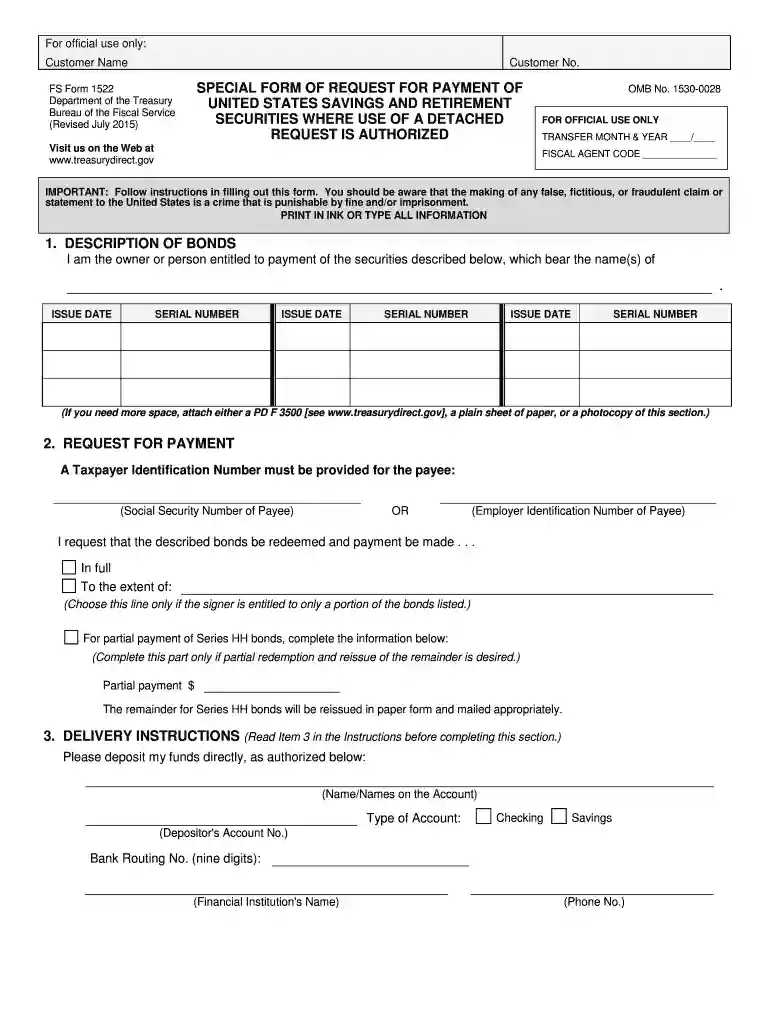
The SPECIAL FORM OF REQUEST FOR PAYMENT OF UNITED, often referred to by its abbreviated form or FS Form 1522, is a document issued by the Department of the Treasury. This form is critical for individuals or entities requesting payment from United States Savings and Retirement Securities held through TreasuryDirect. The form serves multiple purposes, including detailing the required information for processing payments, such as bond descriptions, payment requests, delivery instructions, and certification by a financial officer. Understanding its purpose and accurate completion is essential for legal compliance and ensuring timely payment processing.
To use the SPECIAL FORM OF REQUEST FOR PAYMENT OF UNITED, certain eligibility criteria must be met. Eligibility is generally defined by the ownership or entitlement to United States Savings and Retirement Securities. Owners of these securities, as well as legal representatives such as executors of estates or custodians, may need to complete this form when seeking payment. It's vital for applicants to meet the eligibility requirements as set forth by the Department of the Treasury to prevent processing delays or rejections.


Obtaining the form is a straightforward process, primarily through TreasuryDirect's online portal or by contacting a financial institution that handles Treasury securities. The form may also be available through the official Treasury website or by direct request via mail.
Completing the SPECIAL FORM OF REQUEST involves several key steps to ensure all necessary information is accurately provided. The process involves gathering information, correctly filling in the bond details, and certifying the application.
Several critical elements are integral to the process of completing the SPECIAL FORM OF REQUEST FOR PAYMENT OF UNITED. These components ensure the form is processed effectively and efficiently.
Using the SPECIAL FORM OF REQUEST FOR PAYMENT OF UNITED involves adherence to precise legal regulations, as stipulated by the Department of the Treasury. This legal framework is intended to safeguard the transaction and ensure compliance with U.S. law.
Failure to adhere to the requirements or submit accurate information on the SPECIAL FORM OF REQUEST may result in penalties. Comprehending the potential repercussions of non-compliance is imperative.
To supplement the form, certain documents are necessary to provide backup for the claims and requests made within the form.
Practical examples aid in understanding typical scenarios where an individual or entity might utilize the SPECIAL FORM OF REQUEST FOR PAYMENT OF UNITED.
Opting between digital and paper submissions of the form depends on user preference and circumstance. Understanding the pros and cons of each can inform this choice.
Each block explained above focuses on effectively guiding users through the necessary details and processes associated with the SPECIAL FORM OF REQUEST FOR PAYMENT OF UNITED - treasurydirect. The comprehensive coverage aims to provide clarity and ease of understanding for those engaging with this essential financial document.
We've got more versions of the SPECIAL FORM OF REQUEST FOR PAYMENT OF UNITED - treasurydirect form. Select the right SPECIAL FORM OF REQUEST FOR PAYMENT OF UNITED - treasurydirect version from the list and start editing it straight away!
At DocHub, your data security is our priority. We follow HIPAA, SOC2, GDPR, and other standards, so you can work on your documents with confidence.


