




01. Edit your l33 formular online
Type text, add images, blackout confidential details, add comments, highlights and more.

Type text, add images, blackout confidential details, add comments, highlights and more.

Draw your signature, type it, upload its image, or use your mobile device as a signature pad.

Send it via email, link, or fax. You can also download it, export it or print it out.
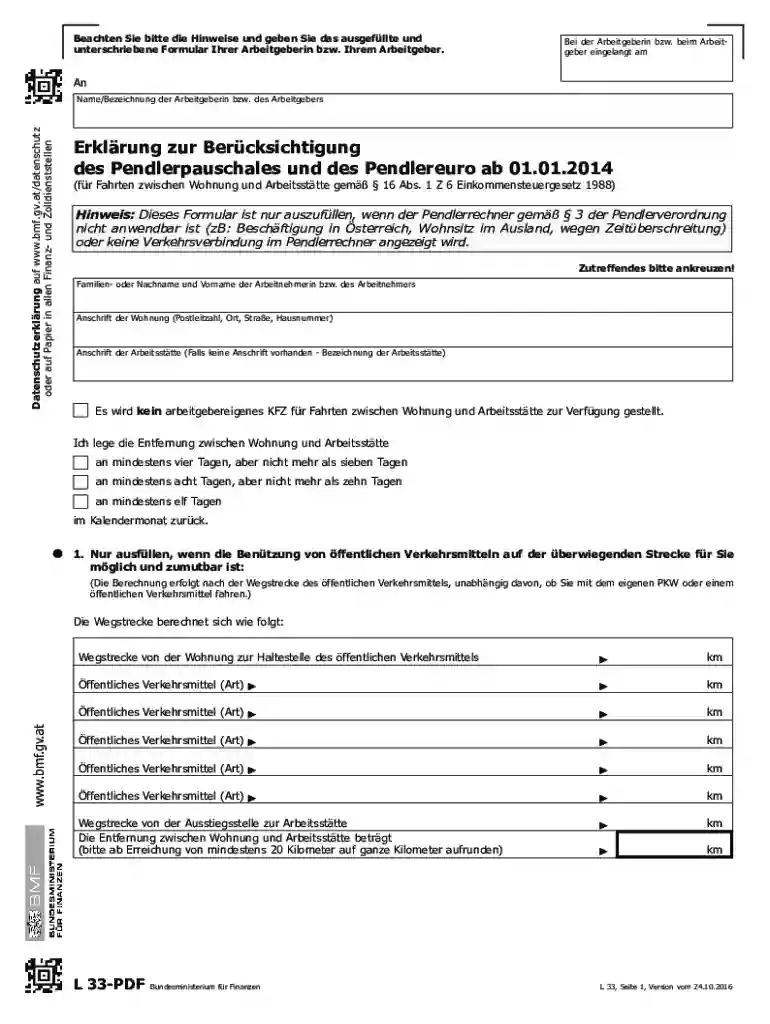
The L33 - Erklärung zur Berücksichtigung des Pendler-Pauschales ab 1.1.2014 (Formular) serves as a formal declaration for commuters in relation to their entitlement for commuter allowances in Austria. This form allows individuals to claim tax reductions based on their travel expenses between residence and workplace when public transportation is not feasible. Understanding the L33 form is essential for eligible commuters seeking to reduce their tax burden.
Commuters should be aware of these terms as they relate directly to the completion and implications of the L33 form. Correct terminological usage can also affect applicants' successes in securing the allowances they seek.
Utilizing the L33 form effectively involves understanding not just the form itself, but also the legislative framework surrounding commuter allowances. This process includes determining eligibility, calculating potential deductions, and correctly filing the necessary documentation.
Utilizing this form correctly can result in significant tax reductions, making it a valuable tool for eligible employees.
Completing the L33 form requires attention to detail to ensure all necessary information is accurately provided. The following steps can guide individuals through the process.
Submitting an accurately completed L33 form is critical for the timely processing of commuter allowance claims.
Several important factors need to be kept in mind regarding the L33 form to avoid pitfalls during the application process.
These considerations ensure compliance and can streamline the process of receiving the commuter allowance.
Understanding how the L33 form applies to real-life scenarios enhances comprehension of its importance and utility.
These examples delineate the different scenarios where the L33 form is applicable, emphasizing its flexibility and importance in various commuting situations.
Filing the L33 form correctly adheres to legal stipulations regarding commuter allowances. Understanding these requirements is crucial for compliance.
By adhering to these legal requirements, individuals can ensure that their claims for commuter expenses are valid and protected against potential issues.
Identifying common errors can significantly improve the accuracy of submitted L33 forms and prevent delays or denials.
Awareness and acknowledgment of these potential errors can strengthen the application process and enable users to maximize their commuter benefits.
Establishing clear eligibility criteria is fundamental for potential applicants of the L33 form.


Meeting these eligibility criteria ensures a smoother application process and enhances the likelihood of receiving the commuter allowance.
We've got more versions of the l33 formular form. Select the right l33 formular version from the list and start editing it straight away!
Microsoft Word doesn’t have signing tools to create valid electronic signatures and enforceable forms. Fortunately, DocHub is an online eSignature-compliant editor that supports various file formats, including .doc files. Log in to your account and upload the Word edition of your L33 - Erkl rung zur Ber cksichtigung des Pendler-Pauschales ab 1 1 2014 (Formular) from your device and cloud, or URL - our editor will automatically convert it into an editable PDF. Make all required alterations in your document and click Sign to create your own legally-binding electronic signature. You will find four signing methods from which to choose.
It is a no-brainer on a computer or via a mobile phone to fill out a L33 - Erkl rung zur Ber cksichtigung des Pendler-Pauschales ab 1 1 2014 (Formular) with DocHub. All you need to do is open any installed internet browser on your smartphone and proceed to the DocHub website. Once authenticated, add your document and open it in editing mode. Use our toolbar to make your edits and save changes. Optionally, keep your document in your files or send it to a recipient on the spot.
At DocHub, your data security is our priority. We follow HIPAA, SOC2, GDPR, and other standards, so you can work on your documents with confidence.


