




01. Edit your form 8862 online
Type text, add images, blackout confidential details, add comments, highlights and more.

Type text, add images, blackout confidential details, add comments, highlights and more.

Draw your signature, type it, upload its image, or use your mobile device as a signature pad.

Send 8862 form via email, link, or fax. You can also download it, export it or print it out.
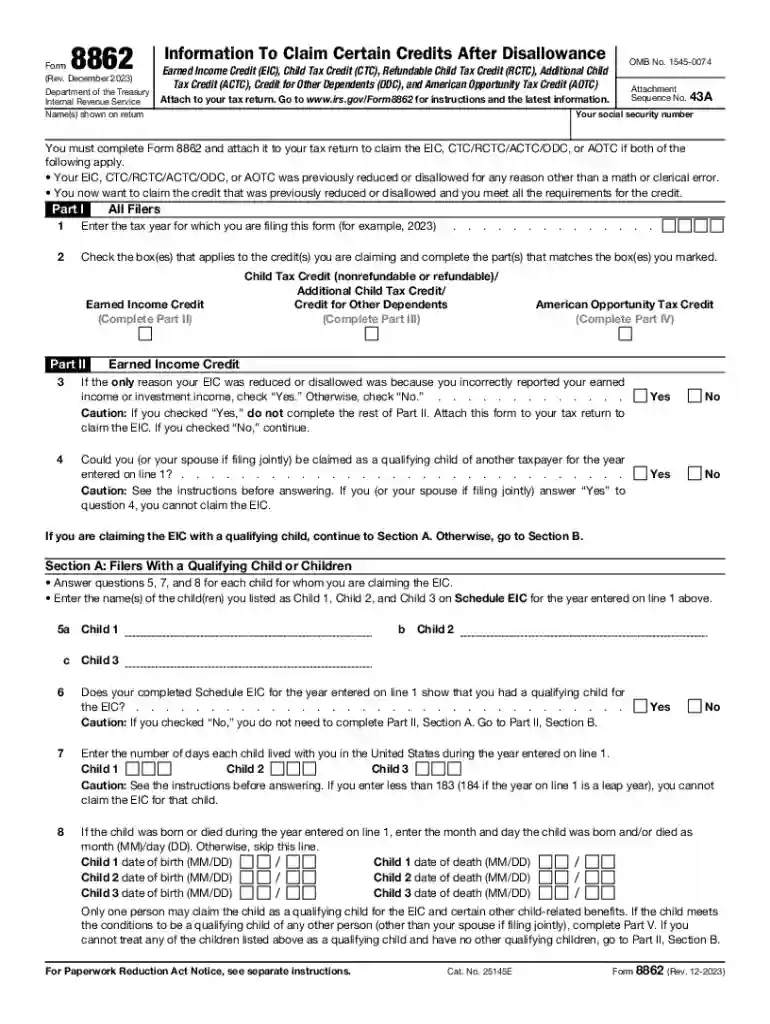
IRS Form 8862, also known as the "Information To Claim Certain Credits After Disallowance," is an essential document for taxpayers. This form is used when individuals seek to reclaim specific tax credits, such as the Earned Income Credit (EIC) and the Child Tax Credit, after these credits have been previously denied. Central to its purpose is the demonstration of eligibility based on current financial and personal circumstances. By completing and filing this form, taxpayers provide the IRS with the necessary information to reconsider their claims for these credits.
The form plays a pivotal role in ensuring taxpayers receive the benefits they are entitled to while maintaining compliance with tax regulations. Accurate completion is crucial, as the information provided directly influences the IRS's decision to reinstate disallowed credits.
Completing IRS Form 8862 involves several critical steps that must be followed meticulously to ensure accuracy and compliance. Here is a detailed walkthrough:
Review Disallowance Letter: Before starting, carefully review the disallowance letter received from the IRS. It provides specific reasons for the denial of previous claims and helps identify areas requiring additional documentation or clarification.
Gather Necessary Documentation: Assemble all relevant documents, including prior tax returns, income statements, and records for dependents if claiming the EIC or Child Tax Credit. Without these, substantiating your eligibility can be challenging.
Fill Out Personal Information: Start by entering your name, Social Security number, and filing status. Ensure that this information matches the records held by the IRS to avoid processing delays.
Complete the Specific Sections Based on Credits: Depending on which credits you are reclaiming, you will fill out different sections of the form. For instance, if you are applying for the EIC without qualifying children, you will need to focus on the parts that address your income and eligibility.
Verify and Add Supporting Information: Double-check all figures and statements entered. Include any additional information or explanations as needed in the comment sections to provide the IRS with a comprehensive view of your eligibility.
Sign and Date the Form: Conclude the process by signing and dating the form. This constitutes your attestation to the accuracy of the information provided.
Attach the Form to Your Tax Return: Form 8862 must be appended to your annual tax filing where you are claiming the credits again. Ensure exact procedures are followed for attachment, as per IRS guidelines.
Understanding eligibility criteria for IRS Form 8862 is crucial for taxpayers who intend to reclaim a disallowed credit. These criteria serve as benchmarks to determine if the reinstatement of the credit is warranted.
Resolution of Prior Issues: Any reasons that led to the initial denial must be addressed and rectified. This includes incorrect dependency claims or underreported income.
Income Requirements: Applicants must meet specific income thresholds pertinent to the credits they seek to recoup. For the Earned Income Credit, income must fall within limits detailed annually by the IRS.
Qualified Children: If applicable, taxpayers must provide evidence of qualified children, such as birth certificates and school records, to support claims for credits like the EIC.
Timeliness: The form should be submitted with the first tax return following the disallowance of a credit. Delays could affect the processing and acceptance of the claim.


Filing IRS Form 8862 necessitates gathering several critical documents. These documents underpin your claims and ensure the IRS has all necessary information:
Personal Identification: Documents such as Social Security cards for each person listed on the tax return.
Proof of Income: Includes W-2s, 1099s, and other forms of income documentation to verify earnings for the tax year in question.
Proof of Residency: Evidence such as utility bills, lease agreements, or school records to establish residency, especially when claiming credits related to dependents.
Prior Disallowance Notice: The IRS notice detailing the disallowance of the original claim should be retained and referenced when filling out Form 8862.
These documents support the data entered into IRS Form 8862, illustrating compliance with eligibility requirements, and reducing the risk of delays or further disallowance.
When filing IRS Form 8862, taxpayers have two main avenues for submission—digitally through online tax software or traditionally via mail. Each submission method has distinct advantages and considerations:
Digital Submission:
Paper Submission:
Failure to correctly complete and submit IRS Form 8862 can result in serious implications. It's vital to understand potential penalties:
Denial of Credits: Incomplete or inaccurate forms can lead to the denial of claimed credits, affecting refunds or increasing tax liabilities.
Fines and Interest: Non-compliance can result in penalties and interest charged on any resulting underpaid taxes due to unclaimed credits.
Filing Delays: Inaccuracies may trigger additional reviews or audits by the IRS, delaying the processing of returns and issuance of refunds.
Understanding potential penalties underscores the importance of meticulous form completion and submission to the IRS, supporting both compliance and accurate credit claims.
Adhering to filing deadlines is essential for IRS Form 8862 to ensure timely processing:
Annual Tax Deadline: Form 8862 should be submitted with your tax return no later than April 15th, unless specific extensions apply.
Extensions: If an extension for filing your federal tax return has been granted, Form 8862 should be included with the extended return. Timely extension requests help avoid penalties for late submissions.
Compliance with prescribed deadlines underpins the process, enhancing the probability of timely credit recovery and minimal procedural complications.
IRS Form 8862 can be instrumental in different taxpayer scenarios. Consider these real-world examples:
Scenario One: A taxpayer was previously denied the Earned Income Credit due to reporting errors. After rectifying income details and verifying dependent eligibility, they successfully claim the credit in subsequent years using Form 8862.
Scenario Two: A self-employed individual had the Child Tax Credit disallowed due to income misreporting. By providing comprehensive documentation through Form 8862, they regain access to this valuable credit.
Effectively using Form 8862 empowers taxpayers to rectify past disallowances and reclaim rightful tax benefits, promoting equitable tax treatment.
We've got more versions of the form 8862 form. Select the right form 8862 version from the list and start editing it straight away!
| Versions | Form popularity | Fillable & printable |
|---|---|---|
| 2025 | 4.7 Satisfied (48 Votes) | |
| 2024 | 4.6 Satisfied (24 Votes) | |
| 2023 | 4.3 Satisfied (55 Votes) | |
| 2022 | 4.1 Satisfied (39 Votes) | |
| 2021 | 4.8 Satisfied (71 Votes) | |
| 2018 | 4.2 Satisfied (101 Votes) | |
| 2017 | 4.2 Satisfied (115 Votes) | |
| 2012 | 4.4 Satisfied (422 Votes) | |
| 2009 | 4.3 Satisfied (48 Votes) | |
| 2002 | 4.6 Satisfied (46 Votes) | |
| 2000 | 4.9 Satisfied (53 Votes) |
At DocHub, your data security is our priority. We follow HIPAA, SOC2, GDPR, and other standards, so you can work on your documents with confidence.
Taxpayers complete Form 8862 and attach it to their tax return if: Their earned income credit (EIC), child tax credit (CTC)/additional child tax credit (ACTC),
Form 8862 may be required. you must attach a completed Form 8862, Infor- mation To Claim Certain Credits After Disallowance, to your tax return for the next


