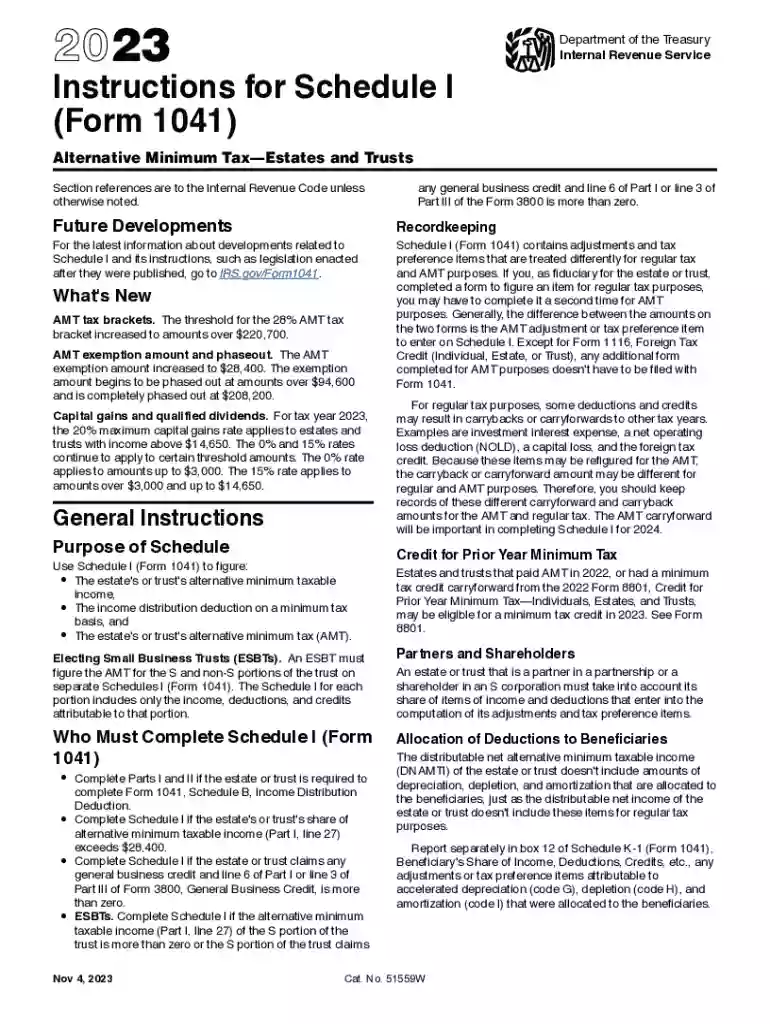
Form 1041-A - Trust Accumulation of Charitable-2026

Get Form
Form 1041-A - Trust Accumulation of Charitable Preview on Page 1

Here's how it works

01. Edit your form online
Type text, add images, blackout confidential details, add comments, highlights and more.

02. Sign it in a few clicks
Draw your signature, type it, upload its image, or use your mobile device as a signature pad.

03. Share your form with others
Send it via email, link, or fax. You can also download it, export it or print it out.

How to use or fill out Form 1041-A - Trust Accumulation of Charitable with our platform

Form edit decoration
9.5
Ease of Setup
DocHub User Ratings on G2
9.0
Ease of Use
DocHub User Ratings on G2
  1. Click ‘Get Form’ to open Form 1041-A in the editor.
  2. Begin by entering the trust's name and identifying information in the designated fields at the top of the form.
  3. In Part I, report the income received by the trust. Ensure you accurately categorize each type of income as specified.
  4. Proceed to Part II, where you will calculate deductions. Carefully follow the instructions for each line to ensure compliance with IRS guidelines.
  5. Complete Part III by detailing any distributions made to beneficiaries. This section is crucial for determining tax obligations.
  6. Review all entries for accuracy. Utilize our platform’s editing features to make any necessary adjustments before finalizing your form.

Start filling out your Form 1041-A today for free using our platform!

See more Form 1041-A - Trust Accumulation of Charitable versions

We've got more versions of the Form 1041-A - Trust Accumulation of Charitable form. Select the right Form 1041-A - Trust Accumulation of Charitable version from the list and start editing it straight away!
Versions Form popularity Fillable & printable
2023 4.2 Satisfied (40 Votes)
2022 4.9 Satisfied (26 Votes)
2021 4.8 Satisfied (230 Votes)
2013 4.3 Satisfied (55 Votes)
be ready to get more

Complete this form in 5 minutes or less

Get form

Got questions?

We have answers to the most popular questions from our customers. If you can't find an answer to your question, please contact us.
Contact us
An Accumulation Trust which accumulates retirement distributions within the trust and does not distribute those benefits to the beneficiary must pay income tax on the accumulated income at trust tax rates, which are much higher than individual rates.
What is the 5 x 5 Rule? Broadly explained, the 5 x 5 rule for trusts refers to a relatively common provision that allows a beneficiary to withdraw either 5 percent of the trusts value or $5,000 annuallywhichever is greater.
What are the top mistakes made on Form 1041? Filing when the trust is grantor-type (they dont need a 1041 tax return) Missing state-level filing requirements. Failing to report rental real estate income. Skipping or misusing Schedules A, G, J, or Schedule K-1. Forgetting Form 8978 for certain entity adjustments.
Can an Estate or Trust Deduct Charitable Contributions on Form 1041? Yes, both estates and trusts can usually deduct charitable contributions.
Discretionary trusts If your payment is from a discretionary trust, then the trustees will have paid tax at the additional rate (45% in 2025/26) before the income is paid to you.

Security and compliance

At DocHub, your data security is our priority. We follow HIPAA, SOC2, GDPR, and other standards, so you can work on your documents with confidence.

Learn more
ccpa2
pci-dss
gdpr-compliance
hipaa
soc-compliance
be ready to get more

Complete this form in 5 minutes or less

Get form

People also ask

Accumulation or discretionary trusts Type of incomeTax rate Dividend-type income 39.35% All other income 45%
Gains on accumulation units/shares Income is not distributed but is automatically reinvested within the fund. This reinvested income inflates the share/unit price but has already been subject to income tax. To avoid double taxation, the notional income can be used to increase the original cost of the investment.
Overview. Trusts and estates cannot claim an income tax deduction under IRC 170 like individuals can. Instead, amounts paid, permanently set aside, or to be used for charitable purposes are deductible by estates or trusts only as provided in IRC 642(c).

Related links