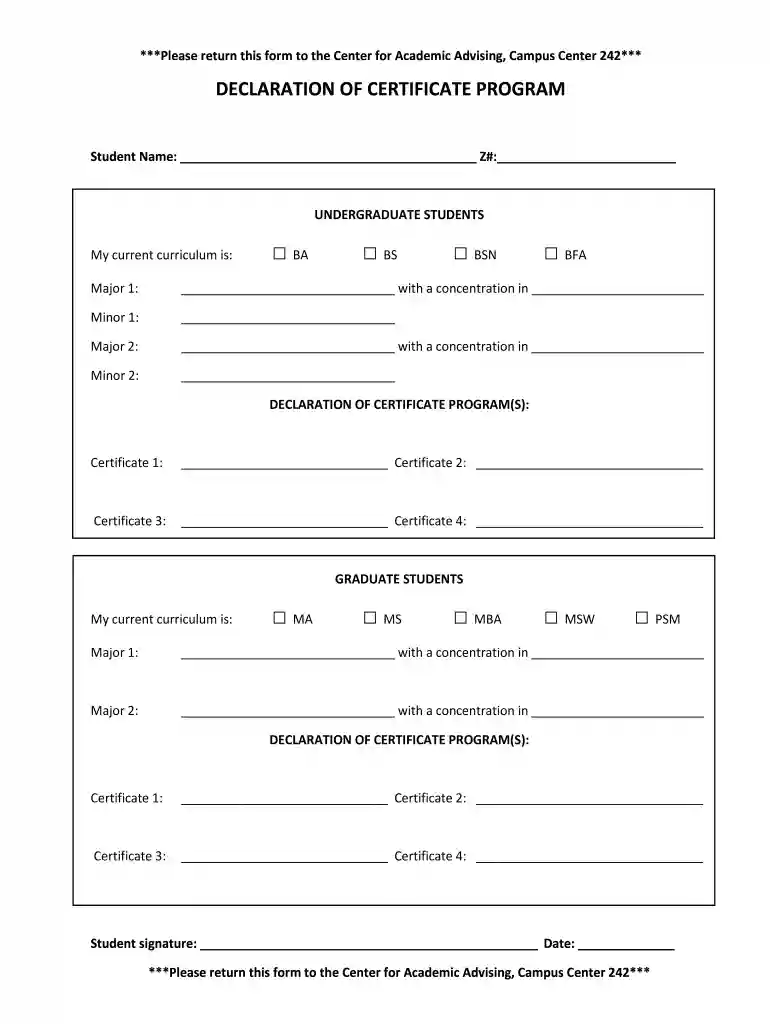
Program Minor Declaration Form 2026

Get Form
Program Minor Declaration Form Preview on Page 1

Here's how it works

01. Edit your form online
Type text, add images, blackout confidential details, add comments, highlights and more.

02. Sign it in a few clicks
Draw your signature, type it, upload its image, or use your mobile device as a signature pad.

03. Share your form with others
Send it via email, link, or fax. You can also download it, export it or print it out.

How to use or fill out Program Minor Declaration Form with DocHub

Form edit decoration
9.5
Ease of Setup
DocHub User Ratings on G2
9.0
Ease of Use
DocHub User Ratings on G2
  1. Click ‘Get Form’ to open the Program Minor Declaration Form in our editor.
  2. Begin by entering your name and Z# at the top of the form. This information is essential for identification.
  3. Select your current curriculum type by checking the appropriate box (BA, BS, BSN, BFA for undergraduate students; MA, MS, MBA, MSW, PSM for graduate students).
  4. Fill in your major(s) and concentration(s) as required. Ensure accuracy as this reflects your academic path.
  5. Indicate your minor(s) by writing them in the designated fields. If you have multiple majors or minors, complete all relevant sections.
  6. For certificate programs, list any certificates you are declaring in the provided spaces.
  7. Finally, sign and date the form at the bottom before submitting it to the Center for Academic Advising.

Start using our platform today to easily fill out your Program Minor Declaration Form for free!

be ready to get more

Complete this form in 5 minutes or less

Get form

Got questions?

We have answers to the most popular questions from our customers. If you can't find an answer to your question, please contact us.
Contact us
Is It Worth Declaring a Minor in College? You might be wondering if adding a minor is worth the extra effort, and the answer often is yes! A minor not only enhances your knowledge and broadens your skill set, but it also shows potential employers that youre driven and well-rounded.
Finding a minor that complements your major can help you be more prepared after graduation. For example, if you major in computer science or IT, a minor in math can help you develop skills that overlap with some of the core concepts of computer science. Also, employers often prefer to hire multifaceted job candidates.
When should I declare a minor and major? It can help to declare a minor around the same time you declare a major, so you clearly understand the courses you need to take after you finish your general education requirements.
A student who wishes to pursue a minor should consult the minor advisor or chairperson of the appropriate department or program as early as possible. Students should declare minors by the time they have earned 75 credits by filling out the Undergraduate Declaration of Minor Form and submit it to J Express.
It may help in very specific circumstances if youre applying to an interdisciplinary field. Generally though its just a way to show you have an interest in a subject outside your major. If youre going to take senior-level courses outside your major, declaring a minor is a nice way to formalize that.

Security and compliance

At DocHub, your data security is our priority. We follow HIPAA, SOC2, GDPR, and other standards, so you can work on your documents with confidence.

Learn more
ccpa2
pci-dss
gdpr-compliance
hipaa
soc-compliance
be ready to get more

Complete this form in 5 minutes or less

Get form

People also ask

At most colleges, undergrads complete 16-30 credits for a minor. Like a major, college students must declare their minor. Depending on the school, students may declare a minor with the department or by contacting an academic advisor.
Most colleges do not require a minor to earn a bachelors degree. A minor can complement your major and help job applicants stand out. Before declaring a minor, weigh the costs against the benefits. Choose a minor based on your interests, goals, and major.
At many colleges, undergrads complete 50-60 credits of general education requirements and 30-40 credits to earn their major. That leaves another 20-40 credits for electives or a minor. Adding a minor might mean adding more credits to your degree, which can mean more time and money than the minor might be worth.

Related links