Pld pi 001 3 2026

Get Form
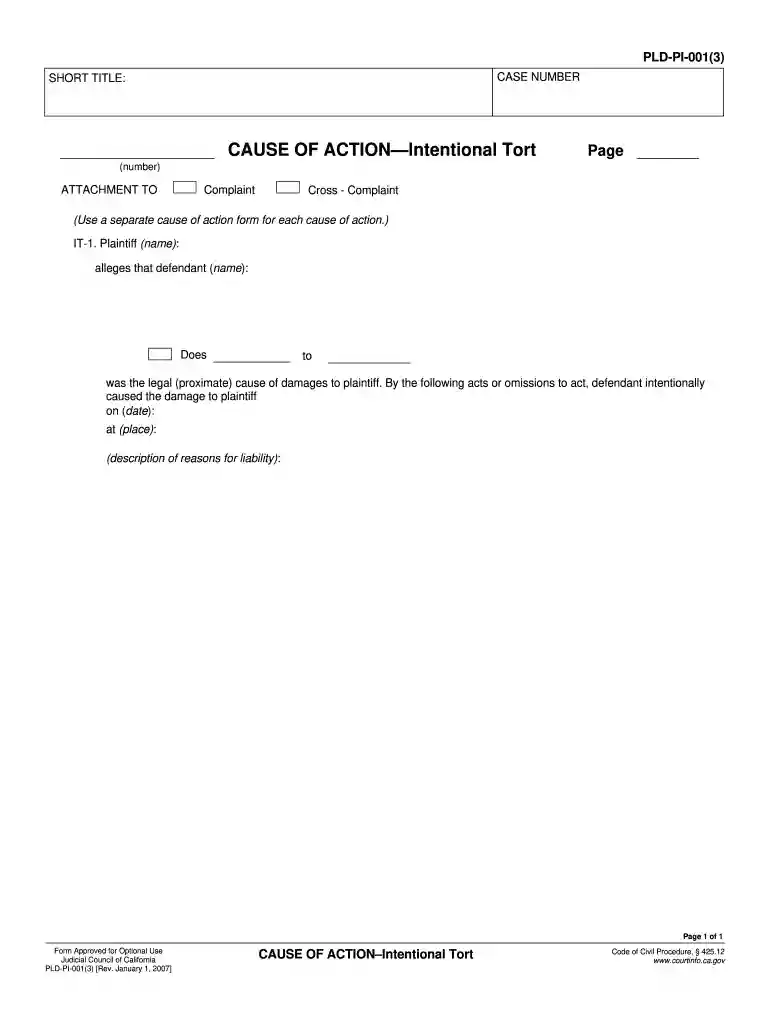
pld pi 001 3 Preview on Page 1

Here's how it works

01. Edit your pld pi 001 3 online
Type text, add images, blackout confidential details, add comments, highlights and more.

02. Sign it in a few clicks
Draw your signature, type it, upload its image, or use your mobile device as a signature pad.

03. Share your form with others
Send it via email, link, or fax. You can also download it, export it or print it out.

How to use or fill out pld pi 001 3 with our platform

Form edit decoration
9.5
Ease of Setup
DocHub User Ratings on G2
9.0
Ease of Use
DocHub User Ratings on G2
  1. Click ‘Get Form’ to open the pld pi 001 3 in the editor.
  2. Begin by entering the 'CASE NUMBER' at the top of the form. This is essential for identifying your case.
  3. In the 'SHORT TITLE' section, provide a brief description of your case. This helps summarize the nature of your complaint.
  4. For 'CAUSE OF ACTION', select 'Intentional Tort'. Ensure you understand this legal term as it pertains to your situation.
  5. Fill in the plaintiff's name in IT-1, followed by the defendant's name. Clearly state how the defendant's actions caused harm.
  6. Specify the date and place where the incident occurred, along with a detailed description of reasons for liability.
  7. Once completed, utilize options to save or print your form. Remember to press 'Clear This Form' for privacy after printing.

Start using our platform today to streamline your document editing and form completion process for free!

See more pld pi 001 3 versions

We've got more versions of the pld pi 001 3 form. Select the right pld pi 001 3 version from the list and start editing it straight away!
Versions Form popularity Fillable & printable
2007 4.8 Satisfied (165 Votes)
be ready to get more

Complete this form in 5 minutes or less

Get form

Got questions?

We have answers to the most popular questions from our customers. If you can't find an answer to your question, please contact us.
Contact us
The legal elements of an intentional tort claim are: The at-fault party acted knowingly, willingly, and purposefully to harm or injure someone. The injured party did not consent to the at-fault partys actions or conduct. The intentional act committed by the at-fault party caused the victim harm or injury.
An intentional tort is a type of tort that can only result from an intentional act of the defendant. Depending on the exact tort alleged, either general or specific intent will need to be proven.
This chapter addresses the four intentional torts, assault, battery, false imprisonment, and intentional infliction of emotional distress, that involve injury to personswhat some call the dignitary torts.
Yes, you can sue for an intentional tort. The very name of the legal concept indicates that a victim can request compensation from the perpetrator because, in legalese, tort means harm. Your right to hold a person or company that harmed you accountable cannot be denied.
Comply With the Relevant Federal, State, and Local Rules. Research Before Writing. Allege Subject Matter Jurisdiction, Personal Jurisdiction, and Venue. Jurisdiction. Draft Concise and Plain Statement of the Facts. Factual Allegations. Draft Separate Counts for Each Legal Claim. Plead Facts With Particularity Where Necessary.

Security and compliance

At DocHub, your data security is our priority. We follow HIPAA, SOC2, GDPR, and other standards, so you can work on your documents with confidence.

Learn more
ccpa2
pci-dss
gdpr-compliance
hipaa
soc-compliance
be ready to get more

Complete this form in 5 minutes or less

Get form

People also ask

COMPLAINTPersonal Injury, Property Damage, Wrongful Death (PLD-PI-001) Tells the court and the other side that you are starting a lawsuit based on personal injury, property damage, or wrongful death, and the general allegations you are making against the other side.
Proving Liability for an Intentional Tort in a California Personal Injury Case. In a criminal case, the state has the burden of proving that the defendant committed the crime beyond a reasonable doubt. If the defendant is guilty, the court issues criminal penalties, such as fines and jail time.

Related links