




01. Edit your form 5472 online
Type text, add images, blackout confidential details, add comments, highlights and more.

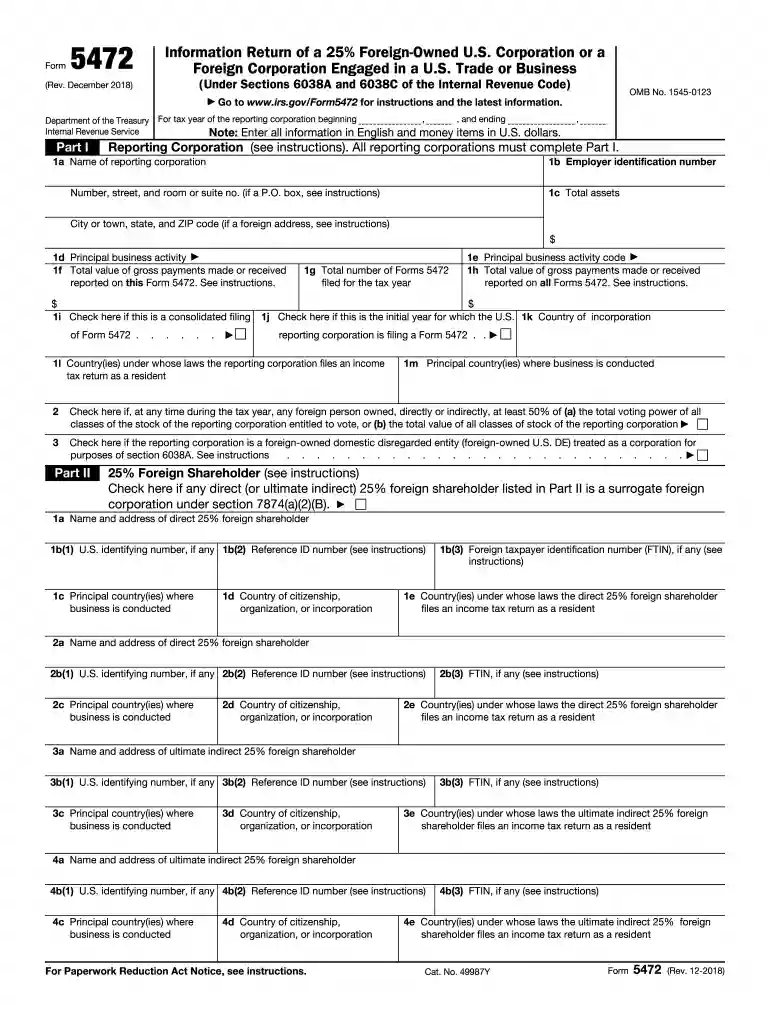
Type text, add images, blackout confidential details, add comments, highlights and more.

Draw your signature, type it, upload its image, or use your mobile device as a signature pad.

Send form 5472 download via email, link, or fax. You can also download it, export it or print it out.
Form 5472 is an informational return required by the IRS for specific corporations operating within the United States. This form applies to U.S. corporations with at least 25% foreign ownership as well as foreign corporations engaged in U.S. trade or business. The form collects data on financial activities, particularly focusing on transactions with foreign shareholders and other related parties. Its primary purpose is to ensure compliance with IRS regulations under the Internal Revenue Code, aiding in the monitoring and regulation of cross-border financial activities.
Gather Necessary Information: Collect detailed information about the reporting corporation, including the name, address, and identifying number. You also need the details of any foreign entities involved.
Identify Reportable Transactions: Identify any reportable transactions between the reporting corporation and related foreign parties. This includes transactions such as sales, leases, licenses, exchanges, and financial activities.
Provide Financial Details: Complete sections dealing with monetary and financial aspects, such as total receipts and financial payments.
Compliance Review: Review the form for completeness and ensure all information complies with the IRS regulations.
Submission: Submit the form along with the corporation’s tax return, ensuring adherence to the IRS’s filing deadlines.
Form 5472 can be obtained directly from the IRS website. This form is typically available in both a downloadable paper format and a fillable PDF version. Corporations can also use tax preparation software that supports this form to ensure proper completion and submission. It’s important to frequently check for updates or revisions to the form to ensure compliance with any new regulations or requirements.
Form 5472 is a critical tool for assessing compliance with U.S. tax laws. By requiring detailed reporting of transactions with foreign shareholders, the IRS ensures that corporations are accurately reporting their global income and adhering to international tax obligations. The form serves as a mechanism to prevent tax evasion through misreported or non-reported financial transactions with foreign entities.
Corporations that are either:
Particular industries, such as multinational corporations, are more likely to engage in cross-border transactions, thus requiring the use of this form.
Form 5472 must be filed alongside the corporation’s annual tax return. Typically, for calendar-year corporations, this is by April 15 of the year following the tax year. However, extensions may apply, and these deadlines require strict adherence to prevent penalties.
Corporations failing to file Form 5472 in a complete and timely manner are subject to significant penalties. These can escalate if the IRS deems the failure to comply as intentional or fraudulent. The base penalty starts at $25,000, with potential increases for continued non-compliance.
The IRS provides detailed guidelines on how to complete and file Form 5472, ensuring adherence to specific requirements and avoiding common errors. These guidelines are essential for any corporation engaging in cross-border transactions to mitigate risks and ensure proper reporting. Such support includes clarity on which transactions qualify as reportable and how to properly document those on the form.
We've got more versions of the form 5472 form. Select the right form 5472 version from the list and start editing it straight away!
At DocHub, your data security is our priority. We follow HIPAA, SOC2, GDPR, and other standards, so you can work on your documents with confidence.
A Form 5472 and Form 8991 required under this section must be filed with the reporting corporations income tax return for the taxable year by the due dateRead more
Indicate by check mark if the registrant is a well-known seasoned issuer, as defined in Rule 405 of the Securities Act. ☒ Yes ☐ No.Read more
Corporations file Form 5472 to provide information required under sections 6038A and 6038C when reportable transactions occur with a foreign or domesticRead more


