




01. Edit your california llc annual fees online
Type text, add images, blackout confidential details, add comments, highlights and more.

Type text, add images, blackout confidential details, add comments, highlights and more.

Draw your signature, type it, upload its image, or use your mobile device as a signature pad.

Send california llc estimated fee via email, link, or fax. You can also download it, export it or print it out.
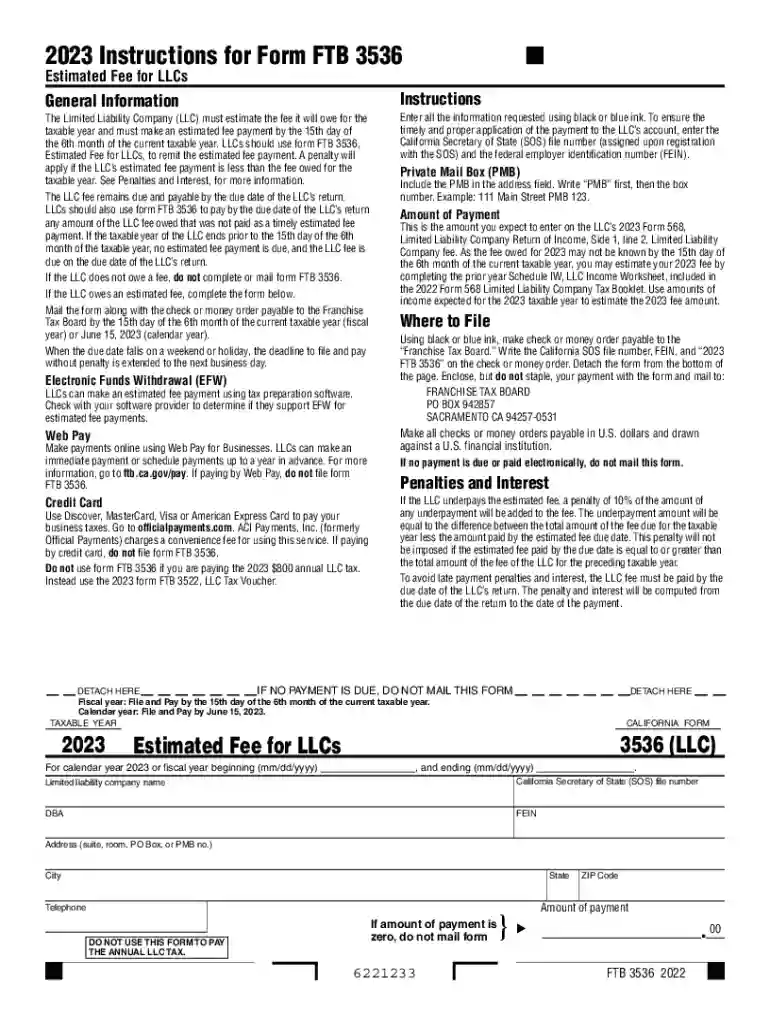
Form FTB 3536 is specifically designed for Limited Liability Companies (LLCs) operating within California. Its primary purpose is to facilitate the annual estimated fee payment for LLCs. This form is essential for managing the estimated fees based on the LLC's total income derived from California sources. By accurately estimating and submitting these payments, LLCs comply with state tax regulations and avoid potential penalties.
LLCs in California must regularly estimate their annual fees based on a tiered system related to their income. This estimation helps the Franchise Tax Board (FTB) efficiently collect expected revenue. The form, therefore, becomes crucial for LLCs as it assists in ensuring these entities meet their tax obligations on time and in accordance with state guidelines.
Completing Form FTB 3536 involves several carefully structured steps to ensure accuracy and compliance. To aid in understanding, here's a detailed breakdown of the process:
Download and Access the Form: Obtain the latest version of Form FTB 3536 through the California Franchise Tax Board's official website or trusted platforms like DocHub.
Gather Required Information: Before filling out the form, collect vital details such as the LLC's full legal name, California Secretary of State (SOS) file number, Federal Employer Identification Number (FEIN), and estimated total income.
Calculate Estimated Fees: Use the income brackets provided to calculate the estimated fee due for the taxable year. This involves assessing gross receipts and applying the appropriate fee structure.
Fill Out the Form: Input the required details carefully in the corresponding fields, including information on income and calculated fees.
Review and Verify Entries: Double-check all entered information for accuracy to prevent errors that may lead to penalties.
Submit the Form: After completion, submit the form along with any required payments through approved methods, such as mailing or electronic submission.
LLCs are legally obligated to adhere to the guidelines and deadlines associated with Form FTB 3536. Failing to comply with these requirements can lead to significant penalties, including interest charges on underestimated or late payments. To maintain good standing, it's critical for LLCs to submit accurate information and payments on time.
Form FTB 3536 contains several crucial sections that require thorough attention:
Form FTB 3536 is available in both digital and paper formats. Choosing between these versions impacts the ease and speed of submission.
While digital is often preferred, some businesses may opt for paper due to:
Adhering to strict deadlines is critical when submitting Form FTB 3536 to avoid any legal or financial repercussions.
Many LLCs use popular accounting software like TurboTax and QuickBooks to aid in the calculation and filing of Form FTB 3536. These platforms offer seamless integration with financial data, ensuring accurate and efficient submission.
While Form FTB 3536 is specific to California LLCs, different business structures may also see advantages in using platforms like DocHub for form management:
By following these guidelines, businesses can navigate the nuances of Form FTB 3536, ensuring compliance and optimizing their document management workflow with DocHub.
We've got more versions of the california llc annual fees form. Select the right california llc annual fees version from the list and start editing it straight away!
| Versions | Form popularity | Fillable & printable |
|---|---|---|
| 2026 | 4.7 Satisfied (56 Votes) | |
| 2025 | 4.8 Satisfied (21 Votes) | |
| 2024 | 4.5 Satisfied (34 Votes) | |
| 2023 | 4.5 Satisfied (53 Votes) | |
| 2022 | 4.9 Satisfied (56 Votes) | |
| 2021 | 4.2 Satisfied (82 Votes) | |
| 2020 | 4.4 Satisfied (59 Votes) | |
| 2019 | 4.4 Satisfied (185 Votes) | |
| 2018 | 4.2 Satisfied (112 Votes) | |
| 2017 | 4.1 Satisfied (44 Votes) | |
| 2014 | 4.4 Satisfied (593 Votes) | |
| 2013 | 4 Satisfied (50 Votes) |
At DocHub, your data security is our priority. We follow HIPAA, SOC2, GDPR, and other standards, so you can work on your documents with confidence.


