




01. Edit your form online
Type text, add images, blackout confidential details, add comments, highlights and more.

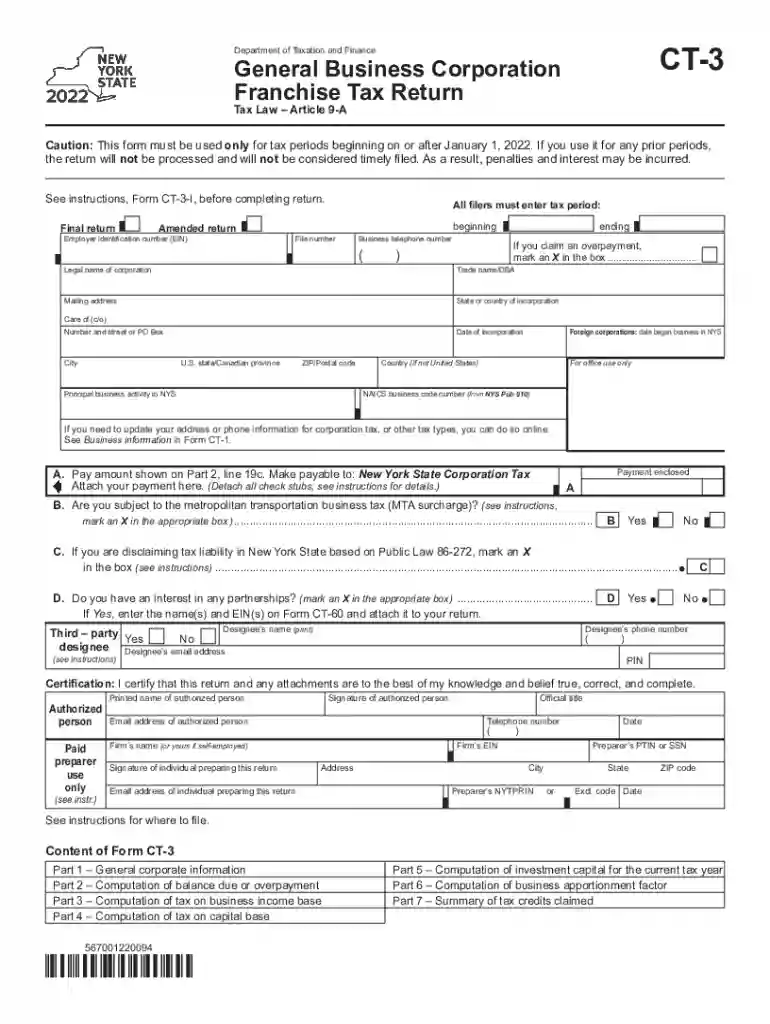
Type text, add images, blackout confidential details, add comments, highlights and more.

Draw your signature, type it, upload its image, or use your mobile device as a signature pad.

Send it via email, link, or fax. You can also download it, export it or print it out.


We've got more versions of the Quick guide to completing Form CT-3, General Business Corporation ... form. Select the right Quick guide to completing Form CT-3, General Business Corporation ... version from the list and start editing it straight away!
| Versions | Form popularity | Fillable & printable |
|---|---|---|
| 2025 | 4.7 Satisfied (38 Votes) | |
| 2024 | 4.9 Satisfied (21 Votes) | |
| 2023 | 4.6 Satisfied (50 Votes) | |
| 2022 | 4.1 Satisfied (39 Votes) | |
| 2021 | 4.8 Satisfied (127 Votes) | |
| 2020 | 4.3 Satisfied (116 Votes) | |
| 2019 | 4.3 Satisfied (152 Votes) | |
| 2018 | 4.4 Satisfied (146 Votes) | |
| 2017 | 4.2 Satisfied (122 Votes) | |
| 2015 | 4.4 Satisfied (556 Votes) | |
| 2014 | 4.4 Satisfied (31 Votes) | |
| 2013 | 4 Satisfied (27 Votes) | |
| 2012 | 3.9 Satisfied (38 Votes) | |
| 2011 | 4 Satisfied (52 Votes) | |
| 2010 | 4.1 Satisfied (65 Votes) |
At DocHub, your data security is our priority. We follow HIPAA, SOC2, GDPR, and other standards, so you can work on your documents with confidence.
Jan 26, 2024 Specific Instructions for Form W-3. How to complete Form W-3. The instructions under. How to complete Form W-2 generally apply to Form W-3.
May 2, 2017 Specific Instructions for Form W-3. How to complete Form W-3. The instructions under. How to complete Form W-2 generally apply to Form W-3.
Dec 13, 2024 You must complete the following parts of Form CT-3: Note: Part 6 must be completed, even if your business apportionment factor is 100%.


