






Definition and Meaning
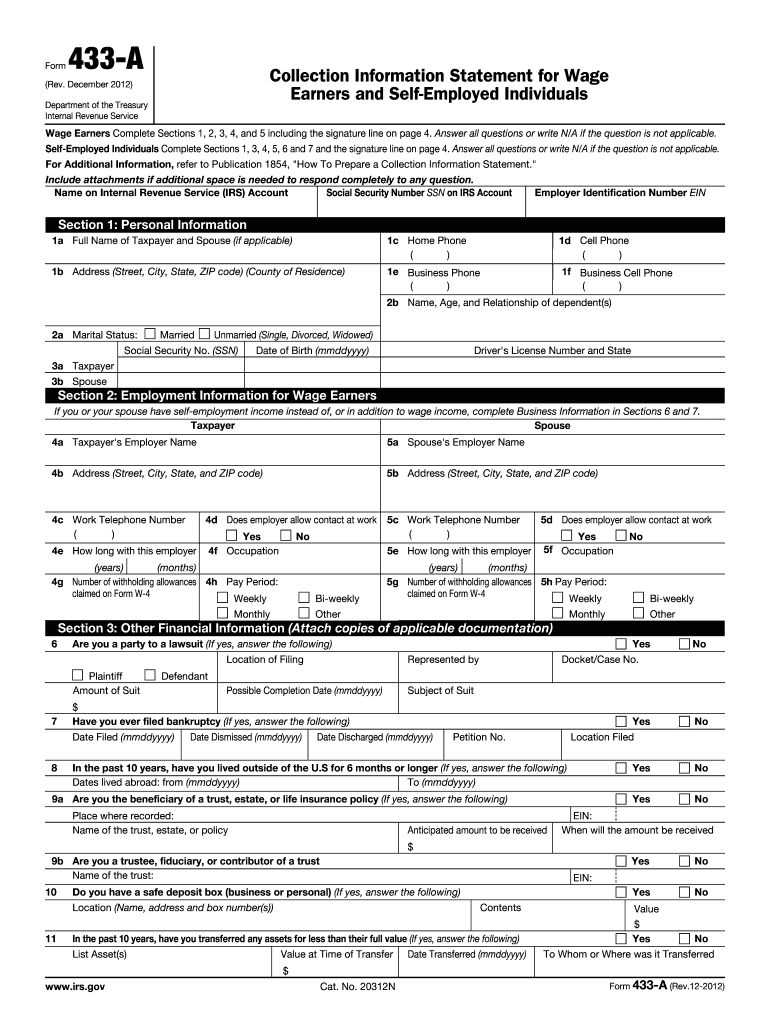
Form 433-A, also known as the Collection Information Statement for Wage Earners and Self-Employed Individuals, is a crucial document used by the IRS to gather comprehensive financial information from taxpayers. This form is designed to assess an individual's financial capacity for paying tax debts and plays a pivotal role in determining eligibility for installment agreements, offers in compromise, or other collection alternatives. It includes various sections that detail personal information, income sources, assets, liabilities, and monthly expenses, providing the IRS with a full financial picture of the taxpayer.
Purpose and Function
- Income and Expenses Analysis: Allows the IRS to evaluate your ability to meet tax obligations.
- Asset Identification: Helps identify financial assets and personal property that might be leveraged to satisfy tax debts.
- Payment Plan Eligibility: Essential for determining eligibility for different IRS payment plans.
Examples of when the Form 433-A is used include when negotiating payment plans for owed back taxes or when applying for an IRS offer in compromise to settle tax liabilities for less than the full amount owed.
Key Elements of the IRS Form 433-A
The IRS Form 433-A comprises several essential components that provide insights into a taxpayer's financial situation:
Personal and Employment Information
- Personal Details: Includes name, social security number, address, and pertinent contact information.
- Employment Information: Collects details of current employment status, employer details, and self-employment income.
Financial Assets and Liabilities
- Assets: Enlists detailed descriptions of assets including bank accounts, investments, and real estate.
- Liabilities: Documents existing financial obligations such as loans and credit card debts.
Monthly Income and Expenses
- Income Sources: Comprehensive breakdown of all income, including wages, dividends, rental income, and other sources.
- Expense Categories: Includes necessary living expenses, subscriptions, and miscellaneous costs.
These sections ensure the IRS fully understands the taxpayer's ability to pay existing tax debts while considering necessary living expenses.
Steps to Complete the IRS Form 433-A
Completing Form 433-A involves several detailed steps to ensure accuracy in the information provided to the IRS. Here's a step-by-step guide:
-
Gather Personal Details: Begin by filling out your basic personal information including your name, social security number, and contact details.
-
Complete Financial Summary: Provide a summary of your income, including wages, self-employment income, and any other revenue streams.
-
List Assets and Liabilities: Clearly detail your assets, including cash on hand, vehicles, property, and existing debts or liabilities.
-
Detail Monthly Income and Expenses: Itemize your monthly income and essential expenses, ensuring all entries are accurate and complete.
-
Verify and Sign: Review the completed form for any discrepancies, then sign and date the form, asserting the truthfulness and accuracy of the provided information.
Tips for Accurate Completion
- Use Current Information: Ensure all financial data is up-to-date at the time of filing.
- Double-check Entries: Verify every section for accuracy to avoid processing delays or requests for additional information from the IRS.
Who Typically Uses the IRS Form 433-A
This form is predominantly used by individuals with tax liabilities, whether they are wage earners or self-employed individuals. It is especially utilized by:
- Taxpayers Seeking Installment Agreements: Individuals unable to pay their full tax liabilities immediately.
- Self-Employed Individuals: Persons running their own businesses who have incurred tax debts.
- Taxpayers Pursuing Offers in Compromise: Those looking to settle their tax debt for less than the full balance.


Practical Scenarios
- Self-Employed Contractor: A freelancer with variable income may use this form to negotiate a manageable payment plan with the IRS.
- Recently Unemployed Taxpayer: An individual who recently lost their job and is unable to meet prior tax commitments might submit this form to explore relief options.
Legal Use of the IRS Form 433-A
The information provided in Form 433-A is used to legally evaluate and negotiate tax-related debts. Compliance with IRS guidelines is crucial, as inaccuracies can lead to:
- Rejection of Payment Plans: Complete and correct information ensures that proposed IRS agreements are approved without complications.
- Potential Legal Action: Erroneous submissions could inadvertently prompt IRS legal actions or audits.
Compliance Best Practices
- Honesty and Transparency: Ensure that all declarations are truthful to best facilitate negotiations with the IRS.
- Consultation with Tax Professionals: Seek expert advice in complex situations to maximize the form's effectiveness.
IRS Guidelines
The IRS provides explicit guidance on completing and submitting Form 433-A, which must be adhered to carefully:
- Submission Instructions: Follow IRS-issued directions for submitting the form, considering stipulated deadlines.
- Supporting Documentation: Attach necessary documents that validate financial figures stated in the form, like bank statements and employer payroll checks.
Common Reasons for IRS Queries
- Incomplete Entries: Leaving sections blank can result in delayed review processes.
- Inconsistent Financial Data: Discrepancies between declared information and supporting documents can prompt further inquiries.
Digital vs. Paper Version
Taxpayers have the choice to complete Form 433-A digitally or in paper format:
- Digital Submission: Offers speedier processing and is often more convenient, with options to complete the form using platforms like DocHub.
- Paper Format: May be preferable for individuals less comfortable with digital submission processes or lacking consistent access to technology.
Choosing the Right Format
- Consider Convenience: Online submissions often result in quicker acknowledgment and processing.
- Factor in Accessibility: If digital access is limited, paper submissions are equally valid, though potentially slower.
Filing Deadlines and Important Dates
While there isn't a standard deadline for submitting Form 433-A, timeliness is vital when responding to IRS requests or when an individual is willingly seeking assistance with a tax liability. It’s pertinent to respond promptly:
- IRS Notification Deadlines: Pay close attention to any deadlines stipulated in IRS communications.
Timing Tips
- Respond Swiftly: Prompt submission often ensures smoother negotiation processes.
- Monitor IRS Notices: Keep track of dates communicated in IRS requests to avoid penalties.