




01. Edit your commercial rent tax forms online
Type text, add images, blackout confidential details, add comments, highlights and more.

Type text, add images, blackout confidential details, add comments, highlights and more.

Draw your signature, type it, upload its image, or use your mobile device as a signature pad.

Send nyc crt form via email, link, or fax. You can also download it, export it or print it out.
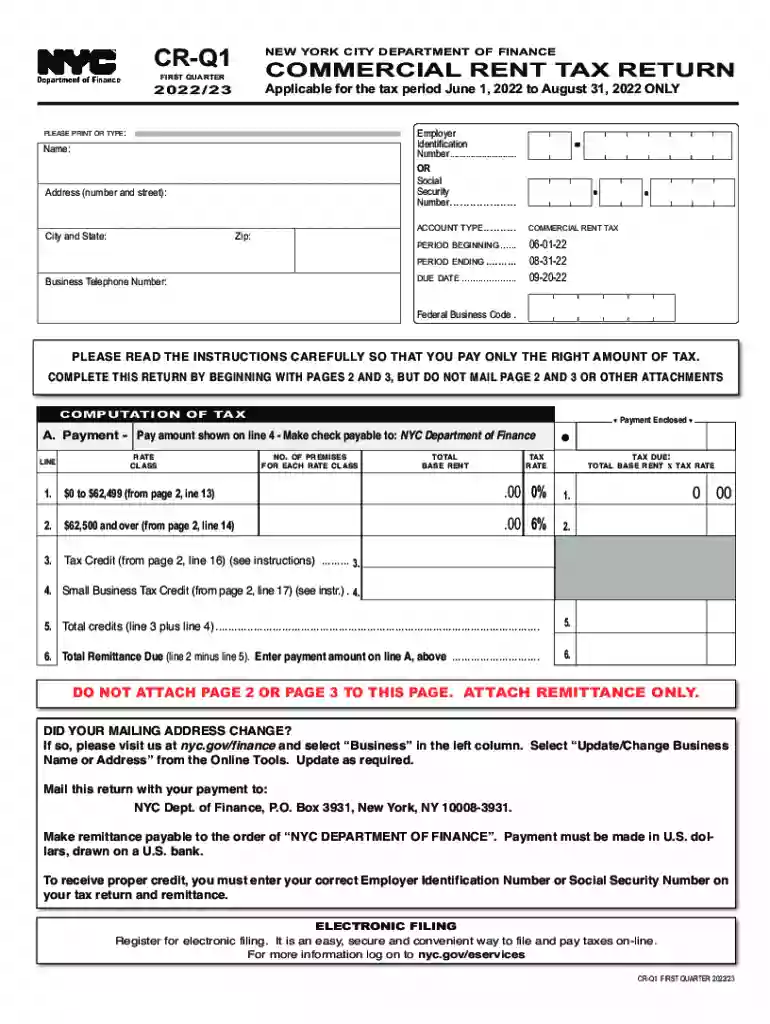
The CR-Q1 Finance Commercial Rent Tax Return is a tax form used by businesses in New York City to report and remit taxes due on commercial rental properties for the first quarter of the fiscal year. This form applies to the commercial rent tax, which is levied on tenants renting commercial space in Manhattan south of 96th Street. The purpose of the CR-Q1 is to ensure compliance with local tax obligations by calculating taxes based on the tenant's base rent and any applicable credits.
Businesses use the CR-Q1 form to calculate the commercial rent tax they owe for a specified quarter. To effectively use this form, businesses must first determine their base rent, including any pass-through expenses paid to the landlord, such as taxes or utilities. The CR-Q1 also requires details on any subtenant rent that may reduce the total tax liability. Businesses can either manually fill out the form or use software compatible with the CR-Q1 to ensure accuracy in calculations.
Gather Necessary Information: Collect details about the leased premises, such as address, lease terms, and the specific amount of base rent paid.
Calculate Base Rent: Determine the total base rent paid during the reporting period, including payments intended for landlord expenses like property taxes.
Identify Tax Credits: Deduct any eligible credits from the total taxable rent. Check relevant guidelines to confirm applicable credits.
Complete the Form: Fill in all required sections of the CR-Q1, ensuring that calculations are precise and verifiable.
Review for Accuracy: Double-check each entry for correctness, as errors can lead to penalties or audit concerns.
Submit the Form: File the completed CR-Q1 through the preferred submission method, whether online, via mail, or in-person, and ensure proof of submission is retained.
Business Information: Contains fields for entering details about the business, including name, address, and identification numbers.
Premises Information: Records specifics about the rented premises, such as location and lease identification.
Rent and Tax Calculation: Sections dedicated to calculating the base rent, adjustments, and final tax liability.
Payment Information: Guides for submitting the due payment via acceptable channels.
Gathering all necessary documentation before completing the CR-Q1 can streamline the process and increase accuracy. Common required documents include:
Lease Agreement: Evidence of the lease terms and conditions that influence base rent calculations.
Payment Records: Proof of rent payments made, including any additional charges paid on behalf of the landlord.
Sublease Documentation: If applicable, records of any sublease arrangements impacting tax calculations.
Credits and Adjustments Documentation: Details on any eligible tax credits or adjustments applied to reduce the overall tax amount.
The CR-Q1 form must be filed quarterly with specific deadlines aligning with New York City's fiscal calendar:
For the first quarter (June 1 through August 31): Filing deadline is typically in early September.
Late submissions can result in penalties, so staying informed of exact due dates is critical.
Businesses have multiple options for submitting the CR-Q1:
Online Submission: The New York City Department of Finance offers an online platform for filing, which simplifies submission and allows for electronic payment.
Mail Submission: Hard copies can be mailed, but must be postmarked by the filing deadline.
In-Person Submission: Direct submission at designated tax offices is available for those preferring face-to-face interaction.
Failing to submit the CR-Q1 on time, or submitting incorrect or incomplete information, can lead to various penalties:
Late Filing Penalty: A percentage of the tax due may be added for each month the return is filed late.
Interest on Unpaid Tax: Accrued interest on any unpaid tax amount begins accruing immediately after the due date.
Potential Audits: Non-compliance could trigger a review of records by the tax authorities, adding administrative strain to the business.
Understanding and adhering to compliance requirements is crucial to avoid these penalties and maintain good standing with tax authorities.
We've got more versions of the commercial rent tax forms form. Select the right commercial rent tax forms version from the list and start editing it straight away!
| Versions | Form popularity | Fillable & printable |
|---|---|---|
| 2025 | 4.1 Satisfied (32 Votes) | |
| 2024 | 4.3 Satisfied (36 Votes) | |
| 2023 | 4.2 Satisfied (37 Votes) | |
| 2022 | 4.1 Satisfied (44 Votes) | |
| 2021 | 4.8 Satisfied (86 Votes) | |
| 2020 | 4.3 Satisfied (48 Votes) | |
| 2019 | 4.3 Satisfied (96 Votes) | |
| 2018 | 4.4 Satisfied (63 Votes) | |
| 2017 | 4.4 Satisfied (171 Votes) | |
| 2014 | 4 Satisfied (75 Votes) |
At DocHub, your data security is our priority. We follow HIPAA, SOC2, GDPR, and other standards, so you can work on your documents with confidence.


