
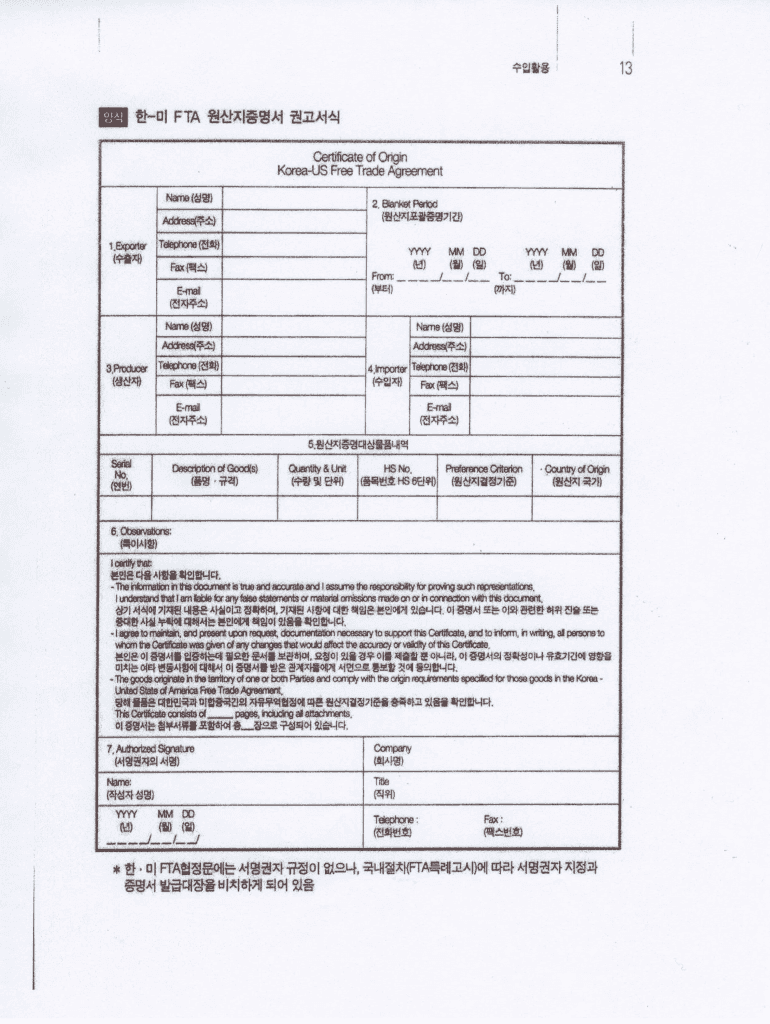







Definition and Meaning of the Korean Certificate of Origin
The Korean certificate of origin is a crucial document that verifies the origin of exported goods, particularly in relation to the Korea-US Free Trade Agreement. This certificate confirms that the goods meet the specified criteria for preferential tariff treatment. It typically includes essential details about the exporter, importer, product description, and a signature from a relevant authority, affirming the accuracy of the information provided.
Understanding the Importance of Origin Certification
- Trade Benefits: Establishing the country of origin is vital for accessing tariff reductions under trade agreements.
- Regulatory Compliance: Many customs authorities require a certificate of origin for import clearance.
- Market Entry: Helps in facilitating international trade by ensuring compliance with local laws and regulations in the importing country.
How to Use the Korean Certificate of Origin Fillable Form
The Korean certificate of origin fillable form can be used effectively by following a straightforward process. It is designed to facilitate easy input of information, allowing users to create a compliant certificate without complications.
Steps to Utilize the Fillable Form
- Access the Form: Obtain the fillable form from a reliable source, such as DocHub.
- Input Exporter Information: Start by entering the details of the exporting party, including name, address, and contact information.
- Enter Importer Information: Fill in the importer’s details, ensuring accuracy for smooth customs processing.
- Provide Product Information: Clearly describe the products being exported, emphasizing relevant specifications and classifications.
- Add Signatures: Include any necessary signatures, which may be required by the exporter or a designated authority.
- Review and Submit: Always double-check all entries for accuracy before submitting the form to ensure compliance with trade regulations.
Steps to Complete the Korean Certificate of Origin Fillable Form
Completing the Korean certificate of origin form involves meticulous attention to detail to ensure compliance with trade regulations.
Detailed Steps
- Download and Open the Fillable Form: Consider using platforms like DocHub to download the necessary fillable form.
- Identify Sections: Familiarize yourself with the various sections of the form, which typically include exporter and importer details, product description, and declaration statements.
- Fill Out Identifying Information: Accurately input the names, addresses, and contact details of both the exporter and the importer.
- Describe the Product: Include detailed and specific information about the products, such as:
- Product name
- Product model or type
- Quantity and unit of measurement
- Complete Declarations: Affirm the statements provided regarding the terms and conditions of the Certificate of Origin.
- Review for Errors: Ensure that all fields are filled correctly and that there are no omissions.
- Save and Share: After completing the form, save it properly and share it directly with the required parties, keeping security in mind.
Key Elements of the Korean Certificate of Origin Fillable Form
Understanding the key components of the Korean certificate of origin fillable form is crucial for accurate completion. Each section serves a unique purpose contributing to the document's integrity.
Important Sections
- Exporter Information: Name, address, and contact details of the entity producing the goods.
- Importer Information: Identifying details of the entity receiving the goods, including their address and contact details.
- Product Description: Comprehensive details about each item, including quantity and type, affirming compliance with market requirements.
- Origin Declaration: A statement confirming that the goods meet the rules of origin criteria as per the Korea-US Free Trade Agreement.
- Signatures and Dates: Required signatures from authorized representatives and the date of completion for validation.
Important Terms Related to the Korean Certificate of Origin Fillable Form
Familiarizing yourself with relevant terminology surrounding the Korean certificate of origin is essential for ensuring effective communication and compliance.
Key Terms
- Certificate of Origin: A document that confirms the country in which the goods were manufactured or produced.
- Preferential Treatment: Special tariff considerations granted under international trade agreements, such as reduced duties.
- Exporter: The entity selling the goods and responsible for providing accurate origin details.
- Importer: The entity receiving the goods that may require the certificate for customs clearance.
- Trade Agreement: Legal frameworks governing trade relationships between countries, affecting tariffs and import/export procedures.
Legal Use of the Korean Certificate of Origin Fillable Form
Legally, the Korean certificate of origin serves as critical evidence in the trade of goods internationally. Its legal validity hinges on compliance with specific regulations established under trade agreements, particularly when entering markets like the United States.
Legal Framework and Requirements
- Compliance with Trade Agreements: The certificate must align with the stipulations outlined in the Korea-US Free Trade Agreement to ensure its acceptance.
- Proper Authorizations: The signatures included on the certificate must come from authorized personnel within the exporting entity or other designated authorities.
- Use in Customs Procedures: The certificate is essential for smooth processing at customs, confirming the product's eligibility for preferential tariffs.
Examples of Using the Korean Certificate of Origin Fillable Form
Practical examples demonstrate the application of the Korean certificate of origin fillable form in real-world scenarios, illustrating its importance in international trade.
Case Scenarios
- Exporting Electronics: A South Korean electronics manufacturer exports smartphones to the U.S., providing a certificate of origin to benefit from reduced tariffs under the trade agreement.
- Textile Exports: A textile company in Korea sends garments to an American retailer, including the Korean certificate of origin to confirm the origin of the products and ensure compliance with U.S. customs.
- Automobile Parts: An automotive parts supplier completes the fillable form to certify that the parts meet origin requirements, essential for maintaining cost-efficiency in tariffs during cross-border trade.
These examples underscore the importance of understanding and utilizing the Korean certificate of origin fillable form accurately to facilitate seamless international transactions.




