




01. Edit your form 706 2022 online
Type text, add images, blackout confidential details, add comments, highlights and more.

Type text, add images, blackout confidential details, add comments, highlights and more.

Draw your signature, type it, upload its image, or use your mobile device as a signature pad.

Send irs form 709 instructions 2022 via email, link, or fax. You can also download it, export it or print it out.
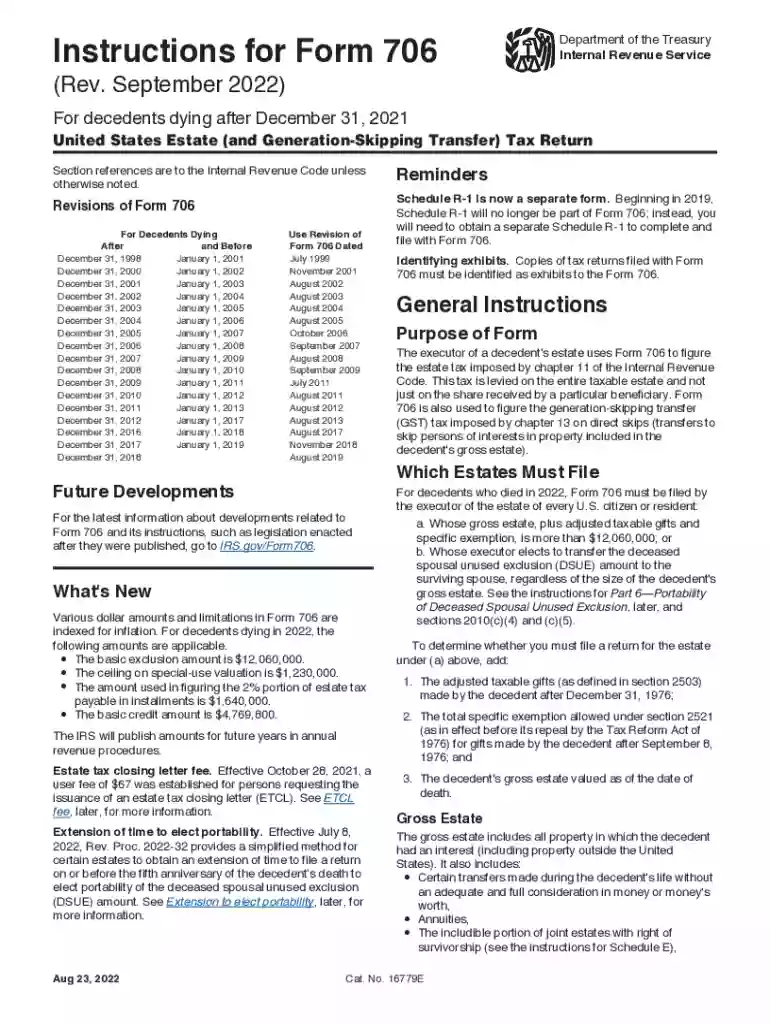
Form 706, United States Estate (and Generation-Skipping Transfer) Tax Return, facilitates the legal reporting of a decedent's estate for tax purposes. This form is essential for calculating and reporting estate taxes with the IRS, particularly for estates of individuals who passed away after December 31, 2021. The form’s instructions provide detailed guidance on assessing estate value, deductions, and credits, along with the latest revisions including inflation-adjusted exclusion amounts and user fees.
The instructions for Form 706 offer crucial step-by-step guidelines to accurately fill out the form. Key sections include details on filing requirements, a line-by-line explanation, and specific schedules to complete. Users should carefully follow these instructions to ensure compliance and prevent errors or omissions, which could lead to penalties.
Understanding Filing Requirements: Determine if the estate meets the IRS thresholds for mandatory filing.
Filling Specific Schedules: Complete necessary schedules for gross estate, deductions, and tax computation.
Applying Revisions: Incorporate any new provisions such as inflation adjustments and portability of unused spousal exclusion.
Properly completing Form 706 necessitates a comprehensive set of documents. Essential documentation includes, but is not limited to, lists of assets (real estate, securities, etc.), appraisals for property values, and records of debts and administrative expenses. Accurate document submission is vital for the IRS to assess the estate’s tax liability correctly.
The IRS provides stringent guidelines for filing Form 706. Compliance with these guidelines involves ensuring all relevant schedules are completed, and that all values are reported accurately. This ensures the estate is properly taxed without misrepresentations or omissions.
Review IRS Instructions: Carefully read the IRS-issued instructions for changes and updates.
Accurate Recordkeeping: Maintain detailed and accurate records of all estate components.
Timely Submission: File the form within the prescribed deadlines to avoid penalties.
Form 706 must be filed within nine months after the decedent's date of death. However, a six-month extension is available through Form 4768, but this does not extend the time for payment of taxes. Note that failure to meet deadlines could result in interest and penalties.
Failing to file Form 706 on time or submitting inaccurate information may lead to significant financial penalties. These penalties can accumulate rapidly and are assessed based on a percentage of the unpaid tax or as set amounts per month. It’s essential to ensure all data is precise and timely to avoid such repercussions.
Complying with IRS regulations when completing and submitting Form 706 is legally mandated for applicable estates. The legal use of this form is integral to enforcing the fair treatment of estate transfers, ensuring that taxes are properly assessed and paid.
While Form 706 is a federal form, state-specific rules may also apply. Some states have additional estate or inheritance taxes with separate forms or requirements. Understanding state-specific obligations is crucial for complete compliance when settling an estate that exceeds even state-based exemption thresholds.
We've got more versions of the form 706 2022 form. Select the right form 706 2022 version from the list and start editing it straight away!
| Versions | Form popularity | Fillable & printable |
|---|---|---|
| 2025 | 4.8 Satisfied (21 Votes) | |
| 2024 | 4.3 Satisfied (20 Votes) | |
| 2023 | 4.6 Satisfied (58 Votes) | |
| 2022 | 4.2 Satisfied (29 Votes) | |
| 2021 | 4.8 Satisfied (110 Votes) | |
| 2020 | 4.3 Satisfied (140 Votes) | |
| 2019 | 4.4 Satisfied (169 Votes) | |
| 2018 | 4.2 Satisfied (109 Votes) | |
| 2017 | 4 Satisfied (55 Votes) | |
| 2016 | 4.3 Satisfied (75 Votes) | |
| 2015 | 4.4 Satisfied (63 Votes) | |
| 1999 | 4 Satisfied (38 Votes) |
At DocHub, your data security is our priority. We follow HIPAA, SOC2, GDPR, and other standards, so you can work on your documents with confidence.
Decedents who were neither U.S. citizens nor U.S. residents at the time of death file Form 706-NA, United. States Estate (and Generation-Skipping Transfer) Tax.Read more
Instructions for Form 706: United States Estate (and Generation-Skipping Transfer) Tax Return. Internal Revenue Service September 2021. Instructions forRead more


