




01. Edit your 2021 form 941 schedule b online
Type text, add images, blackout confidential details, add comments, highlights and more.

Type text, add images, blackout confidential details, add comments, highlights and more.

Draw your signature, type it, upload its image, or use your mobile device as a signature pad.

Send 2021 form 941 schedule b pdf via email, link, or fax. You can also download it, export it or print it out.
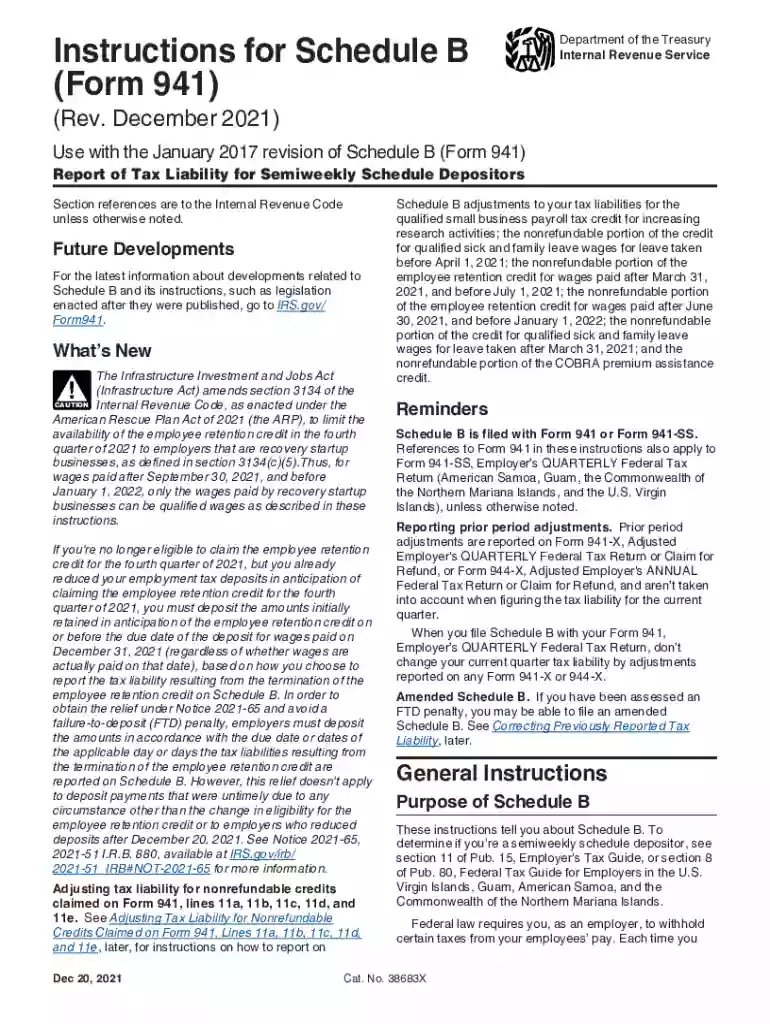
Schedule B is utilized by employers who are required to report federal employment taxes. This schedule is specifically used by semiweekly schedule depositors to detail tax liabilities for each day within a reporting period. It's integral for businesses that do not fall under the monthly deposit schedule, ensuring precise accounting of when liabilities arise. Accurate completion of Schedule B helps avoid discrepancies between tax deposits and liabilities, critical for the IRS's tracking and reconciliation processes.
When filling out Schedule B, it's crucial to follow IRS guidelines meticulously to avoid penalties. Semiweekly schedule depositors must report their liabilities on a daily basis across each line of Schedule B. The IRS provides comprehensive instructions that cover details such as:
Following these guidelines precisely ensures compliance and helps maintain consistency in financial records.
To use Schedule B effectively, start by identifying the payroll periods applicable to your business. This involves:
Employers must remember that this detailed breakdown assists the IRS in verifying timely tax deposits against reported liabilities.
Completing Schedule B involves several crucial steps which ensure accuracy and compliance:
These steps help in aligning reported liabilities with deposited amounts, facilitating correct tax account management.
Semiweekly depositors can often encounter various scenarios when reporting using Schedule B. Consider an example where payroll taxes are withheld biweekly:
Through such scenarios, businesses can understand actual application in practice, ensuring precise and compliant entries for every tax period.
Filing deadlines for Schedule B align with those of Form 941. It's essential for employers to:
Meeting filing deadlines is paramount to avoid penalties and interest charges for late submissions.
Non-compliance with Schedule B filing requirements may lead to serious repercussions:
Employers must remain vigilant to ensure all liabilities are accurately reported to foster a streamlined tax reporting process.
Understanding whether Schedule B is applicable involves assessing deposit schedules:
Ineligible businesses must adhere to appropriate monthly deposit criteria and ensure use of applicable schedules in their filings. Being informed on eligibility helps streamline compliance efforts efficiently across varying business operations.


We've got more versions of the 2021 form 941 schedule b form. Select the right 2021 form 941 schedule b version from the list and start editing it straight away!
At DocHub, your data security is our priority. We follow HIPAA, SOC2, GDPR, and other standards, so you can work on your documents with confidence.
Cited by 4 You must complete this schedule if you are required to deposit on a semiweekly schedule, or if your tax liability on any day is $100,000 or more.Read more
May 2, 2017 Medicare taxes, check 941 (or 944) in box b of Form. W-3 or check 941-SS in box b of Form W-3SS. The wages in box 5 of Form W-2 must beRead more
The IRS uses Schedule B to determine if youve deposited your federal employment tax liabilities on time. If youre a semiweekly schedule depositor and you donRead more


