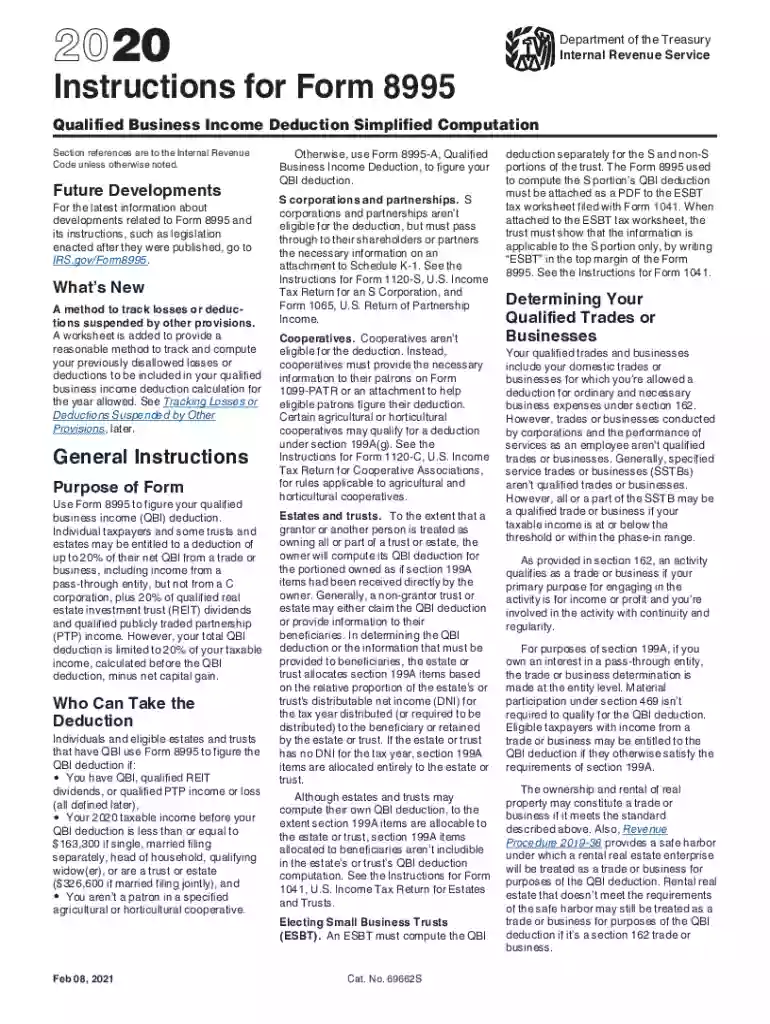
Instructions deduction 2026

Get Form
what is form 8995 Preview on Page 1

Here's how it works

01. Edit your what is form 8995 online
Type text, add images, blackout confidential details, add comments, highlights and more.

02. Sign it in a few clicks
Draw your signature, type it, upload its image, or use your mobile device as a signature pad.

03. Share your form with others
Send it via email, link, or fax. You can also download it, export it or print it out.

How to Use or Fill Out Instructions Deduction with Our Platform

Form edit decoration
9.5
Ease of Setup
DocHub User Ratings on G2
9.0
Ease of Use
DocHub User Ratings on G2
  1. Click 'Get Form' to open the Instructions Deduction form in the editor.
  2. Begin by entering your personal information in the designated fields, including your name and taxpayer identification number.
  3. Proceed to Section 1, where you will input your qualified business income (QBI). Ensure that you include all relevant income sources as specified.
  4. In Section 2, review the eligibility criteria for deductions. Check the boxes that apply to your situation based on your taxable income.
  5. Complete Section 3 by detailing any losses or deductions that were previously suspended. Use our platform's tracking worksheet for accurate calculations.
  6. Finally, review all entries for accuracy before submitting. Utilize our platform’s features to save and share your completed form seamlessly.

Start using our platform today for free and simplify your document editing and form completion process!

See more instructions deduction versions

We've got more versions of the instructions deduction form. Select the right instructions deduction version from the list and start editing it straight away!
Versions Form popularity Fillable & printable
2023 4.3 Satisfied (50 Votes)
2022 4.9 Satisfied (45 Votes)
2021 4.8 Satisfied (93 Votes)
2020 4.3 Satisfied (68 Votes)
2019 3.9 Satisfied (51 Votes)
be ready to get more

Complete this form in 5 minutes or less

Get form

Got questions?

We have answers to the most popular questions from our customers. If you can't find an answer to your question, please contact us.
Contact us
Deduction for Seniors The $6,000 senior deduction is per eligible individual (i.e., $12,000 total for a married couple where both spouses qualify). Deduction phases out for taxpayers with modified adjusted gross income over $75,000 ($150,000 for joint filers).
The $6,000 senior deduction is per eligible individual (or $12,000 total for a married couple where both spouses qualify). Deduction phases out for taxpayers with modified adjusted gross income over $75,000 ($150,000 for joint filers).
The Section 179 tax deduction gives vehicles under 6,000 pounds that are used for business purposes a deduction cap of $12,400 and $30,500 for vehicles over 6,000 but under 14,000 pounds.
Deduction for Seniors (Sec. 70103) New deduction: Effective for 2025 through 2028, individuals who are age 65 and older may claim an additional deduction of $6,000. This new deduction is in addition to the current additional standard deduction for seniors under existing law.
The OBBBA creates a new $6,000 senior tax deduction for each taxpayer 65 and older (up to $12,000 for married couples) starting with the 2025 tax year and running through 2028. It phases out for single filers with a modified adjusted gross income above $75,000 and joint filers above $150,000.

Security and compliance

At DocHub, your data security is our priority. We follow HIPAA, SOC2, GDPR, and other standards, so you can work on your documents with confidence.

Learn more
ccpa2
pci-dss
gdpr-compliance
hipaa
soc-compliance

People also ask

Logically Sound Deductive Reasoning Examples: All dogs have ears; golden retrievers are dogs, therefore they have ears. All racing cars must go over 80MPH; the Dodge Charger is a racing car, therefore it can go over 80MPH. Christmas is always Dec. 25th; today is Dec. 25th, therefore its Christmas.
Mandatory payroll deductions are amounts employers must withhold from employee paychecks by law, regardless of employee preference. The most common mandatory withholdings include federal and state income taxes, Social Security and Medicare contributions, and, where applicable, court-ordered wage garnishments.
Line 4a is a manual numeric entry, in the middle column area, for your total distributions. Line 4b is a manual numeric entry in the column. It also has an associated dropdown menu to the left of the column. Enter your taxable distributions in the right column (4b).

Related links