
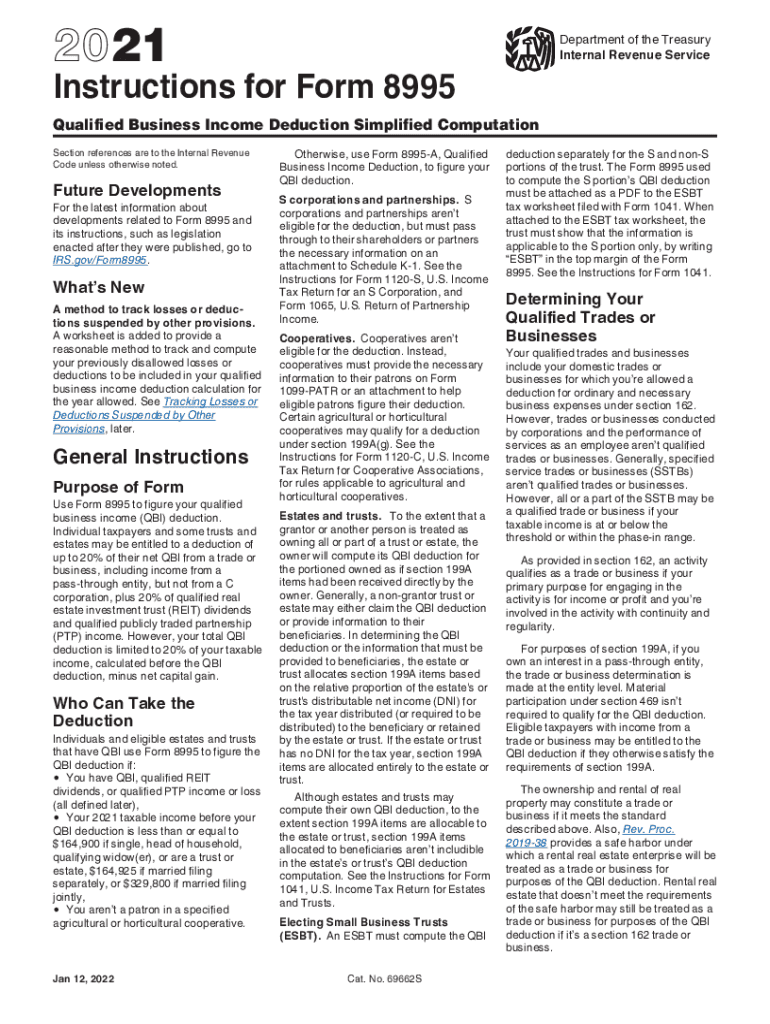







Definition and Meaning
The "2021 instructions deduction" refers to the specific guidelines provided by the IRS for completing Form 8995, which is used to calculate the Qualified Business Income (QBI) deduction. This deduction allows eligible taxpayers, such as individual business owners and certain trusts and estates, to reduce their taxable income by a percentage of their qualified business income. Understanding this form is crucial for accurately reporting and optimizing deductions, ultimately resulting in tax savings.
Key Elements
- Qualified Business Income (QBI): The income eligible for deduction, including net amounts from qualified trades or businesses.
- Deduction Calculation: The deduction is typically up to 20% of the QBI, subject to specified limitations and criteria.
- Income Thresholds: Differing thresholds exist, beyond which additional limitations may apply, such as restrictions on specified service trades or businesses.
- Reporting Requirements: Details on how to report QBI, losses, and applicable deductions accurately.
How to Use the 2021 Instructions Deduction
Using the 2021 instructions deduction involves following specific steps detailed by the IRS to ensure accurate completion of Form 8995.
- Determine Eligibility: Confirm that you or your entity qualifies for the deduction based on your business type and income thresholds.
- Gather Necessary Information: Collect details on all qualified business income, deductions, and any applicable carryover from previous years.
- Calculate QBI: Use the form to compute your total QBI, incorporating various income streams, deductions, and losses.
- Apply Limitations: Consider any phase-out limits or reductions applicable if your income exceeds certain thresholds.
- Complete the Form: Accurately fill out Form 8995 using the IRS instructions, ensuring all relevant information is correctly reported.
Practical Example
- A sole proprietor in the U.S., earning $150,000 in qualified business income, may use the 2021 instructions to calculate their eligible deduction, potentially reducing their taxable income by up to $30,000.
Steps to Complete the 2021 Instructions Deduction
Following a structured approach is essential for correctly completing Form 8995.
- Identify Income Sources: List all businesses and income streams classified under QBI.
- Deduct Allocating Expenses: Subtract related business expenses to compute net QBI.
- Track Suspended Losses: Account for past losses allowed under tax laws.
- Fill out the Form: Follow the IRS instruction guide, entering numbers in corresponding sections.
- Review and File: Double-check all entries and file the completed form with your tax return.
Detailed Context
- Software Compatibility: Use tax preparation software, like TurboTax or QuickBooks, that supports Form 8995 to streamline the process.
- Errors and Omissions: Thoroughly reviewing the form helps prevent errors that could lead to penalties.
Important Terms Related to 2021 Instructions Deduction
Deepening understanding of specific terminology ensures precision in filing.
- Specified Service Trade or Business (SSTB): Certain professional services, like health, law, or consulting, with specific deduction limitations.
- Pass-Through Entities: Includes businesses such as S Corporations, partnerships, and sole proprietorships whose income passes directly to individual owners.
- W-2 Wages: Salaries and wages paid, affecting the calculation of certain deduction limitations.
IRS Guidelines
The IRS offers comprehensive guidelines for the 2021 instructions deduction.
Eligibility Criteria
- Business Types: Only income from qualified trades or businesses is eligible.
- Income Limits: The guidelines provide taxpayer-specific income thresholds, affecting deduction eligibility.


Compliance
- Filing: Adherent filing with specified deadlines prevents non-compliance penalties.
- Documentation: Maintaining adequate records substantiating income and deductions is mandatory.
Who Typically Uses the 2021 Instructions Deduction
Primarily, individuals and entities with profits from qualified business activities are the main users.

Scenarios
- Self-Employed Individuals: These taxpayers often have significant QBI and seek to maximize their deductions.
- Small Business Owners: Those with pass-through income leverage these instructions to elevate tax efficiency.
Legal Use of the 2021 Instructions Deduction
Abiding by IRS rules ensures the deduction is claimed legally and ethically.
Considerations
- Correct Attribution of Income: Only accurately reported QBI qualifies for the deduction.
- Audit Trails: Clear records of income and deductions safeguard against potential audits.
State-Specific Rules for the 2021 Instructions Deduction
Variations in state tax laws can impact the application of the instructions deduction.
State Considerations
- Conformity to Federal Rules: Not all states adhere to federal deduction rules, necessitating state-specific tax advice.
- State Deductions: Additional benefits or disallowances may exist under state law, affecting overall tax obligations.
By understanding and applying these comprehensive insights into the 2021 instructions deduction, taxpayers can efficiently navigate their tax obligations while maximizing deductions.




