Maryland notice default 2026

Get Form
maryland notice default Preview on Page 1

Here's how it works

01. Edit your form online
Type text, add images, blackout confidential details, add comments, highlights and more.
02. Sign it in a few clicks
Draw your signature, type it, upload its image, or use your mobile device as a signature pad.
03. Share your form with others
Send it via email, link, or fax. You can also download it, export it or print it out.

How to use or fill out Maryland Notice Default with Our Platform

Form edit decoration
9.5
Ease of Setup
DocHub User Ratings on G2
9.0
Ease of Use
DocHub User Ratings on G2
  1. Click ‘Get Form’ to open the Maryland Notice Default in the editor.
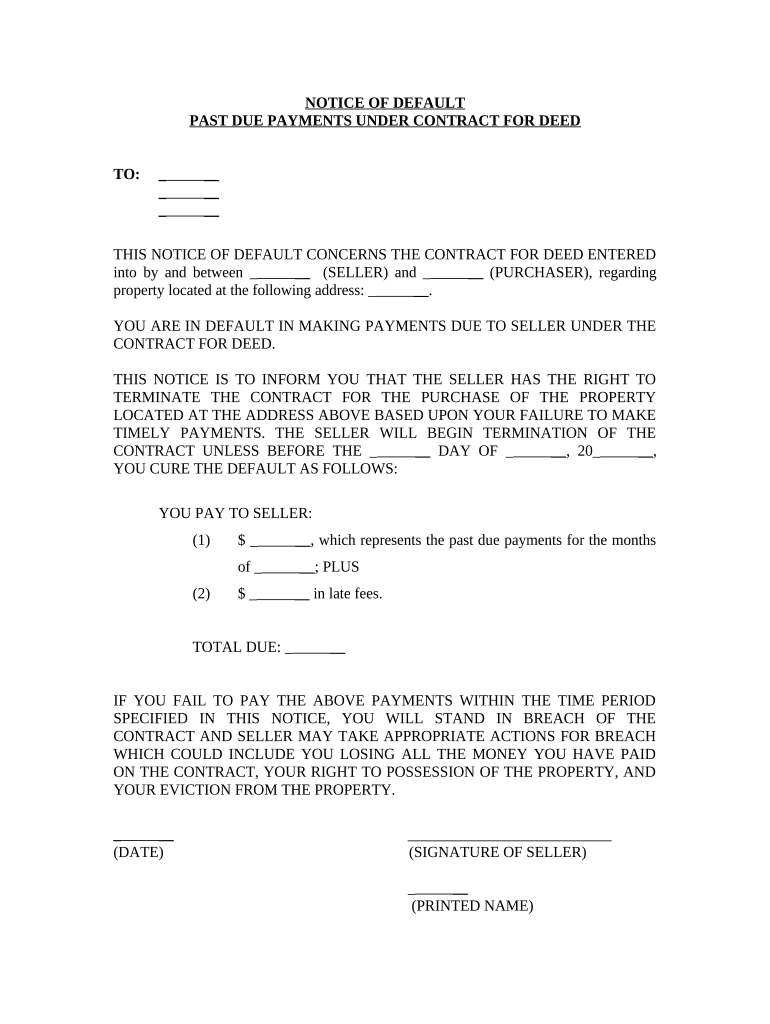
  2. Begin by filling in the recipient's name and address at the top of the form. Ensure accuracy as this identifies who is receiving the notice.
  3. Next, enter the names of both the Seller and Purchaser in their respective fields. This establishes the parties involved in the contract for deed.
  4. Provide the property address where applicable. This is crucial for identifying which property is under discussion.
  5. In the payment section, list any past due payments along with their corresponding months. Be clear and precise to avoid confusion.
  6. Calculate and enter any late fees that apply, ensuring that you total these amounts accurately for clarity.
  7. Finally, sign and print your name at the bottom of the form to validate it before sending it out.

Start using our platform today to fill out your Maryland Notice Default easily and for free!

be ready to get more

Complete this form in 5 minutes or less

Get form

Got questions?

We have answers to the most popular questions from our customers. If you can't find an answer to your question, please contact us.
Contact us
After being served with a motion, the party served can file a written response to the motion with the court. A response must be filed within a set amount of time, usually 15 days. Generally, the court will not decide your motion until the other party has had this chance to respond.
Sometimes, after entering an order of default, the court will hold a hearing to decide how much money the defendant should pay. After the hearing, the court may order a default judgment in that amount.
Once the Order of Default is issued, the defendant has 30 days to respond and explain why they did not answer the initial Complaint and/or why the Order of Default should not proceed. If the Defendant does not respond to the Order of Default, the case will be scheduled for an uncontested hearing.
A Motion to Vacate is a written request, filed with the Clerks office, asking the court to undo the order of default and allow you to defend the case. In the motion, you must show the judge a good reason to allow your request and vacate the default. You must tell the judge why you did not file your response in time.
What happens when you get a default judgment against you. After a default judgment, the Plaintiff will try to collect the money you owe. The Plaintiff may be able to take money from your paycheck or bank account and put a lien on your property. If you dont have any assets to pay the debt, you can let the Plaintiff.

Security and compliance

At DocHub, your data security is our priority. We follow HIPAA, SOC2, GDPR, and other standards, so you can work on your documents with confidence.

Learn more
ccpa2
pci-dss
gdpr-compliance
hipaa
soc-compliance

People also ask

If you do not move out when your lease has ended, your landlord may evict you for holding over. The landlord must prove that they gave you proper notice (at least one months ad- vance written notice) of the ending of your lease. and imminent danger, 14 days notice.

Related links