Special Warranty Deed - Husband and Wife to Husband and Wife - Texas 2026

Get Form
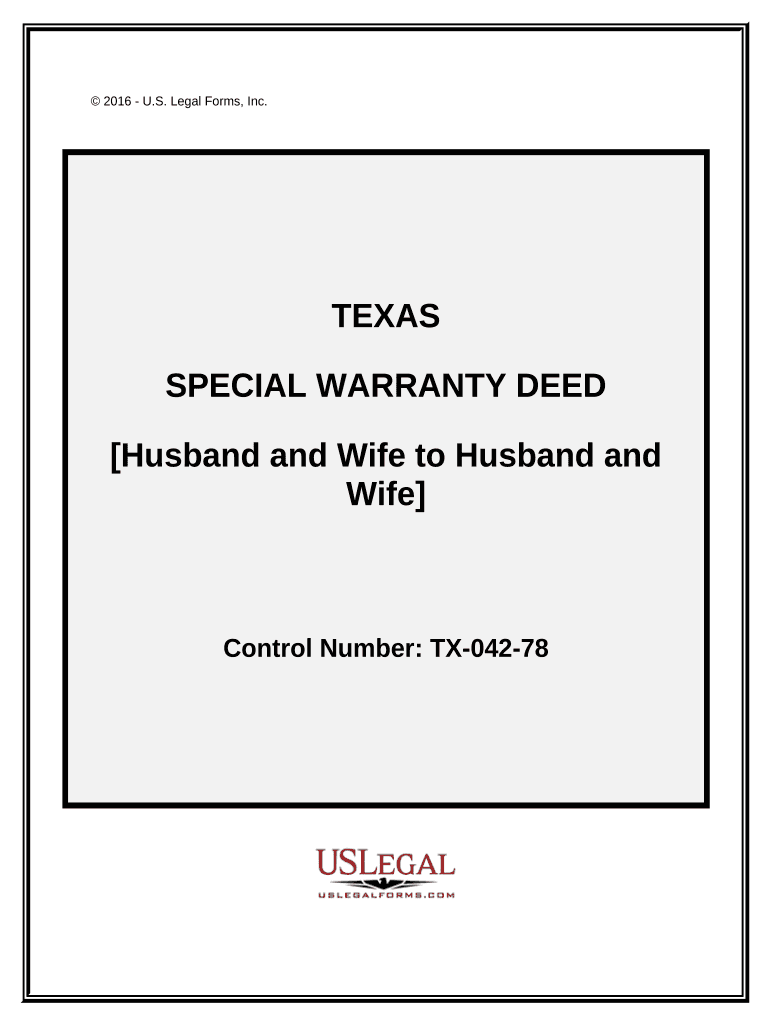
Special Warranty Deed - Husband and Wife to Husband and Wife - Texas Preview on Page 1

Here's how it works

01. Edit your form online
Type text, add images, blackout confidential details, add comments, highlights and more.
02. Sign it in a few clicks
Draw your signature, type it, upload its image, or use your mobile device as a signature pad.
03. Share your form with others
Send it via email, link, or fax. You can also download it, export it or print it out.

How to use or fill out Special Warranty Deed - Husband and Wife to Husband and Wife - Texas with our platform

Form edit decoration
9.5
Ease of Setup
DocHub User Ratings on G2
9.0
Ease of Use
DocHub User Ratings on G2
  1. Click ‘Get Form’ to open the Special Warranty Deed in the editor.
  2. Begin by entering the date of the deed at the top of the form. This is crucial for legal documentation.
  3. In the 'Grantor’s' section, input the names of both spouses as they appear on legal documents, ensuring accuracy.
  4. Fill in the 'Grantor’s Mailing Address' with complete details including street address, city, county, state, and zip code.
  5. Next, enter the names of both spouses in the 'Grantees' section, mirroring how they are listed under Grantors.
  6. Specify the consideration amount in dollars that reflects any cash or valuable consideration exchanged for the property.
  7. Attach a legal description of the property as Exhibit A. Ensure this is accurate to avoid future disputes.
  8. Review any existing conditions or encumbrances that may affect ownership and list them under 'Reservations from and Exceptions to Conveyance and Warranty.'
  9. Both Grantors must sign and print their names at the bottom of the form. Ensure signatures are dated correctly.
  10. If applicable, complete the Community Property Agreement section to clarify ownership rights upon death.

Start using our platform today for free to streamline your document editing and signing process!

be ready to get more

Complete this form in 5 minutes or less

Get form

Got questions?

We have answers to the most popular questions from our customers. If you can't find an answer to your question, please contact us.
Contact us
No, you can not add anyone to a mortgage without refinancing. Exactly why do you want to burden your new wife with a mortgage?
Have a new General Warranty Deed prepared. This document will add your spouse to the title as a co-owner of the property. Sign and notarize the deed. The new deed will need to be signed by you in front of any notary.
A Special Warranty Deed transfers property title but it limits the sellers guarantees or warranties against title defects. Using this deed limits the sellers liability for claims against the property only to the time period of his or her ownership.
A joint-owned property can be held as a joint tenancy. Two or more people have equal rights and obligations to the property they own together in this legal arrangement until one partner passes away.
For example, a quitclaim deed would be used for a name change on a warranty deed, such as to add a new spouse or a child to the title, or to remove the name of a spouse following a divorce. A quitclaim deed also can be used to correct mistakes.

Security and compliance

At DocHub, your data security is our priority. We follow HIPAA, SOC2, GDPR, and other standards, so you can work on your documents with confidence.

Learn more
ccpa2
pci-dss
gdpr-compliance
hipaa
soc-compliance

People also ask

The process to add your spouse to your property title takes a few simple steps: New General Warranty Deed. Have a new General Warranty Deed prepared. Sign and notarize the deed. File the deed. Mail or take the original, signed and notarized, deed to the county clerks office for recording.
At the time your quitclaim deed is recorded, you will need to pay a filing fee and any reassessed property taxes based on the change in ownership. The filing fee should be minimal, under $100, with most states charging under $50. The cost will depend upon your county and state.
By default, under the Texas Constitution, a married couple is assumed to own real property purchased during the marriage as community property without rights of survivorship. This makes them tenants in common, each owning one-half separately, rather than joint owners with rights of survivorship.

Related links