Code of Ethics for Elders of Main Street Presbyterian Church 2026

Get Form
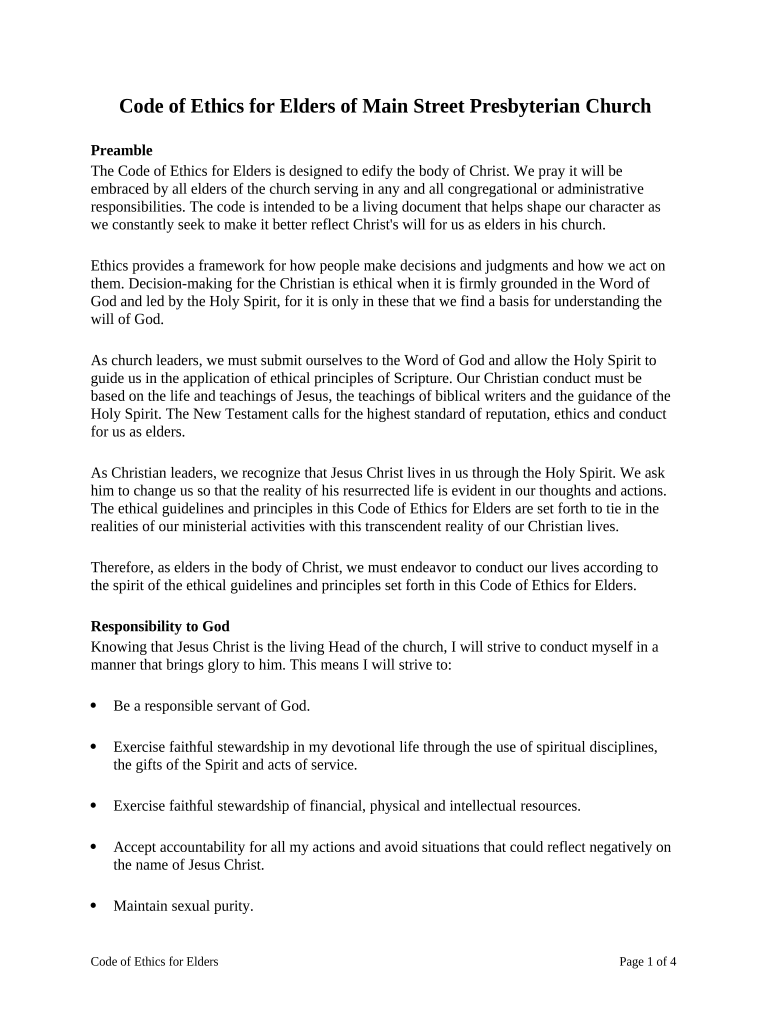
Code of Ethics for Elders of Main Street Presbyterian Church Preview on Page 1

Here's how it works

01. Edit your form online
Type text, add images, blackout confidential details, add comments, highlights and more.
02. Sign it in a few clicks
Draw your signature, type it, upload its image, or use your mobile device as a signature pad.
03. Share your form with others
Send it via email, link, or fax. You can also download it, export it or print it out.

How to use or fill out Code of Ethics for Elders of Main Street Presbyterian Church

Form edit decoration
9.5
Ease of Setup
DocHub User Ratings on G2
9.0
Ease of Use
DocHub User Ratings on G2
  1. Click ‘Get Form’ to open it in the editor.
  2. Begin with the Preamble section. Read through the ethical framework provided, ensuring you understand its significance in guiding your conduct as an elder.
  3. Move to the 'Responsibility to God' section. Fill in your commitments by checking each statement that resonates with your personal dedication and accountability.
  4. Proceed to the 'Responsibility of Denominational Leadership to Elders'. Here, reflect on how you will support fellow elders and ensure fair treatment within your leadership role.
  5. In the 'Responsibility to Family' section, affirm your priorities by marking statements that align with your family values and responsibilities.
  6. Continue to the 'Relationship to the Congregation'. Provide insights on how you plan to lead and mentor members effectively.
  7. Complete the 'Responsibility to Fellow Elders' section by noting how you will foster a collaborative environment among peers.
  8. Finally, address your 'Responsibility to the Local Community', outlining your commitment to community service and engagement.

Start using our platform today for free and empower yourself in fulfilling these important commitments!

be ready to get more

Complete this form in 5 minutes or less

Get form

Got questions?

We have answers to the most popular questions from our customers. If you can't find an answer to your question, please contact us.
Contact us
Treat others fairly. Work collaboratively with Team and Church Leaders to execute the Churchs mission. Make ethical and informed decisions. Avoid the use of offensive language (e.g. vulgarities, sexual connotations, and racial or religious slurs).
Standards of Ethical Conduct (1998) To treat all persons with equal respect and concern. To refrain from gossip and abusive speech. To refrain from abusive, addictive or exploitive behavior. To honor the sacred trust of relationships within the covenant community and to observe appropriate boundaries.
The Code of Conduct for Aged Care (the Code) describes how aged care providers, their governing persons and workers (including volunteers) must behave and treat people receiving aged care. It helps ensure that people can have confidence and trust in the quality and safety of aged care they receive.
(1 Timothy 3:1-7) In the Presbyterian Church there are two types of elders. They are teaching and ruling elders. A teaching elder is a Minister of Word and Sacrament or a pastor, while a ruling elder is a member of the local church. Elders are elected by the people and for the people.
By adhering to the five common codes of ethics - integrity, respect, compliance, responsibility, and professionalism - you can ensure that your business is ethical, sustainable, and successful.

Security and compliance

At DocHub, your data security is our priority. We follow HIPAA, SOC2, GDPR, and other standards, so you can work on your documents with confidence.

Learn more
ccpa2
pci-dss
gdpr-compliance
hipaa
soc-compliance

People also ask

Our Code of Ethics: An Aging Life Care Professional maintains confidentiality, avoids conflicts of interest, and always pursues the best interest of clients. An Aging Life Care Professional promotes clients interests, values, and welfare in order to maximize benefits and avoid harm.
Ethical values in aged care include providing professional care, and paying more attention to human aspects of care. Providing ethical care requires better understanding of older adults, awareness of their needs, and efforts to solve their problems.
Act ethically in every professional situation. Help older persons by treating them with dignity, respect, and compassion, keeping in mind individual differences and cultural and ethnic diversity. Develop, administer, and advocate policies and procedures that produce fair and equitable treatment for all older persons.

Related links