North carolina disclaimer 2026

Get Form
ccbi disclaimer Preview on Page 1

Here's how it works

01. Edit your ccbi disclaimer online
Type text, add images, blackout confidential details, add comments, highlights and more.
02. Sign it in a few clicks
Draw your signature, type it, upload its image, or use your mobile device as a signature pad.
03. Share your form with others
Send ccbi disclaimer google search via email, link, or fax. You can also download it, export it or print it out.

How to use or fill out North Carolina Disclaimer with our platform

Form edit decoration
9.5
Ease of Setup
DocHub User Ratings on G2
9.0
Ease of Use
DocHub User Ratings on G2
  1. Click ‘Get Form’ to open the North Carolina Disclaimer in the editor.
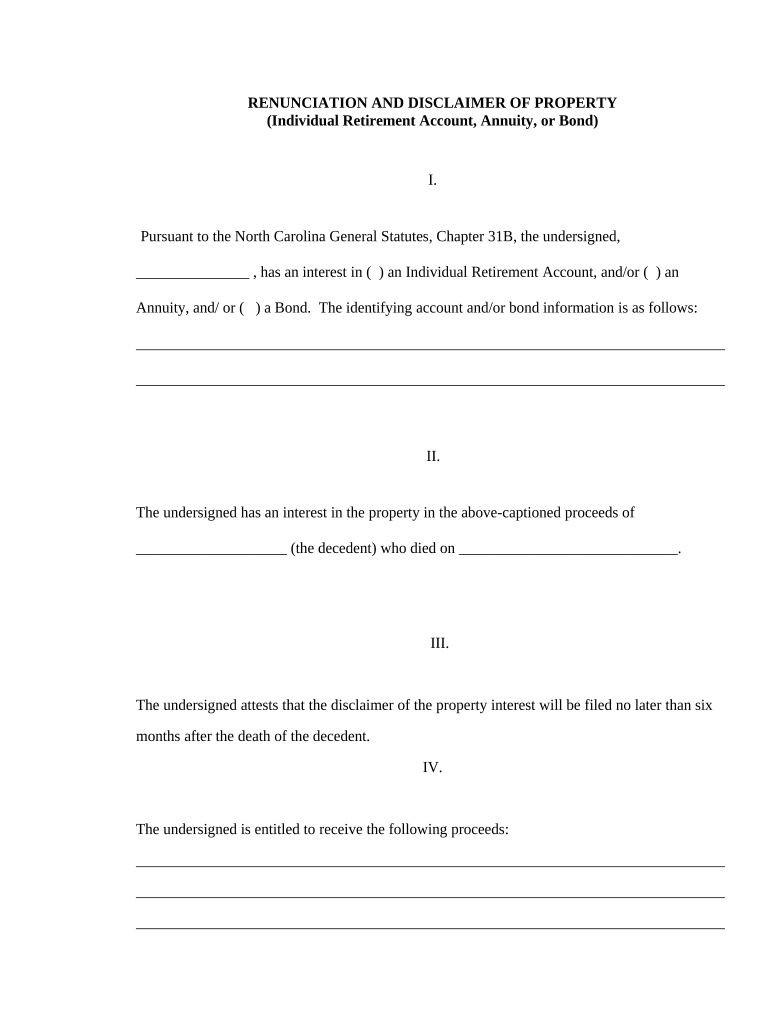
  2. In Section I, fill in your name and select the type of property you are disclaiming: Individual Retirement Account, Annuity, or Bond. Provide any identifying account information as needed.
  3. In Section II, enter the name of the decedent and their date of death to establish the context for your disclaimer.
  4. Section III requires you to acknowledge that this disclaimer must be filed within six months of the decedent's death. Ensure you understand this timeline.
  5. In Section IV, specify the proceeds you are entitled to receive from the estate.
  6. Review Sections V and VI carefully; these sections outline how the property will be treated under state law and confirm your irrevocable decision to disclaim any interest.
  7. Complete Sections VII and notarization details at the end of the form. Ensure all signatures are included before finalizing.

Start using our platform today for free to streamline your document editing and signing process!

be ready to get more

Complete this form in 5 minutes or less

Get form

Got questions?

We have answers to the most popular questions from our customers. If you can't find an answer to your question, please contact us.
Contact us
North Carolina does not have a mandated duty to warn/protect law; however, there is no law prohibiting a professional from doing so.
The EOG is given to test skills in mathematics, English, and science. Students in grades 3 to 8 must take the mathematics and English End of Grade Tests. Students in grades 5 and 8 must take all three. Achievement levels are measured through levels of proficiency, and it differs depending on what grade a student is in.
Students who do not pass the North Carolina Math 1 EOC will have to retake it if they fail the Math 1 course. They will have to take the whole course again and retake the EOC at the end. The original failing grade, unfortunately, will still show up on their high school transcript.
A new bill moving through the North Carolina General Assembly could phase out End-of-Course tests, or EOCs, for high school students. Those tests would be replaced with nationally recognized assessments. If passed, House Bill 486 would effectively end the EOC exams as soon as the 2023-24 school year.
All homeschooled students are required to receive a yearly nationally standardized achievement test. By law, this test must measure achievement in the areas of English grammar, reading, spelling and mathematics.

Security and compliance

At DocHub, your data security is our priority. We follow HIPAA, SOC2, GDPR, and other standards, so you can work on your documents with confidence.

Learn more
ccpa2
pci-dss
gdpr-compliance
hipaa
soc-compliance

People also ask

The North Carolina Supreme Court has said that students who do not pass these tests are probably not receiving a sound basic education, which is their constitutional right. emphasis on these years. Students who do not pass the EOG must be given a chance to retake the test.
Weird Laws in North Carolina Law #1: Elephants Have to Pay for Parking. Law #2: and Furniture Trucks Dont Mix. Law #3: Cant Cross on the Right-Hand Side of a Crosswalk. Law #4: You Cant Play in Traffic. Law #5: Cant Drive on the Sidewalks.
A disclaimer is a formal refusal to accept property that would otherwise pass to you by will, trust, or intestacy. North Carolina General Statute 31B-1 outlines key requirements. The document must be in writing, identify the estate, describe the property, and docHub the proper court within the statutory period.

Related links